


August 12, 2025
Congenital Heart Defects in Children: Signs, Diagnosis & Treatment
ongenital heart defects (CHDs) are structural problems in a child’s heart present from birth, but with early diagnosis and modern treatments most children can now grow up to lead active, healthy lives.
Author:
Paresh Masani
Congenital heart defects (CHDs) are problems in the heart of children that are present from birth. They are the most common type of birth defect worldwide, affecting around 9 to 10 out of every 1,000 live births. It means that over a million babies are born with CHDs each year. In India, these defects contribute to a great share of infant deaths linked to birth conditions.
The good news is that survival rates have improved dramatically in the past few decades. Today, most children with CHDs, including many with serious conditions, can live long and active lives with the right care and treatment.
This guide explains everything a parent needs to know about CHDs. Check for the types of congenital heart diseases, symptoms and diagnoses as well as how you can support your children living with these conditions.
What Do Congenital Heart Defects in Children Mean?
A congenital heart defect occurs when the heart or nearby blood vessels do not develop normally during pregnancy. These structural problems may involve holes in the walls of the heart, valves that do not work properly, or blood vessels that are incorrectly connected or narrowed.
Some CHDs are mild and may close or improve on their own. Others are severe and require immediate medical attention. Early detection plays a crucial role in ensuring the best possible outcomes for affected children.
Types of Congenital Heart Defects
CHDs come in many forms. Some of the most common types include:
- Septal Defects: These are holes in the heart’s walls.
- Ventricular Septal Defect (VSD) - a hole between the lower chambers. Large VSDs can lead to heart failure if untreated.
- Atrial Septal Defect (ASD) - a hole between the upper chambers, increasing blood flow to the lungs.
- Tetralogy of Fallot: A complex defect involving four heart problems at once, leading to low oxygen levels and bluish skin (cyanosis).
- Coarctation of the Aorta: Narrowing of the aorta that restricts blood flow. It may go undetected until later in life.
- Transposition of the Great Arteries (TGA): The two main arteries leaving the heart are reversed, causing oxygen-poor blood to circulate throughout the body.
- Heart Valve Defects: Valves may be too narrow, leaky, or malformed, disturbing normal blood flow.
Each type affects the heart differently, and treatment plans vary based on the defect’s complexity.
What Causes Congenital Heart Defects?
One of the biggest challenges in understanding CHDs is that their exact cause is often unknown. However, research has identified several factors that can increase the risk:
- Genetic changes - Sometimes, a defect arises due to a mutation in the baby’s genes. It may be inherited or occur randomly during pregnancy.
- Maternal health conditions - Poorly controlled diabetes, obesity, or phenylketonuria (PKU) before or during pregnancy can increase the risk.
- Infections during pregnancy - Rubella (German measles) is a known risk factor.
- Medication use - Certain blood pressure medicines, anti-seizure drugs, and acne medications (like retinoic acids) may harm fetal heart development.
- Exposure to harmful substances - Smoking, secondhand smoke, alcohol, and environmental chemicals can contribute.
- Genetic syndromes - Babies with conditions like Down syndrome have a higher chance of CHDs.
Who Is at Higher Risk?
A baby is more likely to have a congenital heart defect if:
- A parent or sibling has a CHD.
- The mother is pregnant at an older age.
- The mother has chronic health issues such as diabetes or obesity.
- There is exposure to high levels of radiation or chemicals during pregnancy.
While some risk factors can’t be changed, early monitoring and medical care during pregnancy help reduce complications.
Symptoms of Congenital Heart Defects
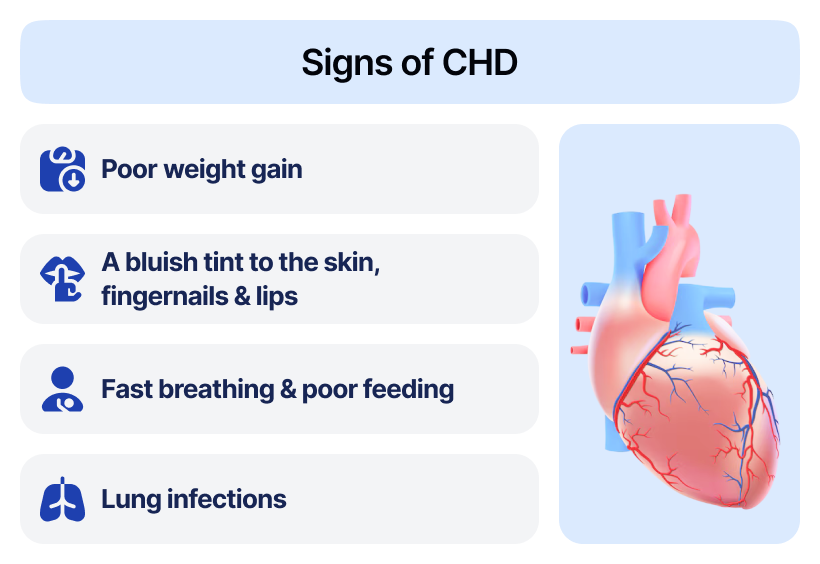
The symptoms of CHDs depend on the defect’s type and severity. Some are noticeable immediately after birth, while others appear later in infancy or childhood.
Signs in Newborns and Infants
- Cyanosis (bluish skin, lips, or nails due to low oxygen)
- Rapid or difficult breathing
- Feeding problems and poor weight gain
- Excessive sweating, especially during feeding
- Heart murmur detected during routine check-ups
- Low blood pressure or irregular heartbeats in severe cases
Signs in Older Children
- Fatigue during normal play or exercise
- Shortness of breath
- Slow growth or developmental delays
- Fainting spells (rare but serious)
Some children with mild CHDs may have no symptoms and only discover the defect later in life during a routine exam.
How Doctors Diagnose Congenital Heart Defects?
During Pregnancy
Routine ultrasounds may detect a suspected heart defect. A fetal echocardiogram can confirm the diagnosis as early as the 18th week of pregnancy. This allows doctors to plan treatment and delivery.
After Birth
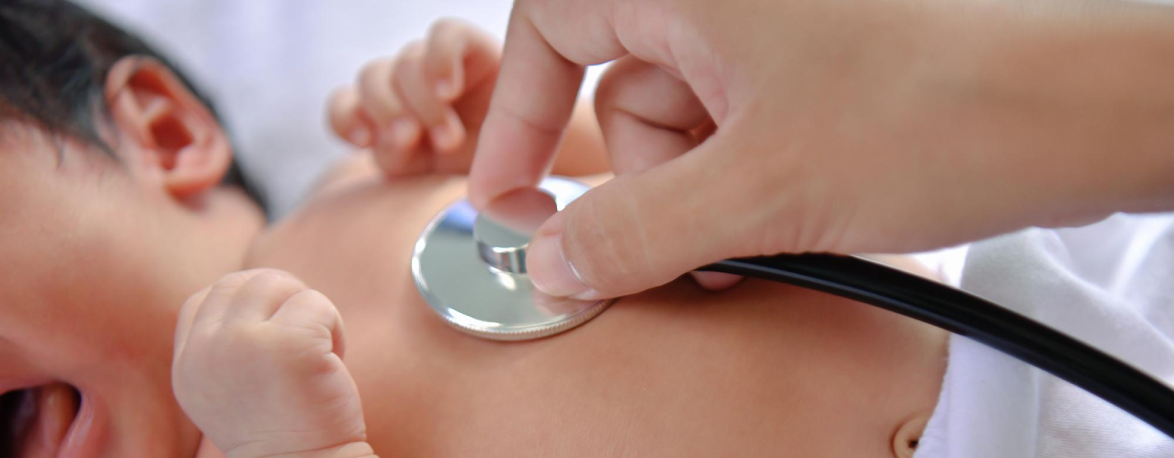
If signs appear after birth, doctors conduct physical exams and tests. They check oxygen levels, listen to heart sounds, and may recommend imaging.
Diagnostic Tests
- Echocardiogram: Uses sound waves to create heart images.
- MRI and CT scans: Provide detailed heart structures for surgical planning.
- Cardiac catheterization: Measures pressure inside the heart and may also treat certain defects.
- Electrocardiogram (ECG): Detects irregular heart rhythms.
- Holter monitors: Record heart activity over 24 hours or longer.
- Stress tests: Evaluate heart performance during physical activity.
Early and accurate diagnosis allows for timely intervention.
Treatment Options for Congenital Heart Defects
Treatment depends on the type and severity of the defect.
Medications
Some CHDs can be managed with medicines to control symptoms like high blood pressure, fluid buildup, or irregular rhythms.
Cardiac Catheterization
A minimally invasive method that repairs certain defects without open-heart surgery.
Surgery
More complex defects require surgery to correct the heart structure. Success rates are high, and most children recover well with follow-up care.
Heart Transplant
In severe cases where the defect cannot be corrected, a heart transplant may be considered.
Lifelong Monitoring
Even after successful treatment, children with CHDs need regular follow-ups to prevent future complications.
Can CHDs Be Prevented?
- Attend regular prenatal check-ups
- Take folic acid supplements before and during pregnancy
- Get vaccinated against infections like rubella before pregnancy
- Avoid smoking, alcohol, and harmful substances
- Manage chronic health conditions with medical guidance
- Consult your doctor before taking any medications during pregnancy
These steps promote a healthy pregnancy and may lower the risk of CHDs.
Living With Congenital Heart Defects

With advancements in pediatric cardiology, survival rates for children with CHDs have improved dramatically. Many lead normal, healthy lives with proper care. Some may need:
- Multiple surgeries over the years
- Regular medications to support heart function
- Special precautions during physical activities
Beyond physical health, CHDs may also affect growth, learning, and emotional development. Supportive care, speech therapy, and counseling can help children reach their full potential.
Early Action for Care Makes a Difference!
Congenital heart defects remain a leading cause of birth-related complications, but advancements in medical care have transformed outcomes. Early detection, proper treatment, and consistent follow-up can give children the chance to grow, learn, and live vibrant lives.
If you suspect any heart-related issues in your child or are planning a pregnancy with known risk factors, consulting a pediatric cardiologist can make all the difference. Awareness and timely action are the keys to protecting your child’s heart health.





India’s first AI-powered NCD diagnostics network.
Follow Us


Helius Wellness 2026. All Rights Reserved
August 12, 2025
Congenital Heart Defects in Children: Signs, Diagnosis & Treatment
ongenital heart defects (CHDs) are structural problems in a child’s heart present from birth, but with early diagnosis and modern treatments most children can now grow up to lead active, healthy lives.
Author:
Paresh Masani
Congenital heart defects (CHDs) are problems in the heart of children that are present from birth. They are the most common type of birth defect worldwide, affecting around 9 to 10 out of every 1,000 live births. It means that over a million babies are born with CHDs each year. In India, these defects contribute to a great share of infant deaths linked to birth conditions.
The good news is that survival rates have improved dramatically in the past few decades. Today, most children with CHDs, including many with serious conditions, can live long and active lives with the right care and treatment.
This guide explains everything a parent needs to know about CHDs. Check for the types of congenital heart diseases, symptoms and diagnoses as well as how you can support your children living with these conditions.
What Do Congenital Heart Defects in Children Mean?
A congenital heart defect occurs when the heart or nearby blood vessels do not develop normally during pregnancy. These structural problems may involve holes in the walls of the heart, valves that do not work properly, or blood vessels that are incorrectly connected or narrowed.
Some CHDs are mild and may close or improve on their own. Others are severe and require immediate medical attention. Early detection plays a crucial role in ensuring the best possible outcomes for affected children.
Types of Congenital Heart Defects
CHDs come in many forms. Some of the most common types include:
- Septal Defects: These are holes in the heart’s walls.
- Ventricular Septal Defect (VSD) - a hole between the lower chambers. Large VSDs can lead to heart failure if untreated.
- Atrial Septal Defect (ASD) - a hole between the upper chambers, increasing blood flow to the lungs.
- Tetralogy of Fallot: A complex defect involving four heart problems at once, leading to low oxygen levels and bluish skin (cyanosis).
- Coarctation of the Aorta: Narrowing of the aorta that restricts blood flow. It may go undetected until later in life.
- Transposition of the Great Arteries (TGA): The two main arteries leaving the heart are reversed, causing oxygen-poor blood to circulate throughout the body.
- Heart Valve Defects: Valves may be too narrow, leaky, or malformed, disturbing normal blood flow.
Each type affects the heart differently, and treatment plans vary based on the defect’s complexity.
What Causes Congenital Heart Defects?
One of the biggest challenges in understanding CHDs is that their exact cause is often unknown. However, research has identified several factors that can increase the risk:
- Genetic changes - Sometimes, a defect arises due to a mutation in the baby’s genes. It may be inherited or occur randomly during pregnancy.
- Maternal health conditions - Poorly controlled diabetes, obesity, or phenylketonuria (PKU) before or during pregnancy can increase the risk.
- Infections during pregnancy - Rubella (German measles) is a known risk factor.
- Medication use - Certain blood pressure medicines, anti-seizure drugs, and acne medications (like retinoic acids) may harm fetal heart development.
- Exposure to harmful substances - Smoking, secondhand smoke, alcohol, and environmental chemicals can contribute.
- Genetic syndromes - Babies with conditions like Down syndrome have a higher chance of CHDs.
Who Is at Higher Risk?
A baby is more likely to have a congenital heart defect if:
- A parent or sibling has a CHD.
- The mother is pregnant at an older age.
- The mother has chronic health issues such as diabetes or obesity.
- There is exposure to high levels of radiation or chemicals during pregnancy.
While some risk factors can’t be changed, early monitoring and medical care during pregnancy help reduce complications.
Symptoms of Congenital Heart Defects
The symptoms of CHDs depend on the defect’s type and severity. Some are noticeable immediately after birth, while others appear later in infancy or childhood.
Signs in Newborns and Infants
- Cyanosis (bluish skin, lips, or nails due to low oxygen)
- Rapid or difficult breathing
- Feeding problems and poor weight gain
- Excessive sweating, especially during feeding
- Heart murmur detected during routine check-ups
- Low blood pressure or irregular heartbeats in severe cases
Signs in Older Children
- Fatigue during normal play or exercise
- Shortness of breath
- Slow growth or developmental delays
- Fainting spells (rare but serious)
Some children with mild CHDs may have no symptoms and only discover the defect later in life during a routine exam.
How Doctors Diagnose Congenital Heart Defects?
During Pregnancy
Routine ultrasounds may detect a suspected heart defect. A fetal echocardiogram can confirm the diagnosis as early as the 18th week of pregnancy. This allows doctors to plan treatment and delivery.
After Birth
If signs appear after birth, doctors conduct physical exams and tests. They check oxygen levels, listen to heart sounds, and may recommend imaging.
Diagnostic Tests
- Echocardiogram: Uses sound waves to create heart images.
- MRI and CT scans: Provide detailed heart structures for surgical planning.
- Cardiac catheterization: Measures pressure inside the heart and may also treat certain defects.
- Electrocardiogram (ECG): Detects irregular heart rhythms.
- Holter monitors: Record heart activity over 24 hours or longer.
- Stress tests: Evaluate heart performance during physical activity.
Early and accurate diagnosis allows for timely intervention.
Treatment Options for Congenital Heart Defects
Treatment depends on the type and severity of the defect.
Medications
Some CHDs can be managed with medicines to control symptoms like high blood pressure, fluid buildup, or irregular rhythms.
Cardiac Catheterization
A minimally invasive method that repairs certain defects without open-heart surgery.
Surgery
More complex defects require surgery to correct the heart structure. Success rates are high, and most children recover well with follow-up care.
Heart Transplant
In severe cases where the defect cannot be corrected, a heart transplant may be considered.
Lifelong Monitoring
Even after successful treatment, children with CHDs need regular follow-ups to prevent future complications.
Can CHDs Be Prevented?
- Attend regular prenatal check-ups
- Take folic acid supplements before and during pregnancy
- Get vaccinated against infections like rubella before pregnancy
- Avoid smoking, alcohol, and harmful substances
- Manage chronic health conditions with medical guidance
- Consult your doctor before taking any medications during pregnancy
These steps promote a healthy pregnancy and may lower the risk of CHDs.
Living With Congenital Heart Defects
With advancements in pediatric cardiology, survival rates for children with CHDs have improved dramatically. Many lead normal, healthy lives with proper care. Some may need:
- Multiple surgeries over the years
- Regular medications to support heart function
- Special precautions during physical activities
Beyond physical health, CHDs may also affect growth, learning, and emotional development. Supportive care, speech therapy, and counseling can help children reach their full potential.
Early Action for Care Makes a Difference!
Congenital heart defects remain a leading cause of birth-related complications, but advancements in medical care have transformed outcomes. Early detection, proper treatment, and consistent follow-up can give children the chance to grow, learn, and live vibrant lives.
If you suspect any heart-related issues in your child or are planning a pregnancy with known risk factors, consulting a pediatric cardiologist can make all the difference. Awareness and timely action are the keys to protecting your child’s heart health.
India’s first AI-powered NCD diagnostics network.
Helius Wellness 2026. All Rights Reserved
Follow Us
August 12, 2025
Congenital Heart Defects in Children: Signs, Diagnosis & Treatment
ongenital heart defects (CHDs) are structural problems in a child’s heart present from birth, but with early diagnosis and modern treatments most children can now grow up to lead active, healthy lives.
Author:
Paresh Masani
Congenital heart defects (CHDs) are problems in the heart of children that are present from birth. They are the most common type of birth defect worldwide, affecting around 9 to 10 out of every 1,000 live births. It means that over a million babies are born with CHDs each year. In India, these defects contribute to a great share of infant deaths linked to birth conditions.
The good news is that survival rates have improved dramatically in the past few decades. Today, most children with CHDs, including many with serious conditions, can live long and active lives with the right care and treatment.
This guide explains everything a parent needs to know about CHDs. Check for the types of congenital heart diseases, symptoms and diagnoses as well as how you can support your children living with these conditions.
What Do Congenital Heart Defects in Children Mean?
A congenital heart defect occurs when the heart or nearby blood vessels do not develop normally during pregnancy. These structural problems may involve holes in the walls of the heart, valves that do not work properly, or blood vessels that are incorrectly connected or narrowed.
Some CHDs are mild and may close or improve on their own. Others are severe and require immediate medical attention. Early detection plays a crucial role in ensuring the best possible outcomes for affected children.
Types of Congenital Heart Defects
CHDs come in many forms. Some of the most common types include:
- Septal Defects: These are holes in the heart’s walls.
- Ventricular Septal Defect (VSD) - a hole between the lower chambers. Large VSDs can lead to heart failure if untreated.
- Atrial Septal Defect (ASD) - a hole between the upper chambers, increasing blood flow to the lungs.
- Tetralogy of Fallot: A complex defect involving four heart problems at once, leading to low oxygen levels and bluish skin (cyanosis).
- Coarctation of the Aorta: Narrowing of the aorta that restricts blood flow. It may go undetected until later in life.
- Transposition of the Great Arteries (TGA): The two main arteries leaving the heart are reversed, causing oxygen-poor blood to circulate throughout the body.
- Heart Valve Defects: Valves may be too narrow, leaky, or malformed, disturbing normal blood flow.
Each type affects the heart differently, and treatment plans vary based on the defect’s complexity.
What Causes Congenital Heart Defects?
One of the biggest challenges in understanding CHDs is that their exact cause is often unknown. However, research has identified several factors that can increase the risk:
- Genetic changes - Sometimes, a defect arises due to a mutation in the baby’s genes. It may be inherited or occur randomly during pregnancy.
- Maternal health conditions - Poorly controlled diabetes, obesity, or phenylketonuria (PKU) before or during pregnancy can increase the risk.
- Infections during pregnancy - Rubella (German measles) is a known risk factor.
- Medication use - Certain blood pressure medicines, anti-seizure drugs, and acne medications (like retinoic acids) may harm fetal heart development.
- Exposure to harmful substances - Smoking, secondhand smoke, alcohol, and environmental chemicals can contribute.
- Genetic syndromes - Babies with conditions like Down syndrome have a higher chance of CHDs.
Who Is at Higher Risk?
A baby is more likely to have a congenital heart defect if:
- A parent or sibling has a CHD.
- The mother is pregnant at an older age.
- The mother has chronic health issues such as diabetes or obesity.
- There is exposure to high levels of radiation or chemicals during pregnancy.
While some risk factors can’t be changed, early monitoring and medical care during pregnancy help reduce complications.
Symptoms of Congenital Heart Defects
The symptoms of CHDs depend on the defect’s type and severity. Some are noticeable immediately after birth, while others appear later in infancy or childhood.
Signs in Newborns and Infants
- Cyanosis (bluish skin, lips, or nails due to low oxygen)
- Rapid or difficult breathing
- Feeding problems and poor weight gain
- Excessive sweating, especially during feeding
- Heart murmur detected during routine check-ups
- Low blood pressure or irregular heartbeats in severe cases
Signs in Older Children
- Fatigue during normal play or exercise
- Shortness of breath
- Slow growth or developmental delays
- Fainting spells (rare but serious)
Some children with mild CHDs may have no symptoms and only discover the defect later in life during a routine exam.
How Doctors Diagnose Congenital Heart Defects?
During Pregnancy
Routine ultrasounds may detect a suspected heart defect. A fetal echocardiogram can confirm the diagnosis as early as the 18th week of pregnancy. This allows doctors to plan treatment and delivery.
After Birth
If signs appear after birth, doctors conduct physical exams and tests. They check oxygen levels, listen to heart sounds, and may recommend imaging.
Diagnostic Tests
- Echocardiogram: Uses sound waves to create heart images.
- MRI and CT scans: Provide detailed heart structures for surgical planning.
- Cardiac catheterization: Measures pressure inside the heart and may also treat certain defects.
- Electrocardiogram (ECG): Detects irregular heart rhythms.
- Holter monitors: Record heart activity over 24 hours or longer.
- Stress tests: Evaluate heart performance during physical activity.
Early and accurate diagnosis allows for timely intervention.
Treatment Options for Congenital Heart Defects
Treatment depends on the type and severity of the defect.
Medications
Some CHDs can be managed with medicines to control symptoms like high blood pressure, fluid buildup, or irregular rhythms.
Cardiac Catheterization
A minimally invasive method that repairs certain defects without open-heart surgery.
Surgery
More complex defects require surgery to correct the heart structure. Success rates are high, and most children recover well with follow-up care.
Heart Transplant
In severe cases where the defect cannot be corrected, a heart transplant may be considered.
Lifelong Monitoring
Even after successful treatment, children with CHDs need regular follow-ups to prevent future complications.
Can CHDs Be Prevented?
- Attend regular prenatal check-ups
- Take folic acid supplements before and during pregnancy
- Get vaccinated against infections like rubella before pregnancy
- Avoid smoking, alcohol, and harmful substances
- Manage chronic health conditions with medical guidance
- Consult your doctor before taking any medications during pregnancy
These steps promote a healthy pregnancy and may lower the risk of CHDs.
Living With Congenital Heart Defects
With advancements in pediatric cardiology, survival rates for children with CHDs have improved dramatically. Many lead normal, healthy lives with proper care. Some may need:
- Multiple surgeries over the years
- Regular medications to support heart function
- Special precautions during physical activities
Beyond physical health, CHDs may also affect growth, learning, and emotional development. Supportive care, speech therapy, and counseling can help children reach their full potential.
Early Action for Care Makes a Difference!
Congenital heart defects remain a leading cause of birth-related complications, but advancements in medical care have transformed outcomes. Early detection, proper treatment, and consistent follow-up can give children the chance to grow, learn, and live vibrant lives.
If you suspect any heart-related issues in your child or are planning a pregnancy with known risk factors, consulting a pediatric cardiologist can make all the difference. Awareness and timely action are the keys to protecting your child’s heart health.
India’s first AI-powered NCD diagnostics network.
Helius Wellness 2026. All Rights Reserved
Follow Us