

July 17, 2026
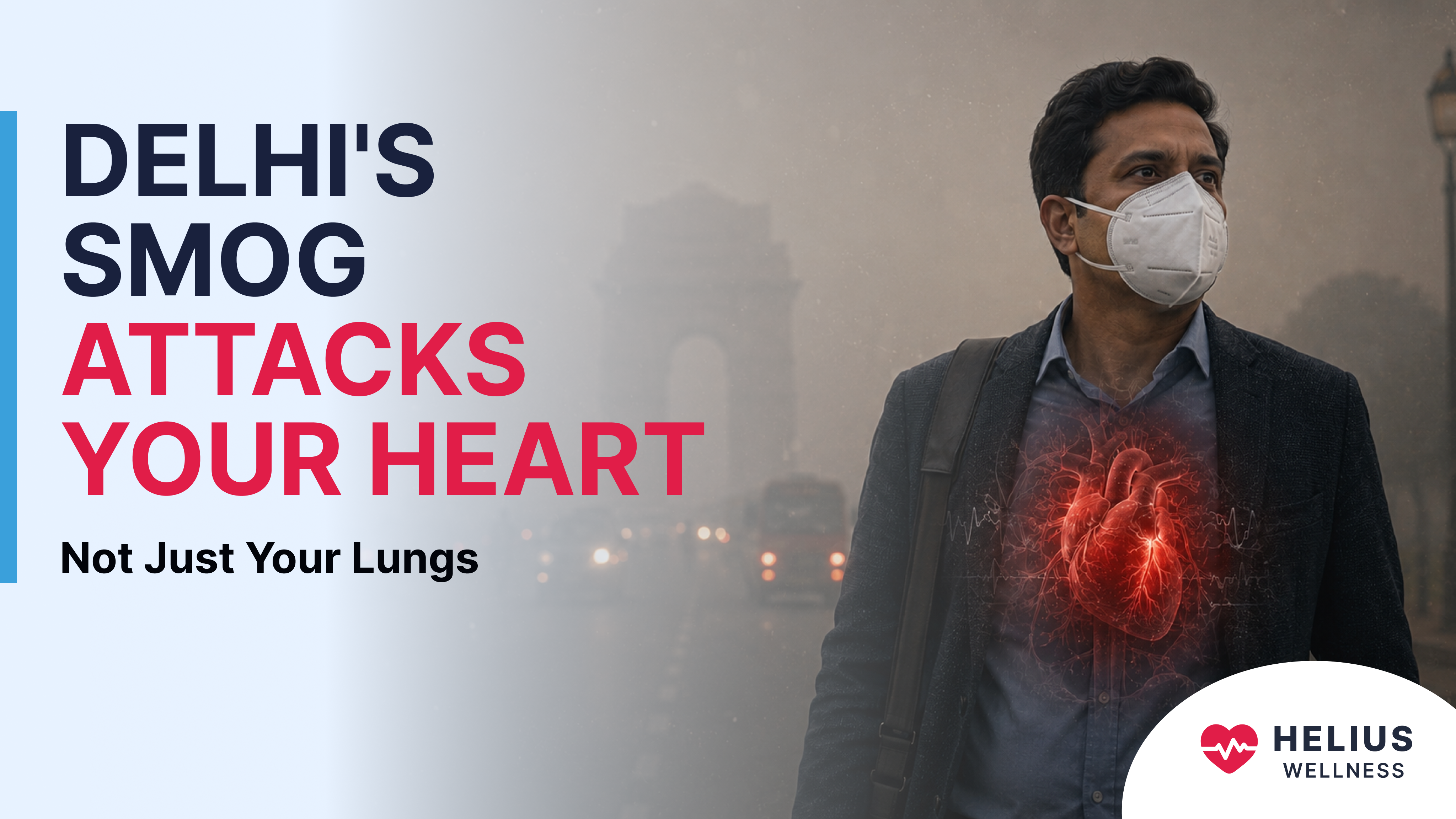
Why Delhi's Smog Season Is a Heart Attack Risk, Not Just a Lung Problem
Delhi's air doesn't just hurt your lungs. It's a measurable, same-day heart attack risk. Here's what smog season does to Indian hearts and how to protect yours.
Author:
Paresh Masani
Every winter, Delhi's AQI crosses 400. Some days, it crosses 500.
At those levels, PM2.5 concentrations have been recorded at roughly 25 times the World Health Organization's safe limit. Government advisories go out. Masks come out. Air purifiers sell out within days.
But here's the number nobody puts on a hoarding:
Short-term spikes in Delhi's PM2.5 correlate with a measurable increase in heart attack risk the same day.
This is not a mild seasonal inconvenience. It is a recurring, entirely predictable, six-to-eight-week cardiac event, and most of Delhi is walking straight into it wearing nothing but a cloth mask.
Table of Contents
1. Why Delhi's Air Turns Into A Weapon Every Winter
2. The Real Target: Your Heart, Not Just Your Lungs
3. Who is Walking Into The Most Danger?
4. The Cardiac Picture From Your Annual Check-Up is Missing
5. What Actually Protects Your Heart This Smog Season
6. FAQs
Why Delhi's Air Turns Into a Weapon Every Winter
- Stubble burning in neighbouring states.
- Vehicular and industrial emissions.
- Construction dust.
- Firecrackers.
And then, right on cue, each November, a meteorological trap: cold air sits low and heavy.
This is temperature inversion, and it turns Delhi's sky into a slow-moving container of toxins for weeks at a time.
Most of what's trapped in that container is PM2.5 particulate matter, so fine that it measures 2.5 microns or smaller.
For scale, that's roughly thirty times thinner than a human hair.
Small enough to slip past your nose, your throat, your lungs' natural filters, and go straight where it was never meant to go.
The Real Target: Your Heart, Not Just Your Lungs
PM2.5 doesn't stop at your lungs. It crosses into your bloodstream. And once it's there, it doesn't sit quietly.
It attacks on multiple fronts, simultaneously:
- Inflammation. Pollution triggers a body-wide inflammatory response, similar to a low-grade infection that your immune system can never fully clear.
- Oxidative stress. Free radicals generated by pollutants damage blood vessel walls and accelerate plaque build-up inside your arteries.
- Blood pressure spikes. Exposure impairs your arteries' ability to relax and dilate, pushing blood pressure up, sometimes within hours.
- Thicker, stickier blood. Fine particulates make blood more prone to clotting, a direct pathway to heart attacks and strokes.
- Electrical disruption. Pollution interferes with the nervous system signals that keep your heartbeat steady, raising the risk of arrhythmia.
Globally, cardiovascular disease accounts for roughly half of all deaths linked to air pollution. In India, PM2.5 exposure is associated with over a million attributable deaths a year, and close to half of them are cardiovascular, not respiratory.
Air pollution now ranks as the 2nd leading risk factor for death worldwide, behind high blood pressure and ahead of tobacco and poor diet.
This is not a distant statistic. It shows up in real time. Hospitals across Delhi NCR routinely report a rise in emergency visits for chest pain, arrhythmia, and heart failure during the weeks when AQI sits in the "Very Poor" or "Severe" range.
No cough warns you that your arteries are inflamed. No symptoms of rising blood pressure at 8 a.m. on your drive to work. The damage accumulates in silence, and it only speaks up on the day it becomes an emergency.
Who is Walking Into the Most Danger
Nobody is fully protected. But some people are at a high risk:
- Anyone with existing heart disease, hypertension, or diabetes
- Adults over 45, especially with a family history of heart disease
- Pregnant women
- Outdoor workers, traffic police, and delivery riders
- Children, whose cardiovascular systems are still developing
- Smokers, whose hearts are already compromised
If you fall into more than one of these categories, smog season deserves the same seriousness you'd give any other major cardiac risk factor, because biologically, that's exactly what it is.
The Cardiac Picture Your Annual Check-Up is Missing
Most annual health packages include a basic ECG: thirty seconds of electrical activity, captured once, interpreted later.
That's not built to catch what pollution does.
A single snapshot can easily miss a pollution-triggered arrhythmia, an early ischemic pattern, or the kind of heart rate variability changes that only show up under sustained environmental stress, exactly the conditions Delhi's smog season creates for weeks at a stretch.
Super ECG by Helius Wellness goes further.
It generates an AI-powered, plain-language summary of your heart's activity, no cardiologist visit required to understand what it means. It's built to catch silent arrhythmias, early ischemic patterns, and heart rate variability markers that a standard annual ECG simply can’t detect.
For anyone living through Delhi's pollution season, that's not a luxury check-up. That's the picture your basic ECG was never going to give you.
What Actually Protects Your Heart This Smog Season
You can't control Delhi's air. You can control your exposure and your body's ability to withstand it.
- Track the AQI daily, and skip outdoor exercise once it crosses 200–300, especially in the early morning, when pollution typically peaks.
- Wear a well-fitted N95 or N99 mask outdoors. Cloth and surgical masks don't filter PM2.5 effectively.
- Run a HEPA air purifier indoors, particularly in the bedroom, and keep windows shut during peak pollution hours.
- Move workouts indoors during severe smog spells. A hard outdoor run on a 400+ AQI day does more cardiovascular harm than good.
- Stay strict with existing medication for blood pressure, cholesterol, or blood sugar; smog season is not the time to skip doses.
- Eat for your arteries: citrus fruits, leafy greens, nuts, and omega-3 sources help counter oxidative stress.
- Get screened before the season peaks, not after symptoms show up. A cardiac risk assessment in October tells you far more than a hospital visit in December.
Summary
Delhi's smog season arrives on schedule, every single year, and so does the cardiac strain that comes with it.
The gap isn't in the science; that link is well established. The gap is in action: most people still treat this as a lung problem and a mask problem, when it's just as much a heart problem.
FAQs
1. Does air pollution actually cause heart attacks, or just breathing problems?
Both, but the cardiac impact is often underestimated. PM2.5 crosses from the lungs into the bloodstream, where it triggers inflammation, arterial damage, blood pressure spikes, and clotting, all established, direct pathways to heart attacks.
2. How quickly can pollution affect the heart, or is it only a long-term risk?
No. Short-term spikes matter too. Across 34 studies, short-term PM2.5 exposure increased the relative risk of acute myocardial infarction by 2.5% per 10 µg/m³ increase.
3. Who is most at risk of pollution-related heart problems during Delhi's smog season?
People with existing heart disease, hypertension, or diabetes; adults over 45; pregnant women; outdoor workers; children; and smokers face the highest risk.
4. Can a normal ECG catch pollution-related heart damage?
Not reliably. A standard ECG captures thirty seconds of electrical activity at a single point in time and can easily miss arrhythmias, early ischemic patterns, or heart rate variability changes that build up over weeks of pollution exposure. More comprehensive, AI-assisted monitoring like Super ECG is designed to catch what a single snapshot misses.
5. What are the warning signs of pollution-related heart strain?
Unusual breathlessness, chest tightness or pressure, heart palpitations, dizziness, and swelling in the ankles or legs should never be dismissed as "just the smog."
6. What's the single most effective thing I can do to protect my heart this smog season?
Get screened before the season peaks. Combine that with daily AQI tracking, an N95/N99 mask outdoors, indoor workouts on severe pollution days, and strict adherence to any existing heart or blood pressure medication.



India’s first AI-powered NCD diagnostics network.
Follow Us


Helius Wellness 2026. All Rights Reserved
July 17, 2026
Why Delhi's Smog Season Is a Heart Attack Risk, Not Just a Lung Problem
Delhi's air doesn't just hurt your lungs. It's a measurable, same-day heart attack risk. Here's what smog season does to Indian hearts and how to protect yours.
Author:
Paresh Masani
Every winter, Delhi's AQI crosses 400. Some days, it crosses 500.
At those levels, PM2.5 concentrations have been recorded at roughly 25 times the World Health Organization's safe limit. Government advisories go out. Masks come out. Air purifiers sell out within days.
But here's the number nobody puts on a hoarding:
Short-term spikes in Delhi's PM2.5 correlate with a measurable increase in heart attack risk the same day.
This is not a mild seasonal inconvenience. It is a recurring, entirely predictable, six-to-eight-week cardiac event, and most of Delhi is walking straight into it wearing nothing but a cloth mask.
Table of Contents
1. Why Delhi's Air Turns Into A Weapon Every Winter
2. The Real Target: Your Heart, Not Just Your Lungs
3. Who is Walking Into The Most Danger?
4. The Cardiac Picture From Your Annual Check-Up is Missing
5. What Actually Protects Your Heart This Smog Season
6. FAQs
Why Delhi's Air Turns Into a Weapon Every Winter
- Stubble burning in neighbouring states.
- Vehicular and industrial emissions.
- Construction dust.
- Firecrackers.
And then, right on cue, each November, a meteorological trap: cold air sits low and heavy.
This is temperature inversion, and it turns Delhi's sky into a slow-moving container of toxins for weeks at a time.
Most of what's trapped in that container is PM2.5 particulate matter, so fine that it measures 2.5 microns or smaller.
For scale, that's roughly thirty times thinner than a human hair.
Small enough to slip past your nose, your throat, your lungs' natural filters, and go straight where it was never meant to go.
The Real Target: Your Heart, Not Just Your Lungs
PM2.5 doesn't stop at your lungs. It crosses into your bloodstream. And once it's there, it doesn't sit quietly.
It attacks on multiple fronts, simultaneously:
- Inflammation. Pollution triggers a body-wide inflammatory response, similar to a low-grade infection that your immune system can never fully clear.
- Oxidative stress. Free radicals generated by pollutants damage blood vessel walls and accelerate plaque build-up inside your arteries.
- Blood pressure spikes. Exposure impairs your arteries' ability to relax and dilate, pushing blood pressure up, sometimes within hours.
- Thicker, stickier blood. Fine particulates make blood more prone to clotting, a direct pathway to heart attacks and strokes.
- Electrical disruption. Pollution interferes with the nervous system signals that keep your heartbeat steady, raising the risk of arrhythmia.
Globally, cardiovascular disease accounts for roughly half of all deaths linked to air pollution. In India, PM2.5 exposure is associated with over a million attributable deaths a year, and close to half of them are cardiovascular, not respiratory.
Air pollution now ranks as the 2nd leading risk factor for death worldwide, behind high blood pressure and ahead of tobacco and poor diet.
This is not a distant statistic. It shows up in real time. Hospitals across Delhi NCR routinely report a rise in emergency visits for chest pain, arrhythmia, and heart failure during the weeks when AQI sits in the "Very Poor" or "Severe" range.
No cough warns you that your arteries are inflamed. No symptoms of rising blood pressure at 8 a.m. on your drive to work. The damage accumulates in silence, and it only speaks up on the day it becomes an emergency.
Who is Walking Into the Most Danger
Nobody is fully protected. But some people are at a high risk:
- Anyone with existing heart disease, hypertension, or diabetes
- Adults over 45, especially with a family history of heart disease
- Pregnant women
- Outdoor workers, traffic police, and delivery riders
- Children, whose cardiovascular systems are still developing
- Smokers, whose hearts are already compromised
If you fall into more than one of these categories, smog season deserves the same seriousness you'd give any other major cardiac risk factor, because biologically, that's exactly what it is.
The Cardiac Picture Your Annual Check-Up is Missing
Most annual health packages include a basic ECG: thirty seconds of electrical activity, captured once, interpreted later.
That's not built to catch what pollution does.
A single snapshot can easily miss a pollution-triggered arrhythmia, an early ischemic pattern, or the kind of heart rate variability changes that only show up under sustained environmental stress, exactly the conditions Delhi's smog season creates for weeks at a stretch.
Super ECG by Helius Wellness goes further.
It generates an AI-powered, plain-language summary of your heart's activity, no cardiologist visit required to understand what it means. It's built to catch silent arrhythmias, early ischemic patterns, and heart rate variability markers that a standard annual ECG simply can’t detect.
For anyone living through Delhi's pollution season, that's not a luxury check-up. That's the picture your basic ECG was never going to give you.
What Actually Protects Your Heart This Smog Season
You can't control Delhi's air. You can control your exposure and your body's ability to withstand it.
- Track the AQI daily, and skip outdoor exercise once it crosses 200–300, especially in the early morning, when pollution typically peaks.
- Wear a well-fitted N95 or N99 mask outdoors. Cloth and surgical masks don't filter PM2.5 effectively.
- Run a HEPA air purifier indoors, particularly in the bedroom, and keep windows shut during peak pollution hours.
- Move workouts indoors during severe smog spells. A hard outdoor run on a 400+ AQI day does more cardiovascular harm than good.
- Stay strict with existing medication for blood pressure, cholesterol, or blood sugar; smog season is not the time to skip doses.
- Eat for your arteries: citrus fruits, leafy greens, nuts, and omega-3 sources help counter oxidative stress.
- Get screened before the season peaks, not after symptoms show up. A cardiac risk assessment in October tells you far more than a hospital visit in December.
Summary
Delhi's smog season arrives on schedule, every single year, and so does the cardiac strain that comes with it.
The gap isn't in the science; that link is well established. The gap is in action: most people still treat this as a lung problem and a mask problem, when it's just as much a heart problem.
FAQs
1. Does air pollution actually cause heart attacks, or just breathing problems?
Both, but the cardiac impact is often underestimated. PM2.5 crosses from the lungs into the bloodstream, where it triggers inflammation, arterial damage, blood pressure spikes, and clotting, all established, direct pathways to heart attacks.
2. How quickly can pollution affect the heart, or is it only a long-term risk?
No. Short-term spikes matter too. Across 34 studies, short-term PM2.5 exposure increased the relative risk of acute myocardial infarction by 2.5% per 10 µg/m³ increase.
3. Who is most at risk of pollution-related heart problems during Delhi's smog season?
People with existing heart disease, hypertension, or diabetes; adults over 45; pregnant women; outdoor workers; children; and smokers face the highest risk.
4. Can a normal ECG catch pollution-related heart damage?
Not reliably. A standard ECG captures thirty seconds of electrical activity at a single point in time and can easily miss arrhythmias, early ischemic patterns, or heart rate variability changes that build up over weeks of pollution exposure. More comprehensive, AI-assisted monitoring like Super ECG is designed to catch what a single snapshot misses.
5. What are the warning signs of pollution-related heart strain?
Unusual breathlessness, chest tightness or pressure, heart palpitations, dizziness, and swelling in the ankles or legs should never be dismissed as "just the smog."
6. What's the single most effective thing I can do to protect my heart this smog season?
Get screened before the season peaks. Combine that with daily AQI tracking, an N95/N99 mask outdoors, indoor workouts on severe pollution days, and strict adherence to any existing heart or blood pressure medication.
India’s first AI-powered NCD diagnostics network.
Helius Wellness 2026. All Rights Reserved
Follow Us
July 17, 2026
Why Delhi's Smog Season Is a Heart Attack Risk, Not Just a Lung Problem
Delhi's air doesn't just hurt your lungs. It's a measurable, same-day heart attack risk. Here's what smog season does to Indian hearts and how to protect yours.
Author:
Paresh Masani
Every winter, Delhi's AQI crosses 400. Some days, it crosses 500.
At those levels, PM2.5 concentrations have been recorded at roughly 25 times the World Health Organization's safe limit. Government advisories go out. Masks come out. Air purifiers sell out within days.
But here's the number nobody puts on a hoarding:
Short-term spikes in Delhi's PM2.5 correlate with a measurable increase in heart attack risk the same day.
This is not a mild seasonal inconvenience. It is a recurring, entirely predictable, six-to-eight-week cardiac event, and most of Delhi is walking straight into it wearing nothing but a cloth mask.
Table of Contents
1. Why Delhi's Air Turns Into A Weapon Every Winter
2. The Real Target: Your Heart, Not Just Your Lungs
3. Who is Walking Into The Most Danger?
4. The Cardiac Picture From Your Annual Check-Up is Missing
5. What Actually Protects Your Heart This Smog Season
6. FAQs
Why Delhi's Air Turns Into a Weapon Every Winter
- Stubble burning in neighbouring states.
- Vehicular and industrial emissions.
- Construction dust.
- Firecrackers.
And then, right on cue, each November, a meteorological trap: cold air sits low and heavy.
This is temperature inversion, and it turns Delhi's sky into a slow-moving container of toxins for weeks at a time.
Most of what's trapped in that container is PM2.5 particulate matter, so fine that it measures 2.5 microns or smaller.
For scale, that's roughly thirty times thinner than a human hair.
Small enough to slip past your nose, your throat, your lungs' natural filters, and go straight where it was never meant to go.
The Real Target: Your Heart, Not Just Your Lungs
PM2.5 doesn't stop at your lungs. It crosses into your bloodstream. And once it's there, it doesn't sit quietly.
It attacks on multiple fronts, simultaneously:
- Inflammation. Pollution triggers a body-wide inflammatory response, similar to a low-grade infection that your immune system can never fully clear.
- Oxidative stress. Free radicals generated by pollutants damage blood vessel walls and accelerate plaque build-up inside your arteries.
- Blood pressure spikes. Exposure impairs your arteries' ability to relax and dilate, pushing blood pressure up, sometimes within hours.
- Thicker, stickier blood. Fine particulates make blood more prone to clotting, a direct pathway to heart attacks and strokes.
- Electrical disruption. Pollution interferes with the nervous system signals that keep your heartbeat steady, raising the risk of arrhythmia.
Globally, cardiovascular disease accounts for roughly half of all deaths linked to air pollution. In India, PM2.5 exposure is associated with over a million attributable deaths a year, and close to half of them are cardiovascular, not respiratory.
Air pollution now ranks as the 2nd leading risk factor for death worldwide, behind high blood pressure and ahead of tobacco and poor diet.
This is not a distant statistic. It shows up in real time. Hospitals across Delhi NCR routinely report a rise in emergency visits for chest pain, arrhythmia, and heart failure during the weeks when AQI sits in the "Very Poor" or "Severe" range.
No cough warns you that your arteries are inflamed. No symptoms of rising blood pressure at 8 a.m. on your drive to work. The damage accumulates in silence, and it only speaks up on the day it becomes an emergency.
Who is Walking Into the Most Danger
Nobody is fully protected. But some people are at a high risk:
- Anyone with existing heart disease, hypertension, or diabetes
- Adults over 45, especially with a family history of heart disease
- Pregnant women
- Outdoor workers, traffic police, and delivery riders
- Children, whose cardiovascular systems are still developing
- Smokers, whose hearts are already compromised
If you fall into more than one of these categories, smog season deserves the same seriousness you'd give any other major cardiac risk factor, because biologically, that's exactly what it is.
The Cardiac Picture Your Annual Check-Up is Missing
Most annual health packages include a basic ECG: thirty seconds of electrical activity, captured once, interpreted later.
That's not built to catch what pollution does.
A single snapshot can easily miss a pollution-triggered arrhythmia, an early ischemic pattern, or the kind of heart rate variability changes that only show up under sustained environmental stress, exactly the conditions Delhi's smog season creates for weeks at a stretch.
Super ECG by Helius Wellness goes further.
It generates an AI-powered, plain-language summary of your heart's activity, no cardiologist visit required to understand what it means. It's built to catch silent arrhythmias, early ischemic patterns, and heart rate variability markers that a standard annual ECG simply can’t detect.
For anyone living through Delhi's pollution season, that's not a luxury check-up. That's the picture your basic ECG was never going to give you.
What Actually Protects Your Heart This Smog Season
You can't control Delhi's air. You can control your exposure and your body's ability to withstand it.
- Track the AQI daily, and skip outdoor exercise once it crosses 200–300, especially in the early morning, when pollution typically peaks.
- Wear a well-fitted N95 or N99 mask outdoors. Cloth and surgical masks don't filter PM2.5 effectively.
- Run a HEPA air purifier indoors, particularly in the bedroom, and keep windows shut during peak pollution hours.
- Move workouts indoors during severe smog spells. A hard outdoor run on a 400+ AQI day does more cardiovascular harm than good.
- Stay strict with existing medication for blood pressure, cholesterol, or blood sugar; smog season is not the time to skip doses.
- Eat for your arteries: citrus fruits, leafy greens, nuts, and omega-3 sources help counter oxidative stress.
- Get screened before the season peaks, not after symptoms show up. A cardiac risk assessment in October tells you far more than a hospital visit in December.
Summary
Delhi's smog season arrives on schedule, every single year, and so does the cardiac strain that comes with it.
The gap isn't in the science; that link is well established. The gap is in action: most people still treat this as a lung problem and a mask problem, when it's just as much a heart problem.
FAQs
1. Does air pollution actually cause heart attacks, or just breathing problems?
Both, but the cardiac impact is often underestimated. PM2.5 crosses from the lungs into the bloodstream, where it triggers inflammation, arterial damage, blood pressure spikes, and clotting, all established, direct pathways to heart attacks.
2. How quickly can pollution affect the heart, or is it only a long-term risk?
No. Short-term spikes matter too. Across 34 studies, short-term PM2.5 exposure increased the relative risk of acute myocardial infarction by 2.5% per 10 µg/m³ increase.
3. Who is most at risk of pollution-related heart problems during Delhi's smog season?
People with existing heart disease, hypertension, or diabetes; adults over 45; pregnant women; outdoor workers; children; and smokers face the highest risk.
4. Can a normal ECG catch pollution-related heart damage?
Not reliably. A standard ECG captures thirty seconds of electrical activity at a single point in time and can easily miss arrhythmias, early ischemic patterns, or heart rate variability changes that build up over weeks of pollution exposure. More comprehensive, AI-assisted monitoring like Super ECG is designed to catch what a single snapshot misses.
5. What are the warning signs of pollution-related heart strain?
Unusual breathlessness, chest tightness or pressure, heart palpitations, dizziness, and swelling in the ankles or legs should never be dismissed as "just the smog."
6. What's the single most effective thing I can do to protect my heart this smog season?
Get screened before the season peaks. Combine that with daily AQI tracking, an N95/N99 mask outdoors, indoor workouts on severe pollution days, and strict adherence to any existing heart or blood pressure medication.
Related Blogs

Why Delhi's Smog Season Is a Heart Attack Risk, Not Just a Lung Problem


July 17, 2026

ECG vs 2D Echo vs Super ECG: What Each Test Actually Tells You About Your Heart And What It Doesn't
July 10, 2026

Your Smartwatch Might Be Lying to You, Especially If You're Indian
July 3, 2026
Show all blogs
India’s first AI-powered NCD diagnostics network.
Helius Wellness 2026. All Rights Reserved
Follow Us