

October 16, 2026
Does Family History Really Determine Heart Disease Risk?
Does heart disease run in your family? Learn how much family history really affects your risk, what you can control, and why early screening matters.
Author:
Kavya Dave
Key Takeaways
- A family history of heart disease raises your risk, but it does not decide your future.
- What counts most: a parent or sibling with heart disease before 55 (men) or 65 (women).
- A healthy lifestyle can cut risk by nearly half, even in people with high genetic risk.
- No family history is not a free pass. Silent risks like high blood pressure and inherited Lp(a) often go unnoticed.
- The best move for everyone: know your numbers early and don't wait for symptoms.
"Heart problems run in our family."
Most of us have heard this line at a family gathering, said with a shrug or a worried look. For some, it turns into a quiet fear. For others, a family with no heart trouble feels like a safety net.
Both reactions miss the full picture. And the stakes are high: cardiovascular disease is the world's leading cause of death, claiming an estimated 19.8 million lives in 2022, about 32% of all global deaths.
So let's look at what your family history really says about your heart, and what it doesn't.
Short answer: No, family history does not determine your heart disease risk on its own. It raises it. If a parent or sibling developed heart disease early (before 55 in men or 65 in women), your risk can roughly double. But blood pressure, cholesterol, blood sugar, and lifestyle still shape much of your risk, and people with no family history can develop heart disease too.
What Does "Family History of Heart Disease" Actually Mean?
Not every relative counts equally. Doctors mainly look at first-degree relatives: your parents, brothers, sisters, and children.
Age matters most.
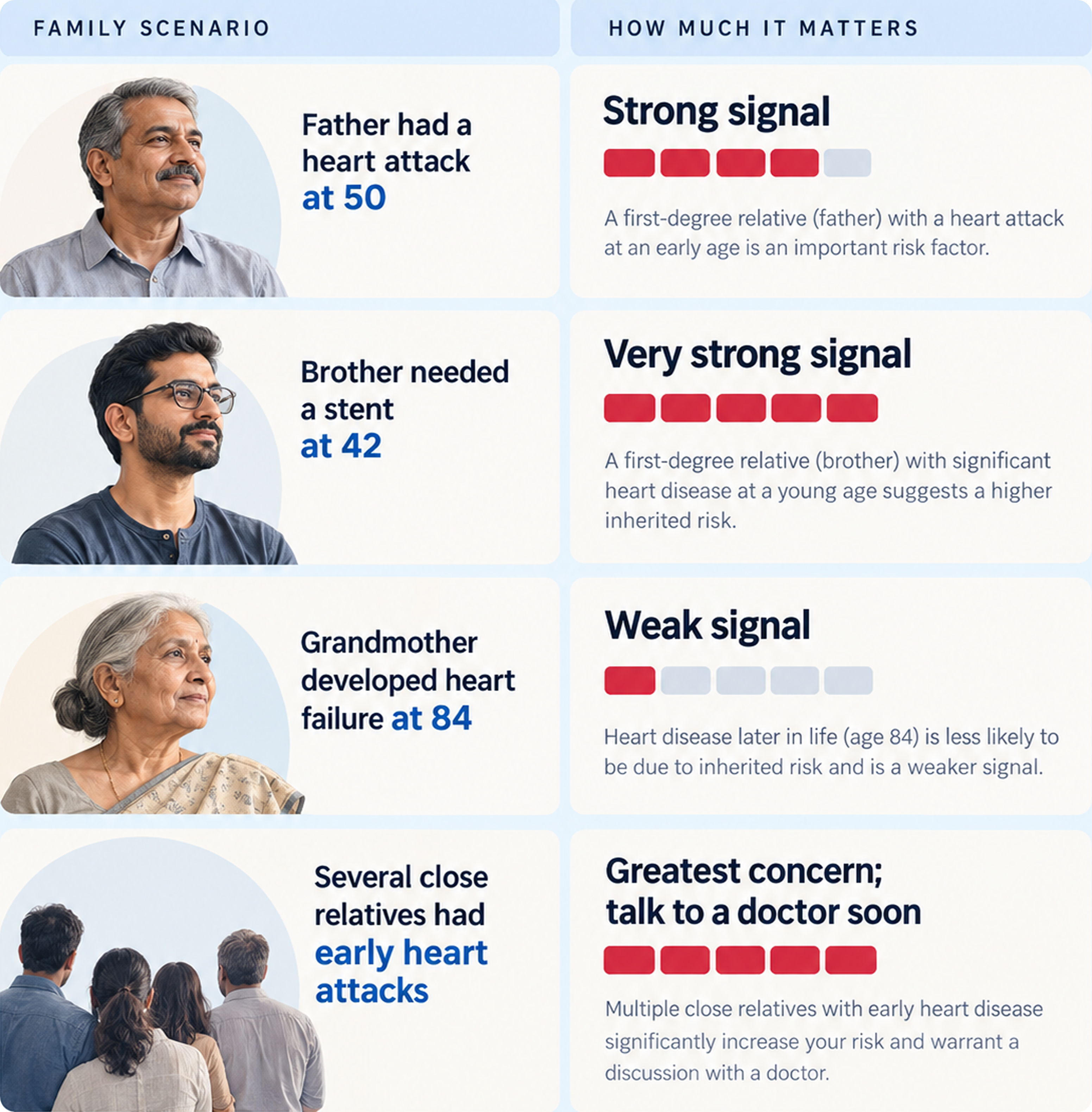
If a parent or sibling had coronary artery disease or a heart attack before 55 (men) or before 65 (women), your risk of having one doubles. With several affected relatives, or relatives affected even younger, risk can rise to 12-fold.
Large studies confirm this. In the US All of Us research program, adults with a family history of heart attack had 2.17 times the odds of having a heart attack themselves.
Does your family history count?
Rare Inherited Conditions vs. Everyday Genetic Risk
"It runs in the family" can mean two very different things.
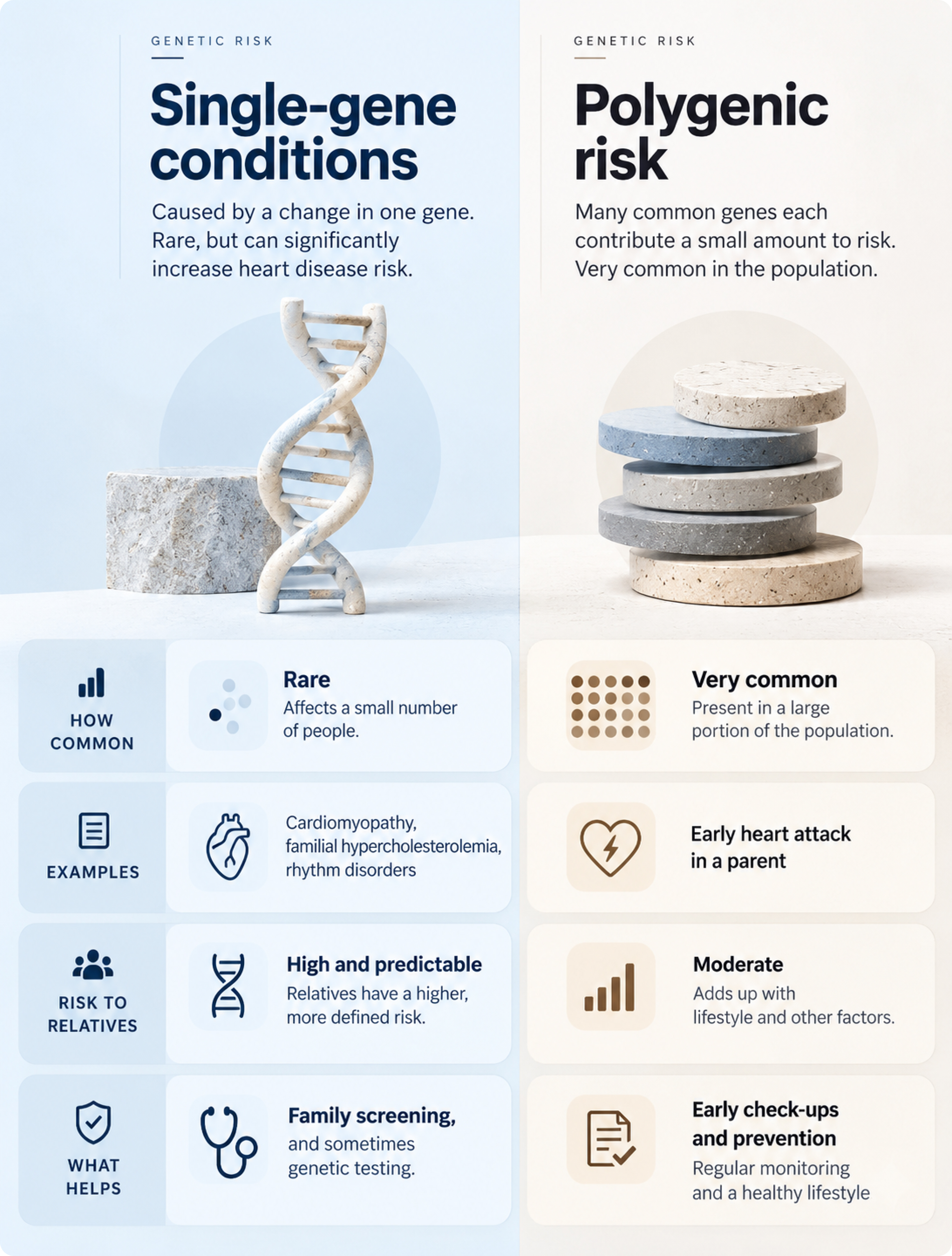
1. Single-gene (inherited) conditions.
These are rare but powerful. They include heart muscle diseases, life-threatening heart rhythms, and very high cholesterol levels. For example, if a parent or sibling has hypertrophic cardiomyopathy, you have a 50% chance of carrying the same gene mutation. The CDC notes that very high cholesterol or heart attacks at a young age in a family may point to familial hypercholesterolemia.
2. Polygenic (everyday) risk.
This is far more common. There's no single "heart disease gene." Instead, many small genetic nudges make high blood pressure, high cholesterol, or diabetes more likely.
Shared Genes or Shared Kitchens?
Families share more than DNA. They share recipes, salt and oil habits, activity levels, smoking at home, stress, and even attitudes toward doctors. Family history reflects a mix of shared genes and shared environments.
This matters for Indian families. South Asians tend to develop coronary artery disease up to a decade earlier, with about a quarter of heart attacks occurring before age 40.
Yet the INTERHEART study found that traditional, modifiable risk factors largely explain this earlier onset.
The good news? Habits you learned can be unlearned.
Can a Healthy Lifestyle Offset Genetic Heart Disease Risk?
Yes, to a large degree. A landmark study of 55,685 people found that among those at high genetic risk, a favourable lifestyle was linked to a nearly 50% lower relative risk of coronary artery disease compared with an unfavourable one. The World Heart Federation estimates that up to 80% of premature heart attacks and strokes are preventable.
- What you can't change: your genes, age, sex, and family history.
- What you can change or manage: blood pressure, cholesterol, blood sugar, weight, smoking, physical activity, sleep, and stress.
- Know where you actually stand. Family history tells you about your relatives. A Super ECG screening from Helius Wellness tells you about you, analysing 55+ cardiac risk patterns in a single non-invasive session.
No Family History? Why It's Not a Free Pass
A clean family tree can be misleading, for three reasons.
1. Family records are often incomplete.
Relatives may have died young from other causes, never been diagnosed, or simply not talked about their health. The CDC recommends collecting history from both sides of the family, including ages at diagnosis and causes of death.
2. Some inherited risks hide in plain sight.
Lipoprotein(a), or Lp(a), is a cholesterol-like particle that is 75 to 95% genetically determined. About 1 in 5 people have high levels, which carry about 1.5 times the risk of coronary artery disease. Yet in a study of over 343,000 people, 86.8% did not report a family history of heart disease. Lp(a) barely responds to diet.
3. The biggest risks are often silent.
An estimated 600 million adults with high blood pressure (44%) don't know they have it.
Don't wait for symptoms.
Heart risk often builds quietly for years. Helius Wellness Super ECG combines electrical, acoustic, and mechanical heart signals, with elevated-risk results reviewed by a cardiologist. Curious how it compares with wearables?
Also read: Your Smartwatch Might Be Lying to You.
How to Use Your Family History: A 3-Step Plan
- Ask. Try: "Did anyone in our family have a heart attack, stroke, or very high cholesterol? How old were they?"
- Share. Tell your doctor, especially about early heart attacks, sudden deaths, or very high cholesterol.
- Check. Get baseline tests: blood pressure, lipid profile, blood sugar, and a heart screening. Ask whether a one-time Lp(a) test suits you.
Summary
Family history is the hand you're dealt, not how the game ends. If heart disease runs in your family, you have more control than you think. If it doesn't, you have less certainty than you think. Either way, the answer is the same: know your numbers, and don't wait for symptoms.
FAQs
1. Is heart disease inherited from the mother or father?
From either. You inherit genes from both parents, so risk can come from either side.
2. Can I get heart disease with no family history?
Yes. Silent risks like high blood pressure, diabetes, and inherited Lp(a) can affect anyone.
3. Does a grandparent's heart disease count as family history?
It counts less than a parent or sibling, especially if it happened late in life.
4. When should I start heart screening if it runs in my family?
Earlier than average. Talk to your doctor about starting baseline checks in your 20s or 30s.






India’s first AI-powered NCD diagnostics network.
Follow Us


Helius Wellness 2026. All Rights Reserved
October 16, 2026
Does Family History Really Determine Heart Disease Risk?
Does heart disease run in your family? Learn how much family history really affects your risk, what you can control, and why early screening matters.
Author:
Kavya Dave
Key Takeaways
- A family history of heart disease raises your risk, but it does not decide your future.
- What counts most: a parent or sibling with heart disease before 55 (men) or 65 (women).
- A healthy lifestyle can cut risk by nearly half, even in people with high genetic risk.
- No family history is not a free pass. Silent risks like high blood pressure and inherited Lp(a) often go unnoticed.
- The best move for everyone: know your numbers early and don't wait for symptoms.
"Heart problems run in our family."
Most of us have heard this line at a family gathering, said with a shrug or a worried look. For some, it turns into a quiet fear. For others, a family with no heart trouble feels like a safety net.
Both reactions miss the full picture. And the stakes are high: cardiovascular disease is the world's leading cause of death, claiming an estimated 19.8 million lives in 2022, about 32% of all global deaths.
So let's look at what your family history really says about your heart, and what it doesn't.
Short answer: No, family history does not determine your heart disease risk on its own. It raises it. If a parent or sibling developed heart disease early (before 55 in men or 65 in women), your risk can roughly double. But blood pressure, cholesterol, blood sugar, and lifestyle still shape much of your risk, and people with no family history can develop heart disease too.
What Does "Family History of Heart Disease" Actually Mean?
Not every relative counts equally. Doctors mainly look at first-degree relatives: your parents, brothers, sisters, and children.
Age matters most.
If a parent or sibling had coronary artery disease or a heart attack before 55 (men) or before 65 (women), your risk of having one doubles. With several affected relatives, or relatives affected even younger, risk can rise to 12-fold.
Large studies confirm this. In the US All of Us research program, adults with a family history of heart attack had 2.17 times the odds of having a heart attack themselves.
Does your family history count?
Rare Inherited Conditions vs. Everyday Genetic Risk
"It runs in the family" can mean two very different things.
1. Single-gene (inherited) conditions.
These are rare but powerful. They include heart muscle diseases, life-threatening heart rhythms, and very high cholesterol levels. For example, if a parent or sibling has hypertrophic cardiomyopathy, you have a 50% chance of carrying the same gene mutation. The CDC notes that very high cholesterol or heart attacks at a young age in a family may point to familial hypercholesterolemia.
2. Polygenic (everyday) risk.
This is far more common. There's no single "heart disease gene." Instead, many small genetic nudges make high blood pressure, high cholesterol, or diabetes more likely.
Shared Genes or Shared Kitchens?
Families share more than DNA. They share recipes, salt and oil habits, activity levels, smoking at home, stress, and even attitudes toward doctors. Family history reflects a mix of shared genes and shared environments.
This matters for Indian families. South Asians tend to develop coronary artery disease up to a decade earlier, with about a quarter of heart attacks occurring before age 40.
Yet the INTERHEART study found that traditional, modifiable risk factors largely explain this earlier onset.
The good news? Habits you learned can be unlearned.
Can a Healthy Lifestyle Offset Genetic Heart Disease Risk?
Yes, to a large degree. A landmark study of 55,685 people found that among those at high genetic risk, a favourable lifestyle was linked to a nearly 50% lower relative risk of coronary artery disease compared with an unfavourable one. The World Heart Federation estimates that up to 80% of premature heart attacks and strokes are preventable.
- What you can't change: your genes, age, sex, and family history.
- What you can change or manage: blood pressure, cholesterol, blood sugar, weight, smoking, physical activity, sleep, and stress.
- Know where you actually stand. Family history tells you about your relatives. A Super ECG screening from Helius Wellness tells you about you, analysing 55+ cardiac risk patterns in a single non-invasive session.
No Family History? Why It's Not a Free Pass
A clean family tree can be misleading, for three reasons.
1. Family records are often incomplete.
Relatives may have died young from other causes, never been diagnosed, or simply not talked about their health. The CDC recommends collecting history from both sides of the family, including ages at diagnosis and causes of death.
2. Some inherited risks hide in plain sight.
Lipoprotein(a), or Lp(a), is a cholesterol-like particle that is 75 to 95% genetically determined. About 1 in 5 people have high levels, which carry about 1.5 times the risk of coronary artery disease. Yet in a study of over 343,000 people, 86.8% did not report a family history of heart disease. Lp(a) barely responds to diet.
3. The biggest risks are often silent.
An estimated 600 million adults with high blood pressure (44%) don't know they have it.
Don't wait for symptoms.
Heart risk often builds quietly for years. Helius Wellness Super ECG combines electrical, acoustic, and mechanical heart signals, with elevated-risk results reviewed by a cardiologist. Curious how it compares with wearables?
Also read: Your Smartwatch Might Be Lying to You.
How to Use Your Family History: A 3-Step Plan
- Ask. Try: "Did anyone in our family have a heart attack, stroke, or very high cholesterol? How old were they?"
- Share. Tell your doctor, especially about early heart attacks, sudden deaths, or very high cholesterol.
- Check. Get baseline tests: blood pressure, lipid profile, blood sugar, and a heart screening. Ask whether a one-time Lp(a) test suits you.
Summary
Family history is the hand you're dealt, not how the game ends. If heart disease runs in your family, you have more control than you think. If it doesn't, you have less certainty than you think. Either way, the answer is the same: know your numbers, and don't wait for symptoms.
FAQs
1. Is heart disease inherited from the mother or father?
From either. You inherit genes from both parents, so risk can come from either side.
2. Can I get heart disease with no family history?
Yes. Silent risks like high blood pressure, diabetes, and inherited Lp(a) can affect anyone.
3. Does a grandparent's heart disease count as family history?
It counts less than a parent or sibling, especially if it happened late in life.
4. When should I start heart screening if it runs in my family?
Earlier than average. Talk to your doctor about starting baseline checks in your 20s or 30s.
India’s first AI-powered NCD diagnostics network.
Helius Wellness 2026. All Rights Reserved
Follow Us

October 16, 2026
Does Family History Really Determine Heart Disease Risk?
Does heart disease run in your family? Learn how much family history really affects your risk, what you can control, and why early screening matters.
Author:
Kavya Dave
Key Takeaways
- A family history of heart disease raises your risk, but it does not decide your future.
- What counts most: a parent or sibling with heart disease before 55 (men) or 65 (women).
- A healthy lifestyle can cut risk by nearly half, even in people with high genetic risk.
- No family history is not a free pass. Silent risks like high blood pressure and inherited Lp(a) often go unnoticed.
- The best move for everyone: know your numbers early and don't wait for symptoms.
"Heart problems run in our family."
Most of us have heard this line at a family gathering, said with a shrug or a worried look. For some, it turns into a quiet fear. For others, a family with no heart trouble feels like a safety net.
Both reactions miss the full picture. And the stakes are high: cardiovascular disease is the world's leading cause of death, claiming an estimated 19.8 million lives in 2022, about 32% of all global deaths.
So let's look at what your family history really says about your heart, and what it doesn't.
Short answer: No, family history does not determine your heart disease risk on its own. It raises it. If a parent or sibling developed heart disease early (before 55 in men or 65 in women), your risk can roughly double. But blood pressure, cholesterol, blood sugar, and lifestyle still shape much of your risk, and people with no family history can develop heart disease too.
What Does "Family History of Heart Disease" Actually Mean?
Not every relative counts equally. Doctors mainly look at first-degree relatives: your parents, brothers, sisters, and children.
Age matters most.
If a parent or sibling had coronary artery disease or a heart attack before 55 (men) or before 65 (women), your risk of having one doubles. With several affected relatives, or relatives affected even younger, risk can rise to 12-fold.
Large studies confirm this. In the US All of Us research program, adults with a family history of heart attack had 2.17 times the odds of having a heart attack themselves.
Does your family history count?
Rare Inherited Conditions vs. Everyday Genetic Risk
"It runs in the family" can mean two very different things.
1. Single-gene (inherited) conditions.
These are rare but powerful. They include heart muscle diseases, life-threatening heart rhythms, and very high cholesterol levels. For example, if a parent or sibling has hypertrophic cardiomyopathy, you have a 50% chance of carrying the same gene mutation. The CDC notes that very high cholesterol or heart attacks at a young age in a family may point to familial hypercholesterolemia.
2. Polygenic (everyday) risk.
This is far more common. There's no single "heart disease gene." Instead, many small genetic nudges make high blood pressure, high cholesterol, or diabetes more likely.
Shared Genes or Shared Kitchens?
Families share more than DNA. They share recipes, salt and oil habits, activity levels, smoking at home, stress, and even attitudes toward doctors. Family history reflects a mix of shared genes and shared environments.
This matters for Indian families. South Asians tend to develop coronary artery disease up to a decade earlier, with about a quarter of heart attacks occurring before age 40.
Yet the INTERHEART study found that traditional, modifiable risk factors largely explain this earlier onset.
The good news? Habits you learned can be unlearned.
Can a Healthy Lifestyle Offset Genetic Heart Disease Risk?
Yes, to a large degree. A landmark study of 55,685 people found that among those at high genetic risk, a favourable lifestyle was linked to a nearly 50% lower relative risk of coronary artery disease compared with an unfavourable one. The World Heart Federation estimates that up to 80% of premature heart attacks and strokes are preventable.
- What you can't change: your genes, age, sex, and family history.
- What you can change or manage: blood pressure, cholesterol, blood sugar, weight, smoking, physical activity, sleep, and stress.
- Know where you actually stand. Family history tells you about your relatives. A Super ECG screening from Helius Wellness tells you about you, analysing 55+ cardiac risk patterns in a single non-invasive session.
No Family History? Why It's Not a Free Pass
A clean family tree can be misleading, for three reasons.
1. Family records are often incomplete.
Relatives may have died young from other causes, never been diagnosed, or simply not talked about their health. The CDC recommends collecting history from both sides of the family, including ages at diagnosis and causes of death.
2. Some inherited risks hide in plain sight.
Lipoprotein(a), or Lp(a), is a cholesterol-like particle that is 75 to 95% genetically determined. About 1 in 5 people have high levels, which carry about 1.5 times the risk of coronary artery disease. Yet in a study of over 343,000 people, 86.8% did not report a family history of heart disease. Lp(a) barely responds to diet.
3. The biggest risks are often silent.
An estimated 600 million adults with high blood pressure (44%) don't know they have it.
Don't wait for symptoms.
Heart risk often builds quietly for years. Helius Wellness Super ECG combines electrical, acoustic, and mechanical heart signals, with elevated-risk results reviewed by a cardiologist. Curious how it compares with wearables?
Also read: Your Smartwatch Might Be Lying to You.
How to Use Your Family History: A 3-Step Plan
- Ask. Try: "Did anyone in our family have a heart attack, stroke, or very high cholesterol? How old were they?"
- Share. Tell your doctor, especially about early heart attacks, sudden deaths, or very high cholesterol.
- Check. Get baseline tests: blood pressure, lipid profile, blood sugar, and a heart screening. Ask whether a one-time Lp(a) test suits you.
Summary
Family history is the hand you're dealt, not how the game ends. If heart disease runs in your family, you have more control than you think. If it doesn't, you have less certainty than you think. Either way, the answer is the same: know your numbers, and don't wait for symptoms.
FAQs
1. Is heart disease inherited from the mother or father?
From either. You inherit genes from both parents, so risk can come from either side.
2. Can I get heart disease with no family history?
Yes. Silent risks like high blood pressure, diabetes, and inherited Lp(a) can affect anyone.
3. Does a grandparent's heart disease count as family history?
It counts less than a parent or sibling, especially if it happened late in life.
4. When should I start heart screening if it runs in my family?
Earlier than average. Talk to your doctor about starting baseline checks in your 20s or 30s.


India’s first AI-powered NCD diagnostics network.
Helius Wellness 2026. All Rights Reserved
Follow Us