

September 25, 2026
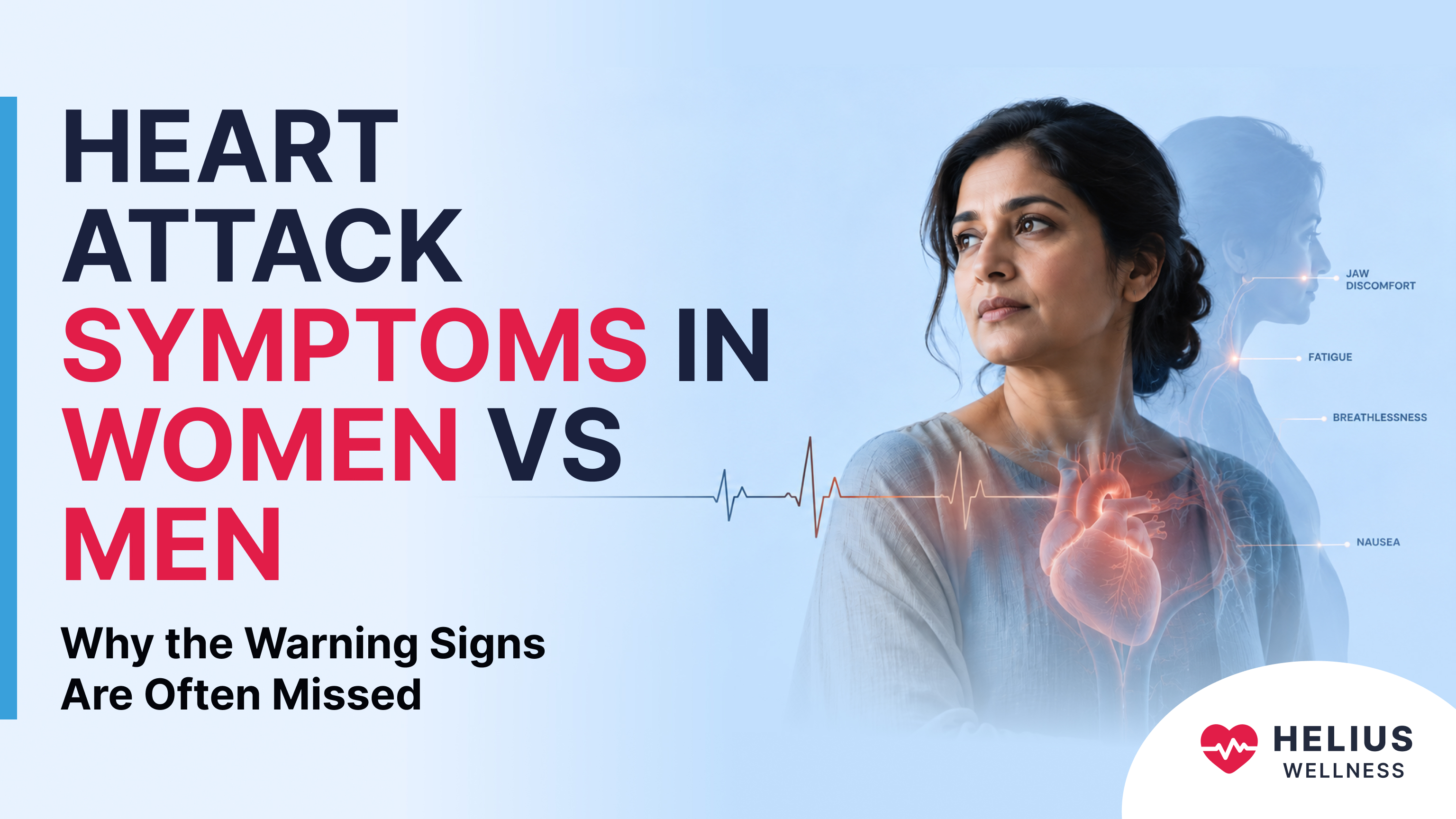
Heart Attack Symptoms in Women vs Men: Why the Warning Signs Are Often Missed
Heart attack symptoms in women often differ from men's, and that difference quietly costs lives. Here's why the warning signs get missed, and how to close the gap.
Author:
Paresh Masani
Key Takeaways
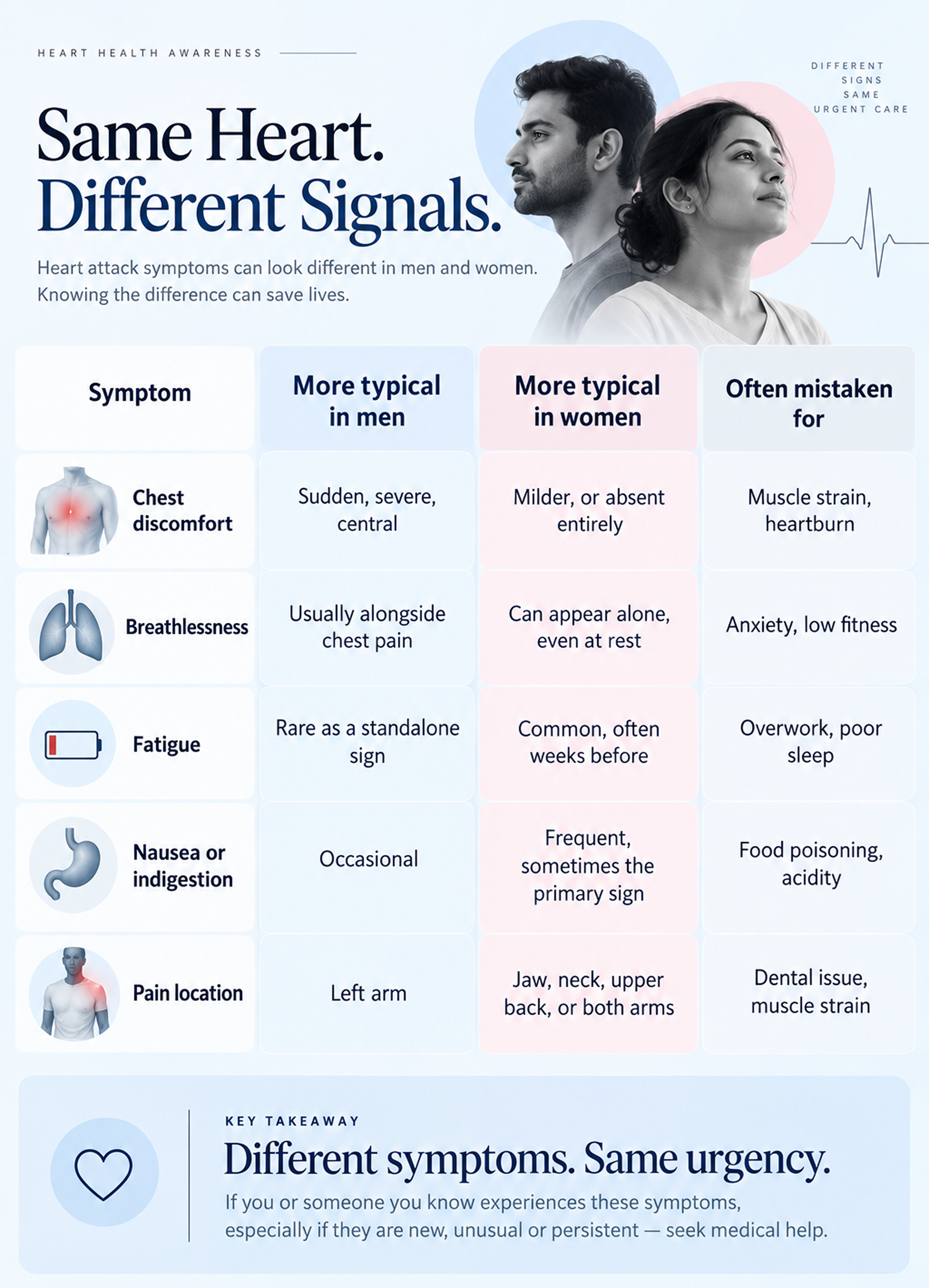
- Chest pain is common to both, but women are more likely to have it alongside, or instead of, breathlessness, unusual fatigue, nausea, or jaw and back discomfort.
- In one landmark study, fewer than 30% of women reported chest discomfort as an early warning sign before their heart attack, while over 70% reported unusual fatigue.
- The warning signs are being missed, and women with heart attacks are often diagnosed later because the recognition system, on all sides, was built around men.
Cardiovascular disease is the leading cause of death worldwide, responsible for roughly a third of all deaths globally, and it affects men and women in roughly equal measure, according to the WHO.
Yet how a heart attack shows up, and how quickly it gets caught, is still shaped by decades of research built largely around men's bodies.
The World Heart Federation notes that close to one in three deaths among women worldwide are caused by cardiovascular disease, and that women's symptoms are still too often overlooked or mistaken for anxiety.
That mismatch between what a heart attack is expected to look like and what it actually looks like in a woman's body isn't a minor detail. It's the reason so many warning signs are missed.
1. The Body: A Different Set Of Signals
Most people, including many clinicians, still picture a heart attack as sudden, crushing chest pain spreading down the left arm. That image holds up reasonably well for men.
For women, it's only part of the picture. A widely cited study published in the American Heart Association's journal followed women after a heart attack and found that fewer than 30% recalled chest discomfort as a warning sign in the weeks beforehand, and 43% experienced no chest pain at all during the actual event.
What did show up consistently: unusual fatigue in over 70% of cases, sleep disturbance in nearly half, and breathlessness in over 40%.
Indian research tells a similar story from a different angle. Studies on coronary artery disease in Indian women show they more often present with unstable angina or a non-ST-elevation heart attack, along with a higher likelihood of single-vessel disease. The underlying blockage is just as real. The presentation is simply different.
This is exactly the kind of pattern that's easy to miss in the moment and easy to explain away afterwards. Helius Wellness's Super ECG reads the heart's electrical, acoustic, and mechanical signals together, so shifts a person might not consciously notice can still be recorded and flagged early, well before an emergency.
The People: Why They Get Explained Away
Because women's symptoms rarely match the "clutch the chest" script, both patients and the people around them are slower to name what's actually happening.
A qualitative study of women describing their first heart attack found that most struggled to connect vague discomfort, fatigue, or breathlessness to a cardiac cause at all, and many tried to manage through it rather than seek help.
India-specific data shows how costly that delay can be.
A systematic review of coronary artery disease found the median time to reach a hospital after a heart attack was around six hours.
In a North Indian STEMI registry, women made up only 16% of the patient group, and the median time from symptom onset to diagnostic angiography across the full cohort was 71 hours, nearly three days.
Whether that specific delay runs longer for women is still being studied in India, but the broader pattern, one hesitation compounding another, holds consistently across the research.
The System: Why Clinicians Miss It Too
The gap isn't only in how women read their own bodies.
Research on gender differences in heart attack presentation in North India found that women tend to be older at diagnosis, carry a higher burden of diabetes and hypertension, and are more likely to be misdiagnosed simply because their presentation doesn't match the expected pattern.
Researchers have a name for the wider phenomenon: the "Yentl syndrome", the idea that women's symptoms are often taken seriously only once they resemble the male-pattern presentation clinicians are trained to look for.
The result is a chain of small delays: one symptom dismissed, one test not ordered early enough, one diagnosis reached later, that adds up to worse outcomes overall.
Closing The Gap
Closing this gap only requires a few deliberate shifts: describing symptoms precisely to a doctor rather than downplaying them.
New, unexplained fatigue is worth saying out loud; asking directly whether a symptom could be cardiac, especially alongside risk factors like diabetes, hypertension, or a family history; and treating persistent, unexplained symptoms as reason enough to get checked, chest pain or not.
On the clinical side, broader awareness of these differences among frontline doctors, and easier access to tools like Super ECG by Helius Wellness that catch irregular cardiac patterns early, both matter just as much. Recognition on every side of this gap saves time when it counts most.
Summary
A heart attack in a woman's body isn't a rarer or milder event. It's often just a differently represented warning.
The data is consistent enough now, from global health bodies down to India-specific hospital registries, that the outdated "clutch the chest" script shouldn't be the only one anyone is trained to recognise.
Reading the actual signs, in the body, around the body, and inside the system, is what turns a missed warning into a caught one.
FAQs
1. How are heart attack symptoms in women different from men?
Men more often report sudden, severe chest pain radiating to the left arm. Women are more likely to experience milder or absent chest pain alongside breathlessness, unusual fatigue, nausea, or discomfort in the jaw, neck, or back.
2. Can a heart attack feel like anxiety or indigestion in women?
Yes. Breathlessness, nausea, and a general sense of unease are commonly reported by women during a heart attack, and these are frequently mistaken for anxiety, acidity, or indigestion, which delays diagnosis.
3. Do women get left-arm pain during a heart attack?
Some do, but women are also more likely to feel discomfort in both arms, the jaw, the neck, or the upper back, rather than the classic single left-arm pain pattern seen in men.
4. Why are heart attacks in women diagnosed later than in men?
A combination of atypical symptoms, patients not connecting vague symptoms to the heart, and clinicians defaulting to male-pattern symptom checklists all contribute to delayed diagnosis and treatment in women.
5. What early warning signs appear before a heart attack in women?
Research shows unusual fatigue, sleep disturbance, and breathlessness are among the most common signs women report in the weeks before a heart attack, often well before any chest discomfort appears.






India’s first AI-powered NCD diagnostics network.
Follow Us


Helius Wellness 2026. All Rights Reserved
September 25, 2026
Heart Attack Symptoms in Women vs Men: Why the Warning Signs Are Often Missed
Heart attack symptoms in women often differ from men's, and that difference quietly costs lives. Here's why the warning signs get missed, and how to close the gap.
Author:
Paresh Masani
Key Takeaways
- Chest pain is common to both, but women are more likely to have it alongside, or instead of, breathlessness, unusual fatigue, nausea, or jaw and back discomfort.
- In one landmark study, fewer than 30% of women reported chest discomfort as an early warning sign before their heart attack, while over 70% reported unusual fatigue.
- The warning signs are being missed, and women with heart attacks are often diagnosed later because the recognition system, on all sides, was built around men.
Cardiovascular disease is the leading cause of death worldwide, responsible for roughly a third of all deaths globally, and it affects men and women in roughly equal measure, according to the WHO.
Yet how a heart attack shows up, and how quickly it gets caught, is still shaped by decades of research built largely around men's bodies.
The World Heart Federation notes that close to one in three deaths among women worldwide are caused by cardiovascular disease, and that women's symptoms are still too often overlooked or mistaken for anxiety.
That mismatch between what a heart attack is expected to look like and what it actually looks like in a woman's body isn't a minor detail. It's the reason so many warning signs are missed.
1. The Body: A Different Set Of Signals
Most people, including many clinicians, still picture a heart attack as sudden, crushing chest pain spreading down the left arm. That image holds up reasonably well for men.
For women, it's only part of the picture. A widely cited study published in the American Heart Association's journal followed women after a heart attack and found that fewer than 30% recalled chest discomfort as a warning sign in the weeks beforehand, and 43% experienced no chest pain at all during the actual event.
What did show up consistently: unusual fatigue in over 70% of cases, sleep disturbance in nearly half, and breathlessness in over 40%.
Indian research tells a similar story from a different angle. Studies on coronary artery disease in Indian women show they more often present with unstable angina or a non-ST-elevation heart attack, along with a higher likelihood of single-vessel disease. The underlying blockage is just as real. The presentation is simply different.
This is exactly the kind of pattern that's easy to miss in the moment and easy to explain away afterwards. Helius Wellness's Super ECG reads the heart's electrical, acoustic, and mechanical signals together, so shifts a person might not consciously notice can still be recorded and flagged early, well before an emergency.
The People: Why They Get Explained Away
Because women's symptoms rarely match the "clutch the chest" script, both patients and the people around them are slower to name what's actually happening.
A qualitative study of women describing their first heart attack found that most struggled to connect vague discomfort, fatigue, or breathlessness to a cardiac cause at all, and many tried to manage through it rather than seek help.
India-specific data shows how costly that delay can be.
A systematic review of coronary artery disease found the median time to reach a hospital after a heart attack was around six hours.
In a North Indian STEMI registry, women made up only 16% of the patient group, and the median time from symptom onset to diagnostic angiography across the full cohort was 71 hours, nearly three days.
Whether that specific delay runs longer for women is still being studied in India, but the broader pattern, one hesitation compounding another, holds consistently across the research.
The System: Why Clinicians Miss It Too
The gap isn't only in how women read their own bodies.
Research on gender differences in heart attack presentation in North India found that women tend to be older at diagnosis, carry a higher burden of diabetes and hypertension, and are more likely to be misdiagnosed simply because their presentation doesn't match the expected pattern.
Researchers have a name for the wider phenomenon: the "Yentl syndrome", the idea that women's symptoms are often taken seriously only once they resemble the male-pattern presentation clinicians are trained to look for.
The result is a chain of small delays: one symptom dismissed, one test not ordered early enough, one diagnosis reached later, that adds up to worse outcomes overall.
Closing The Gap
Closing this gap only requires a few deliberate shifts: describing symptoms precisely to a doctor rather than downplaying them.
New, unexplained fatigue is worth saying out loud; asking directly whether a symptom could be cardiac, especially alongside risk factors like diabetes, hypertension, or a family history; and treating persistent, unexplained symptoms as reason enough to get checked, chest pain or not.
On the clinical side, broader awareness of these differences among frontline doctors, and easier access to tools like Super ECG by Helius Wellness that catch irregular cardiac patterns early, both matter just as much. Recognition on every side of this gap saves time when it counts most.
Summary
A heart attack in a woman's body isn't a rarer or milder event. It's often just a differently represented warning.
The data is consistent enough now, from global health bodies down to India-specific hospital registries, that the outdated "clutch the chest" script shouldn't be the only one anyone is trained to recognise.
Reading the actual signs, in the body, around the body, and inside the system, is what turns a missed warning into a caught one.
FAQs
1. How are heart attack symptoms in women different from men?
Men more often report sudden, severe chest pain radiating to the left arm. Women are more likely to experience milder or absent chest pain alongside breathlessness, unusual fatigue, nausea, or discomfort in the jaw, neck, or back.
2. Can a heart attack feel like anxiety or indigestion in women?
Yes. Breathlessness, nausea, and a general sense of unease are commonly reported by women during a heart attack, and these are frequently mistaken for anxiety, acidity, or indigestion, which delays diagnosis.
3. Do women get left-arm pain during a heart attack?
Some do, but women are also more likely to feel discomfort in both arms, the jaw, the neck, or the upper back, rather than the classic single left-arm pain pattern seen in men.
4. Why are heart attacks in women diagnosed later than in men?
A combination of atypical symptoms, patients not connecting vague symptoms to the heart, and clinicians defaulting to male-pattern symptom checklists all contribute to delayed diagnosis and treatment in women.
5. What early warning signs appear before a heart attack in women?
Research shows unusual fatigue, sleep disturbance, and breathlessness are among the most common signs women report in the weeks before a heart attack, often well before any chest discomfort appears.
India’s first AI-powered NCD diagnostics network.
Helius Wellness 2026. All Rights Reserved
Follow Us
September 25, 2026
Heart Attack Symptoms in Women vs Men: Why the Warning Signs Are Often Missed
Heart attack symptoms in women often differ from men's, and that difference quietly costs lives. Here's why the warning signs get missed, and how to close the gap.
Author:
Paresh Masani
Key Takeaways
- Chest pain is common to both, but women are more likely to have it alongside, or instead of, breathlessness, unusual fatigue, nausea, or jaw and back discomfort.
- In one landmark study, fewer than 30% of women reported chest discomfort as an early warning sign before their heart attack, while over 70% reported unusual fatigue.
- The warning signs are being missed, and women with heart attacks are often diagnosed later because the recognition system, on all sides, was built around men.
Cardiovascular disease is the leading cause of death worldwide, responsible for roughly a third of all deaths globally, and it affects men and women in roughly equal measure, according to the WHO.
Yet how a heart attack shows up, and how quickly it gets caught, is still shaped by decades of research built largely around men's bodies.
The World Heart Federation notes that close to one in three deaths among women worldwide are caused by cardiovascular disease, and that women's symptoms are still too often overlooked or mistaken for anxiety.
That mismatch between what a heart attack is expected to look like and what it actually looks like in a woman's body isn't a minor detail. It's the reason so many warning signs are missed.
1. The Body: A Different Set Of Signals
Most people, including many clinicians, still picture a heart attack as sudden, crushing chest pain spreading down the left arm. That image holds up reasonably well for men.
For women, it's only part of the picture. A widely cited study published in the American Heart Association's journal followed women after a heart attack and found that fewer than 30% recalled chest discomfort as a warning sign in the weeks beforehand, and 43% experienced no chest pain at all during the actual event.
What did show up consistently: unusual fatigue in over 70% of cases, sleep disturbance in nearly half, and breathlessness in over 40%.
Indian research tells a similar story from a different angle. Studies on coronary artery disease in Indian women show they more often present with unstable angina or a non-ST-elevation heart attack, along with a higher likelihood of single-vessel disease. The underlying blockage is just as real. The presentation is simply different.
This is exactly the kind of pattern that's easy to miss in the moment and easy to explain away afterwards. Helius Wellness's Super ECG reads the heart's electrical, acoustic, and mechanical signals together, so shifts a person might not consciously notice can still be recorded and flagged early, well before an emergency.
The People: Why They Get Explained Away
Because women's symptoms rarely match the "clutch the chest" script, both patients and the people around them are slower to name what's actually happening.
A qualitative study of women describing their first heart attack found that most struggled to connect vague discomfort, fatigue, or breathlessness to a cardiac cause at all, and many tried to manage through it rather than seek help.
India-specific data shows how costly that delay can be.
A systematic review of coronary artery disease found the median time to reach a hospital after a heart attack was around six hours.
In a North Indian STEMI registry, women made up only 16% of the patient group, and the median time from symptom onset to diagnostic angiography across the full cohort was 71 hours, nearly three days.
Whether that specific delay runs longer for women is still being studied in India, but the broader pattern, one hesitation compounding another, holds consistently across the research.
The System: Why Clinicians Miss It Too
The gap isn't only in how women read their own bodies.
Research on gender differences in heart attack presentation in North India found that women tend to be older at diagnosis, carry a higher burden of diabetes and hypertension, and are more likely to be misdiagnosed simply because their presentation doesn't match the expected pattern.
Researchers have a name for the wider phenomenon: the "Yentl syndrome", the idea that women's symptoms are often taken seriously only once they resemble the male-pattern presentation clinicians are trained to look for.
The result is a chain of small delays: one symptom dismissed, one test not ordered early enough, one diagnosis reached later, that adds up to worse outcomes overall.
Closing The Gap
Closing this gap only requires a few deliberate shifts: describing symptoms precisely to a doctor rather than downplaying them.
New, unexplained fatigue is worth saying out loud; asking directly whether a symptom could be cardiac, especially alongside risk factors like diabetes, hypertension, or a family history; and treating persistent, unexplained symptoms as reason enough to get checked, chest pain or not.
On the clinical side, broader awareness of these differences among frontline doctors, and easier access to tools like Super ECG by Helius Wellness that catch irregular cardiac patterns early, both matter just as much. Recognition on every side of this gap saves time when it counts most.
Summary
A heart attack in a woman's body isn't a rarer or milder event. It's often just a differently represented warning.
The data is consistent enough now, from global health bodies down to India-specific hospital registries, that the outdated "clutch the chest" script shouldn't be the only one anyone is trained to recognise.
Reading the actual signs, in the body, around the body, and inside the system, is what turns a missed warning into a caught one.
FAQs
1. How are heart attack symptoms in women different from men?
Men more often report sudden, severe chest pain radiating to the left arm. Women are more likely to experience milder or absent chest pain alongside breathlessness, unusual fatigue, nausea, or discomfort in the jaw, neck, or back.
2. Can a heart attack feel like anxiety or indigestion in women?
Yes. Breathlessness, nausea, and a general sense of unease are commonly reported by women during a heart attack, and these are frequently mistaken for anxiety, acidity, or indigestion, which delays diagnosis.
3. Do women get left-arm pain during a heart attack?
Some do, but women are also more likely to feel discomfort in both arms, the jaw, the neck, or the upper back, rather than the classic single left-arm pain pattern seen in men.
4. Why are heart attacks in women diagnosed later than in men?
A combination of atypical symptoms, patients not connecting vague symptoms to the heart, and clinicians defaulting to male-pattern symptom checklists all contribute to delayed diagnosis and treatment in women.
5. What early warning signs appear before a heart attack in women?
Research shows unusual fatigue, sleep disturbance, and breathlessness are among the most common signs women report in the weeks before a heart attack, often well before any chest discomfort appears.

India’s first AI-powered NCD diagnostics network.
Helius Wellness 2026. All Rights Reserved
Follow Us