

October 30, 2026
AFib and Stroke: The Irregular Heartbeat You Might Not Feel
Many people with atrial fibrillation feel nothing, yet their stroke risk is real. Learn why AFib can be silent and how an ECG helps your doctor detect it.
Author:
Paresh Masani
Key Takeaways
- AFib is an irregular heart rhythm that raises stroke risk about five times.
- Many people with AFib feel no symptoms at all.
- Feeling fine does not mean your stroke risk is low.
- An ECG, reviewed by a doctor, is how AFib is confirmed.
Most of us assume a serious heart problem would make itself known: a pounding chest or something impossible to ignore. Atrial fibrillation (AFib), the most common irregular heartbeat, often breaks that rule. In a large European registry, two-thirds of patients newly diagnosed with AFib in Western Europe had no symptoms at all.
That silence matters, because AFib is a major cause of stroke, and stroke is anything but quiet. According to the World Stroke Organisation, there are almost 12 million new strokes worldwide each year. This World Stroke Day, October 29, 2026, let’s explore why your heart can beat irregularly without you noticing, and what that means for your stroke risk.
What Is Atrial Fibrillation?
Atrial fibrillation is a heart rhythm disorder in which the heart’s upper chambers beat chaotically instead of in a steady pattern.
Your heart has four chambers. Normally, an electrical signal moves through them in a neat sequence: the upper chambers (atria) squeeze first, then the lower chambers (ventricles) follow. In AFib, this organised signal is replaced by disorganised electrical activity, so the atria quiver rather than contract normally.
Your heart keeps pumping too, just out of rhythm. AFib can come and go in short episodes or stay constant.
Why Can’t You Feel AFib?
You may not feel AFib because an irregular rhythm doesn’t always change your heartbeat enough to cause noticeable sensations. Doctors point to several reasons:
- The pace may stay moderate. Palpitations are often felt when the heart races. If the lower chambers keep a fairly normal pace, nothing may feel wrong.
- Episodes can be brief or happen during sleep. An episode lasting minutes, or one that happens at night, can pass unnoticed.
- Mild signs get explained away. Tiredness or breathlessness on the stairs is easy to blame on age, stress, or a busy week.
- The body adjusts. When an irregular rhythm has been present for a long time, people often stop noticing it.
Research supports how common this is. In a study of nearly 2,600 pacemaker patients with no history of AFib, more than one-third had episodes of rapid, irregular heartbeat, and in 85 per cent of these patients the episodes caused no symptoms.
How Does AFib Lead to a Stroke?
AFib leads to stroke when blood pools in the quivering heart, forms a clot, and that clot travels to the brain.
When the atria quiver instead of squeezing, blood is not fully pushed out. Clots most often form in a small pouch of the left atrium called the left atrial appendage, and if a clot travels to the brain, it can cause a stroke.
The numbers are striking. People with non-valvular AFib have a fivefold higher stroke risk than people without it. For people aged 75 and above, AFib is the leading cause of stroke.
Silent AFib vs. Symptomatic AFib: Is One Safer?
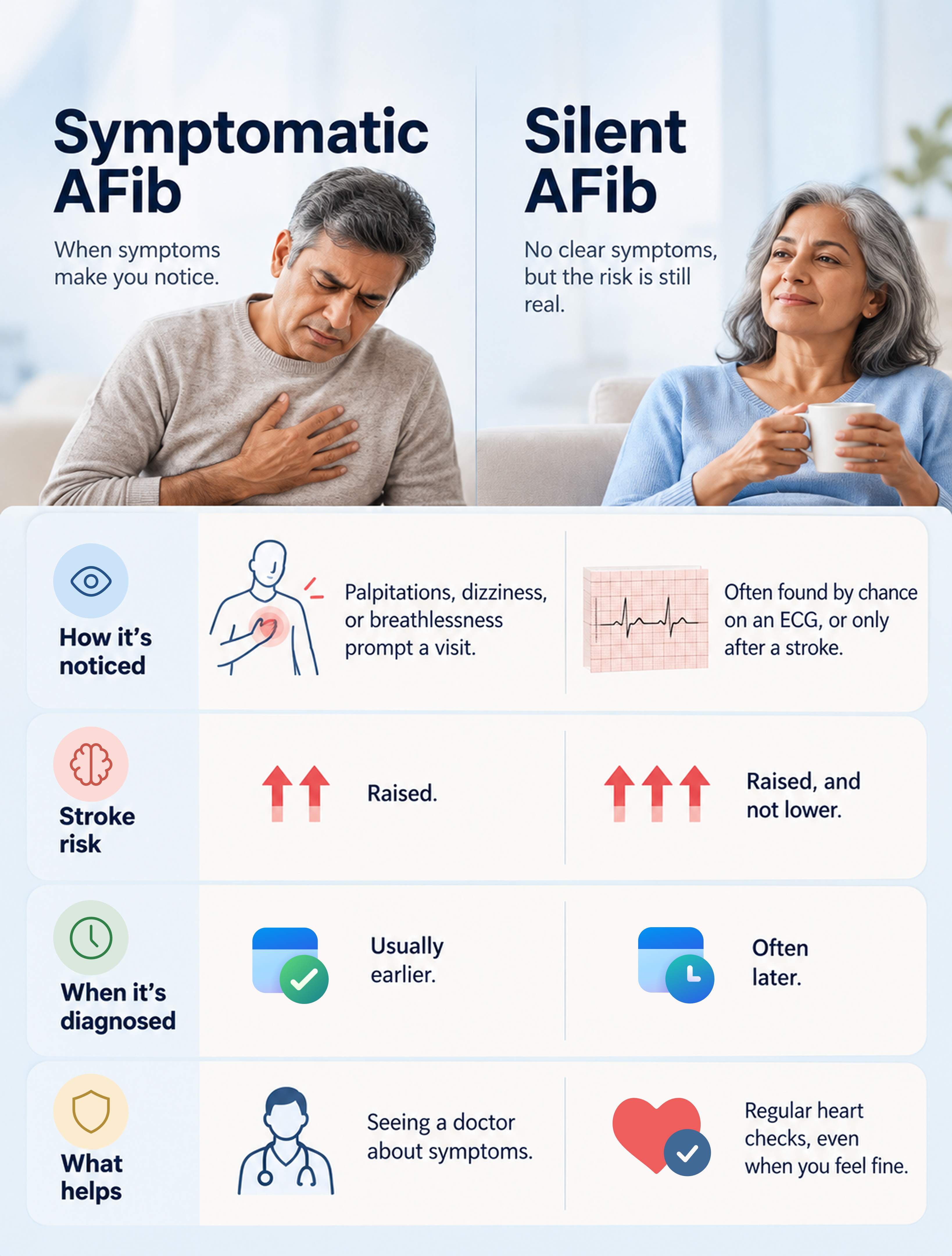
No. Silent AFib is not safer than AFib you can feel, and it may be riskier because it goes unnoticed for longer.
In the same European registry, patients without symptoms were more than twice as likely to have already had a stroke (14.7% vs 6.0%) as patients with symptoms, even though both groups had similar stroke risk factors. Researchers suggested this may reflect a longer stretch of undiagnosed AFib. For many people, a stroke is the first sign that they had AFib.
Feeling fine but have risk factors?
A Super ECG at Helius Wellness records your heart’s electrical rhythm so your doctor has clear information to review.
How Is Silent AFib Detected?
AFib is confirmed with an electrocardiogram (ECG), a quick, painless test that records your heart’s electrical activity, which a doctor then interprets.
Silent AFib is usually found in one of these ways: a doctor notices an irregular pulse during a routine check, a resting ECG captures the rhythm, longer monitoring catches episodes that come and go, or a smartwatch flags an irregular rhythm.
Wearables can be useful, but they support doctors rather than replace them. Many smartwatches can record a short ECG that you can send to your doctor, but this is never a substitute for direct medical advice. Treat an alert as a reason to book an appointment, not as a diagnosis.
Consider asking your doctor about a heart rhythm check if you are over 65, or have high blood pressure, diabetes, heart disease, or a history of stroke or mini-stroke.
Got a smartwatch alert or an irregular pulse? Don’t guess.
Schedule a Super ECG with Helius Wellness and share the results with your doctor for an expert review.
What Happens After AFib Is Found?
Once AFib is detected, doctors can take effective steps to lower stroke risk. AFib is one of the major treatable risk factors for stroke, and effective therapies reduce stroke risk by more than 70%.
Your doctor will assess your personal risk and recommend a plan suited to you. Never start or stop any medicine without medical advice.
World Stroke Day 2026: Know the Signs and Act FAST
This year’s World Stroke Organisation campaign focuses on recognising stroke symptoms and the need to #ActFAST in seeking emergency care.
Remember FAST:
- Face drooping
- Arm weakness
- Speech difficulty
- Time to call emergency services immediately
Summary
AFib is common, often silent, and closely linked to stroke. The encouraging part is that it can be found with a simple ECG, and once a doctor knows about it, stroke risk can be lowered significantly. This World Stroke Day, don’t wait for a symptom that may never come.
Take the first step this World Stroke Day.
Explore Helius Wellness heart health services or book your Super ECG, and give your doctor the information they need to protect your heart and brain.
Frequently Asked Questions
1. Can you have AFib and not know it?
Yes. Many people with AFib have no symptoms, and it is often discovered during a routine check or ECG.
2. Does silent AFib still cause strokes?
Yes. Silent AFib carries stroke risk, and it may go undetected for longer than AFib with symptoms.
3. Can a smartwatch diagnose AFib?
No. A smartwatch can flag a possible irregular rhythm, but only a doctor can confirm AFib, usually with an ECG.
4. Who should get checked for AFib?
People over 65 and those with high blood pressure, diabetes, heart disease, or a past stroke should ask their doctor about a heart rhythm check.







India’s first AI-powered NCD diagnostics network.
Follow Us


Helius Wellness 2026. All Rights Reserved
October 30, 2026
AFib and Stroke: The Irregular Heartbeat You Might Not Feel
Many people with atrial fibrillation feel nothing, yet their stroke risk is real. Learn why AFib can be silent and how an ECG helps your doctor detect it.
Author:
Paresh Masani
Key Takeaways
- AFib is an irregular heart rhythm that raises stroke risk about five times.
- Many people with AFib feel no symptoms at all.
- Feeling fine does not mean your stroke risk is low.
- An ECG, reviewed by a doctor, is how AFib is confirmed.
Most of us assume a serious heart problem would make itself known: a pounding chest or something impossible to ignore. Atrial fibrillation (AFib), the most common irregular heartbeat, often breaks that rule. In a large European registry, two-thirds of patients newly diagnosed with AFib in Western Europe had no symptoms at all.
That silence matters, because AFib is a major cause of stroke, and stroke is anything but quiet. According to the World Stroke Organisation, there are almost 12 million new strokes worldwide each year. This World Stroke Day, October 29, 2026, let’s explore why your heart can beat irregularly without you noticing, and what that means for your stroke risk.
What Is Atrial Fibrillation?
Atrial fibrillation is a heart rhythm disorder in which the heart’s upper chambers beat chaotically instead of in a steady pattern.
Your heart has four chambers. Normally, an electrical signal moves through them in a neat sequence: the upper chambers (atria) squeeze first, then the lower chambers (ventricles) follow. In AFib, this organised signal is replaced by disorganised electrical activity, so the atria quiver rather than contract normally.
Your heart keeps pumping too, just out of rhythm. AFib can come and go in short episodes or stay constant.
Why Can’t You Feel AFib?
You may not feel AFib because an irregular rhythm doesn’t always change your heartbeat enough to cause noticeable sensations. Doctors point to several reasons:
- The pace may stay moderate. Palpitations are often felt when the heart races. If the lower chambers keep a fairly normal pace, nothing may feel wrong.
- Episodes can be brief or happen during sleep. An episode lasting minutes, or one that happens at night, can pass unnoticed.
- Mild signs get explained away. Tiredness or breathlessness on the stairs is easy to blame on age, stress, or a busy week.
- The body adjusts. When an irregular rhythm has been present for a long time, people often stop noticing it.
Research supports how common this is. In a study of nearly 2,600 pacemaker patients with no history of AFib, more than one-third had episodes of rapid, irregular heartbeat, and in 85 per cent of these patients the episodes caused no symptoms.
How Does AFib Lead to a Stroke?
AFib leads to stroke when blood pools in the quivering heart, forms a clot, and that clot travels to the brain.
When the atria quiver instead of squeezing, blood is not fully pushed out. Clots most often form in a small pouch of the left atrium called the left atrial appendage, and if a clot travels to the brain, it can cause a stroke.
The numbers are striking. People with non-valvular AFib have a fivefold higher stroke risk than people without it. For people aged 75 and above, AFib is the leading cause of stroke.
Silent AFib vs. Symptomatic AFib: Is One Safer?
No. Silent AFib is not safer than AFib you can feel, and it may be riskier because it goes unnoticed for longer.
In the same European registry, patients without symptoms were more than twice as likely to have already had a stroke (14.7% vs 6.0%) as patients with symptoms, even though both groups had similar stroke risk factors. Researchers suggested this may reflect a longer stretch of undiagnosed AFib. For many people, a stroke is the first sign that they had AFib.
Feeling fine but have risk factors?
A Super ECG at Helius Wellness records your heart’s electrical rhythm so your doctor has clear information to review.
How Is Silent AFib Detected?
AFib is confirmed with an electrocardiogram (ECG), a quick, painless test that records your heart’s electrical activity, which a doctor then interprets.
Silent AFib is usually found in one of these ways: a doctor notices an irregular pulse during a routine check, a resting ECG captures the rhythm, longer monitoring catches episodes that come and go, or a smartwatch flags an irregular rhythm.
Wearables can be useful, but they support doctors rather than replace them. Many smartwatches can record a short ECG that you can send to your doctor, but this is never a substitute for direct medical advice. Treat an alert as a reason to book an appointment, not as a diagnosis.
Consider asking your doctor about a heart rhythm check if you are over 65, or have high blood pressure, diabetes, heart disease, or a history of stroke or mini-stroke.
Got a smartwatch alert or an irregular pulse? Don’t guess.
Schedule a Super ECG with Helius Wellness and share the results with your doctor for an expert review.
What Happens After AFib Is Found?
Once AFib is detected, doctors can take effective steps to lower stroke risk. AFib is one of the major treatable risk factors for stroke, and effective therapies reduce stroke risk by more than 70%.
Your doctor will assess your personal risk and recommend a plan suited to you. Never start or stop any medicine without medical advice.
World Stroke Day 2026: Know the Signs and Act FAST
This year’s World Stroke Organisation campaign focuses on recognising stroke symptoms and the need to #ActFAST in seeking emergency care.
Remember FAST:
- Face drooping
- Arm weakness
- Speech difficulty
- Time to call emergency services immediately
Summary
AFib is common, often silent, and closely linked to stroke. The encouraging part is that it can be found with a simple ECG, and once a doctor knows about it, stroke risk can be lowered significantly. This World Stroke Day, don’t wait for a symptom that may never come.
Take the first step this World Stroke Day.
Explore Helius Wellness heart health services or book your Super ECG, and give your doctor the information they need to protect your heart and brain.
Frequently Asked Questions
1. Can you have AFib and not know it?
Yes. Many people with AFib have no symptoms, and it is often discovered during a routine check or ECG.
2. Does silent AFib still cause strokes?
Yes. Silent AFib carries stroke risk, and it may go undetected for longer than AFib with symptoms.
3. Can a smartwatch diagnose AFib?
No. A smartwatch can flag a possible irregular rhythm, but only a doctor can confirm AFib, usually with an ECG.
4. Who should get checked for AFib?
People over 65 and those with high blood pressure, diabetes, heart disease, or a past stroke should ask their doctor about a heart rhythm check.
India’s first AI-powered NCD diagnostics network.
Helius Wellness 2026. All Rights Reserved
Follow Us
October 30, 2026
AFib and Stroke: The Irregular Heartbeat You Might Not Feel
Many people with atrial fibrillation feel nothing, yet their stroke risk is real. Learn why AFib can be silent and how an ECG helps your doctor detect it.
Author:
Paresh Masani
Key Takeaways
- AFib is an irregular heart rhythm that raises stroke risk about five times.
- Many people with AFib feel no symptoms at all.
- Feeling fine does not mean your stroke risk is low.
- An ECG, reviewed by a doctor, is how AFib is confirmed.
Most of us assume a serious heart problem would make itself known: a pounding chest or something impossible to ignore. Atrial fibrillation (AFib), the most common irregular heartbeat, often breaks that rule. In a large European registry, two-thirds of patients newly diagnosed with AFib in Western Europe had no symptoms at all.
That silence matters, because AFib is a major cause of stroke, and stroke is anything but quiet. According to the World Stroke Organisation, there are almost 12 million new strokes worldwide each year. This World Stroke Day, October 29, 2026, let’s explore why your heart can beat irregularly without you noticing, and what that means for your stroke risk.
What Is Atrial Fibrillation?
Atrial fibrillation is a heart rhythm disorder in which the heart’s upper chambers beat chaotically instead of in a steady pattern.
Your heart has four chambers. Normally, an electrical signal moves through them in a neat sequence: the upper chambers (atria) squeeze first, then the lower chambers (ventricles) follow. In AFib, this organised signal is replaced by disorganised electrical activity, so the atria quiver rather than contract normally.
Your heart keeps pumping too, just out of rhythm. AFib can come and go in short episodes or stay constant.
Why Can’t You Feel AFib?
You may not feel AFib because an irregular rhythm doesn’t always change your heartbeat enough to cause noticeable sensations. Doctors point to several reasons:
- The pace may stay moderate. Palpitations are often felt when the heart races. If the lower chambers keep a fairly normal pace, nothing may feel wrong.
- Episodes can be brief or happen during sleep. An episode lasting minutes, or one that happens at night, can pass unnoticed.
- Mild signs get explained away. Tiredness or breathlessness on the stairs is easy to blame on age, stress, or a busy week.
- The body adjusts. When an irregular rhythm has been present for a long time, people often stop noticing it.
Research supports how common this is. In a study of nearly 2,600 pacemaker patients with no history of AFib, more than one-third had episodes of rapid, irregular heartbeat, and in 85 per cent of these patients the episodes caused no symptoms.
How Does AFib Lead to a Stroke?
AFib leads to stroke when blood pools in the quivering heart, forms a clot, and that clot travels to the brain.
When the atria quiver instead of squeezing, blood is not fully pushed out. Clots most often form in a small pouch of the left atrium called the left atrial appendage, and if a clot travels to the brain, it can cause a stroke.
The numbers are striking. People with non-valvular AFib have a fivefold higher stroke risk than people without it. For people aged 75 and above, AFib is the leading cause of stroke.
Silent AFib vs. Symptomatic AFib: Is One Safer?
No. Silent AFib is not safer than AFib you can feel, and it may be riskier because it goes unnoticed for longer.
In the same European registry, patients without symptoms were more than twice as likely to have already had a stroke (14.7% vs 6.0%) as patients with symptoms, even though both groups had similar stroke risk factors. Researchers suggested this may reflect a longer stretch of undiagnosed AFib. For many people, a stroke is the first sign that they had AFib.
Feeling fine but have risk factors?
A Super ECG at Helius Wellness records your heart’s electrical rhythm so your doctor has clear information to review.
How Is Silent AFib Detected?
AFib is confirmed with an electrocardiogram (ECG), a quick, painless test that records your heart’s electrical activity, which a doctor then interprets.
Silent AFib is usually found in one of these ways: a doctor notices an irregular pulse during a routine check, a resting ECG captures the rhythm, longer monitoring catches episodes that come and go, or a smartwatch flags an irregular rhythm.
Wearables can be useful, but they support doctors rather than replace them. Many smartwatches can record a short ECG that you can send to your doctor, but this is never a substitute for direct medical advice. Treat an alert as a reason to book an appointment, not as a diagnosis.
Consider asking your doctor about a heart rhythm check if you are over 65, or have high blood pressure, diabetes, heart disease, or a history of stroke or mini-stroke.
Got a smartwatch alert or an irregular pulse? Don’t guess.
Schedule a Super ECG with Helius Wellness and share the results with your doctor for an expert review.
What Happens After AFib Is Found?
Once AFib is detected, doctors can take effective steps to lower stroke risk. AFib is one of the major treatable risk factors for stroke, and effective therapies reduce stroke risk by more than 70%.
Your doctor will assess your personal risk and recommend a plan suited to you. Never start or stop any medicine without medical advice.
World Stroke Day 2026: Know the Signs and Act FAST
This year’s World Stroke Organisation campaign focuses on recognising stroke symptoms and the need to #ActFAST in seeking emergency care.
Remember FAST:
- Face drooping
- Arm weakness
- Speech difficulty
- Time to call emergency services immediately
Summary
AFib is common, often silent, and closely linked to stroke. The encouraging part is that it can be found with a simple ECG, and once a doctor knows about it, stroke risk can be lowered significantly. This World Stroke Day, don’t wait for a symptom that may never come.
Take the first step this World Stroke Day.
Explore Helius Wellness heart health services or book your Super ECG, and give your doctor the information they need to protect your heart and brain.
Frequently Asked Questions
1. Can you have AFib and not know it?
Yes. Many people with AFib have no symptoms, and it is often discovered during a routine check or ECG.
2. Does silent AFib still cause strokes?
Yes. Silent AFib carries stroke risk, and it may go undetected for longer than AFib with symptoms.
3. Can a smartwatch diagnose AFib?
No. A smartwatch can flag a possible irregular rhythm, but only a doctor can confirm AFib, usually with an ECG.
4. Who should get checked for AFib?
People over 65 and those with high blood pressure, diabetes, heart disease, or a past stroke should ask their doctor about a heart rhythm check.

India’s first AI-powered NCD diagnostics network.
Helius Wellness 2026. All Rights Reserved
Follow Us