

August 27, 2026
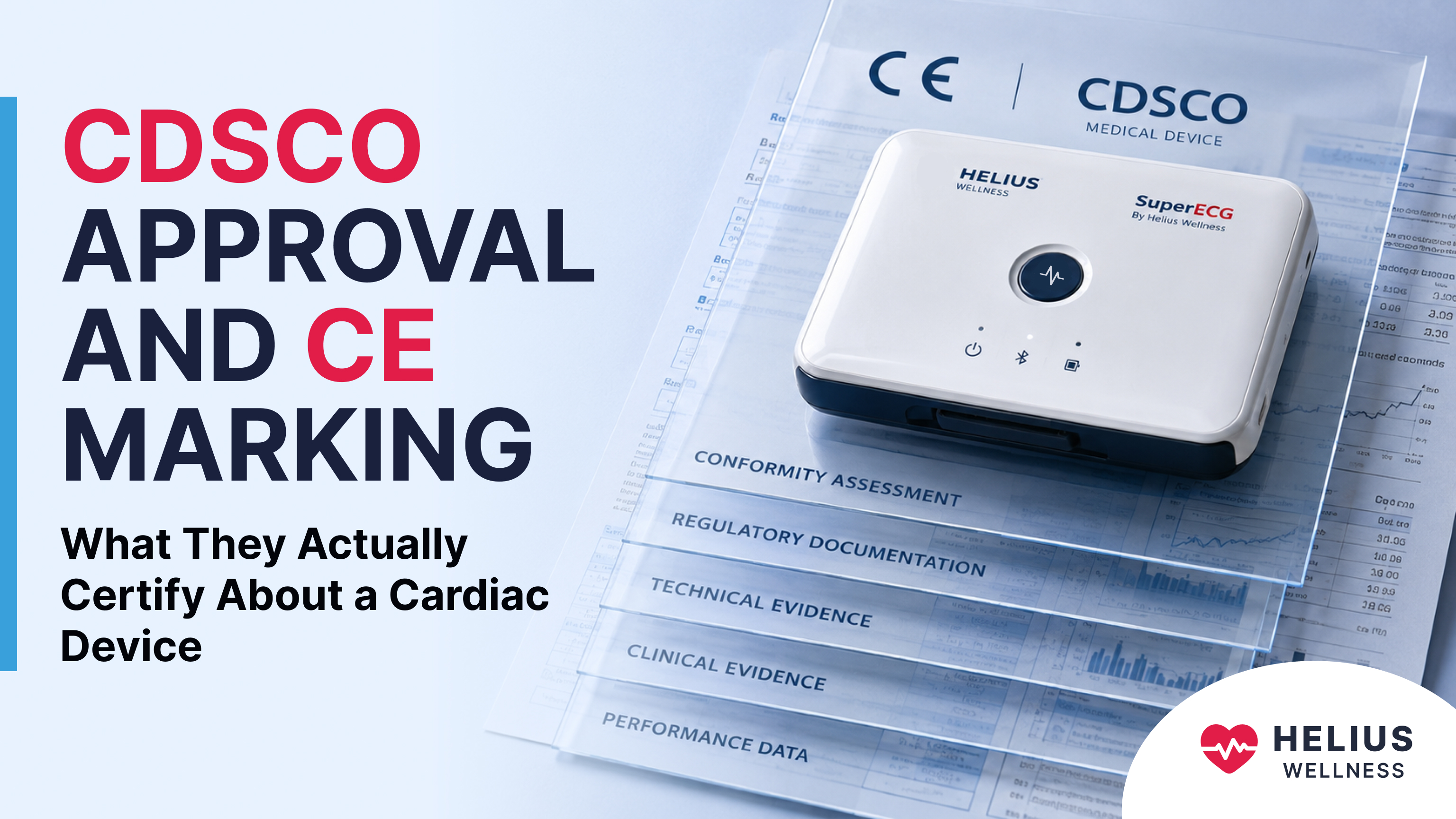
CDSCO Approval and CE Marking: What They Actually Certify About a Cardiac Device
CDSCO approval and CE marking are different. Here's a guide to what each certifies about a cardiac device and what to ask beyond the logo.
Author:
Paresh Masani
Key Takeaways
- CE marking = a conformity declaration, verified for high-risk devices by a private notified body, not a government endorsement.
- CDSCO approval = legal permission to import, manufacture, or sell a device in India, issued under the Medical Devices Rules, 2017.
- Cardiac devices are almost always Class C or D, India's highest risk tiers, licensed centrally.
- The two marks are often linked; a CE certificate is frequently the input to the Indian file, not a second independent check.
- Ask three questions: which class, which certificate, which evidence.
You've seen the line on a pitch deck or a product page: "CE Marked | CDSCO Approved." Two logos, one sentence, and an implied promise that some serious authority has vetted this device twice.
For a cardiac device, that assumption deserves scrutiny. These two credentials answer genuinely different questions, and knowing the difference is the single most useful thing an investor, a hospital buyer, or a patient can learn about medical device regulation. Here's what each one really means and the three questions that cut through the logo.
Table of Contents
1. Two Certificates, Two Different Questions
2. Where Cardiac Devices Sit in The Risk Hierarchy
3. The Part Almost Nobody Explains: How The Two Are Connected
4. What Neither Mark Tells You
5. Three Essential Questions
6. Approval Is the Starting Line, Not the Finish
7. FAQs
Two Certificates, Two Different Questions
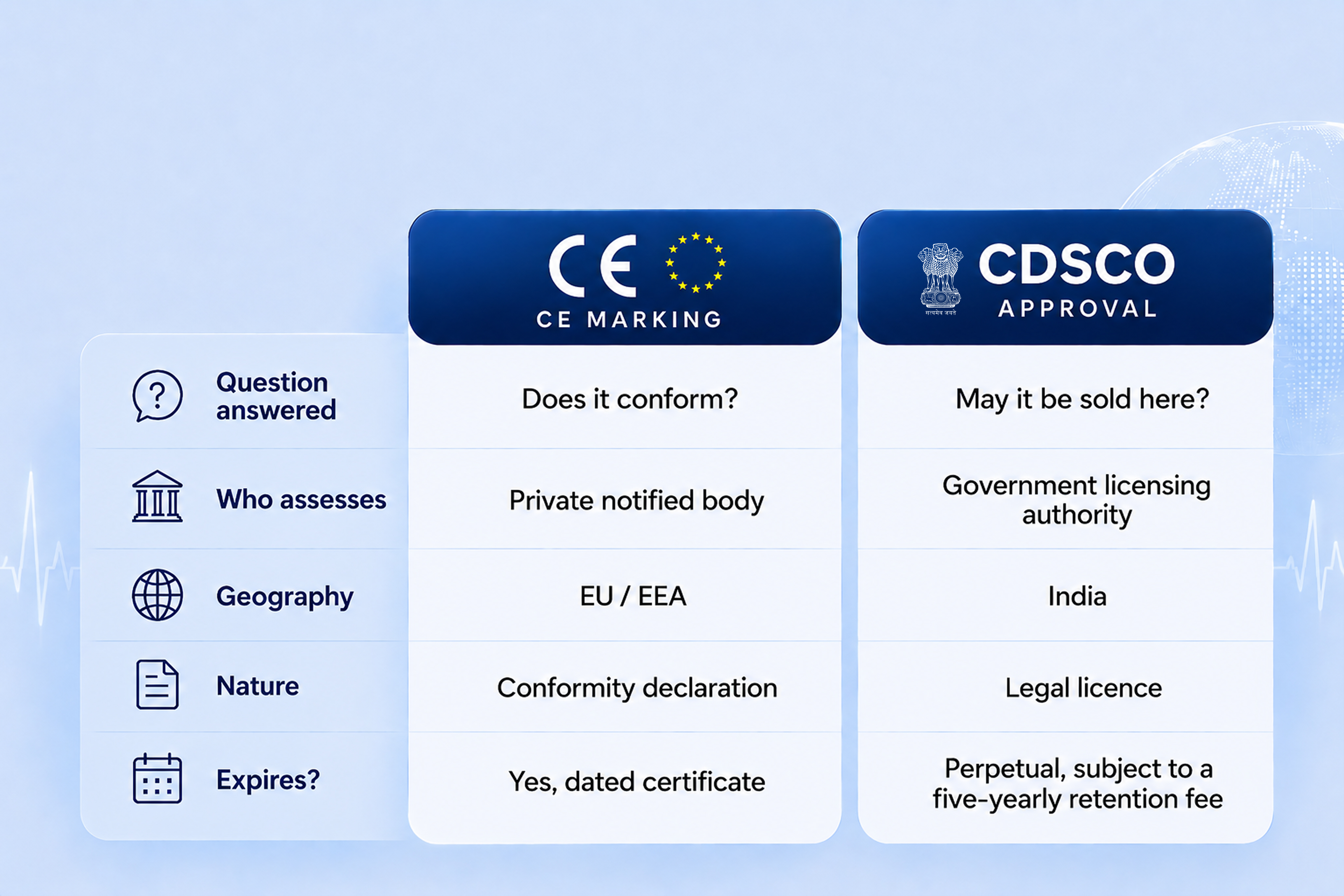
CE marking answers: Does this device conform to a standard?
A CE mark is a manufacturer's declaration that a device meets EU safety and performance requirements. For higher-risk devices, that declaration is verified by a notified body, a private, accredited organisation, not a government agency. It's a market-access passport for Europe. It is not a state seal of approval, and it is not a clinical recommendation.
CDSCO approval answers: May this device be legally sold in India?
The Central Drugs Standard Control Organisation, under the Ministry of Health & Family Welfare, is India's National Regulatory Authority. Approval means a licence has been granted under the Medical Devices Rules, 2017, the framework that replaced drug-era rules with device-specific ones. No Class C or D device can be manufactured, imported or sold in India without it; unregistered trade can trigger seizure or prosecution under the Drugs and Cosmetics Act.
Where Cardiac Devices Sit in The Risk Hierarchy
India uses a four-class, risk-based system. Cardiac devices cluster at the top. Class D, the highest-risk tier, includes cardiac pacemakers, heart valves and coronary stents, and the Central Licensing Authority headed by the Drugs Controller General of India handles imports of all classes and manufacturing of Class C and D devices.
This matters more than it sounds. "CDSCO registered" is a meaningful phrase for a Class D implant and a near-trivial one for a Class A thermometer. The class is the information. Always ask which one.
The Part Almost Nobody Explains: How The Two Are Connected
Here's the insight that separates informed diligence from logo-counting.
India's rules allow an abridged review pathway when a device already holds approval in a reference regulatory jurisdiction: the EU, US, Japan, Australia, Canada. In practice, that means a CE certificate is often the foundation of the Indian submission rather than an independent second opinion. Two logos on a slide may represent one body of evidence, reviewed once and recognised twice.
Then there's the second layer: not all CE marks are equal.
Certificates issued under the older Medical Device Directive were held to a lighter evidentiary standard than the EU Medical Device Regulation that replaced it, and legacy certificates have been allowed to persist for years.
Regulation (EU) 2023/607 automatically extended certificates valid on 26 May 2021, permitting Class III and Class IIb devices to remain on the market until 31 December 2027, and most other classes until 31 December 2028. The reason was blunt: 21,376 products held directive-era certificates expiring by May 2024, while notified bodies estimated they could issue only around 7,000 MDR certificates in that window.
So "CE marked" without a regulation, a notified body number, and an expiry date is an incomplete claim, not a false one, just an unfinished one.
What Neither Mark Tells You
Neither guarantees performance in Indian patients.
This is not academic. Cardiovascular disease is the leading cause of mortality in India, and while only 23% of CVD deaths in Western populations occur before age 70, in India that figure is 52%.
India's age-standardised CVD death rate of 272 per 100,000 exceeds the global average of 235. Devices validated in older European cohorts are being deployed in a population that is younger and dies faster.
Neither is permanent.
Certificates lapse, get suspended, get withdrawn.
Post-market safety data is thinner than the paperwork suggests. Under the Materiovigilance Programme of India, launched in July 2015, 174 monitoring centres report adverse events on a purely voluntary basis.
Between July 2015 and October 2019, roughly 1,931 adverse event reports were received. As recently as this year, the Indian Pharmacopoeia Commission wrote to device firms noting that under-reporting remains a matter of concern, limiting the completeness of national data.
A clean safety record can mean a safe device. It can also mean nobody filed.
Three Essential Questions
- Which class, and which licensing authority? A centrally licensed Class D approval is a materially higher bar than a state-issued Class B one.
- Which regulation, which notified body, which expiry? Ask for the certificate, not the logo. MDR-issued outranks legacy MDD-issued.
- What evidence is Indian? Was clinical investigation conducted here, waived on foreign data, or is there registry follow-up in Indian patients?
Approval Is the Starting Line, Not the Finish
Regulatory marks tell you a device cleared a minimum legal bar. They do not tell you it is the best device, the right device, or the device with the strongest evidence in people who look like you.
The organisations worth trusting are the ones that volunteer their class, certificate number, and evidence base before anyone asks and that treat regulatory clearance as the starting line rather than the finish.
Super ECG by Helius Wellness is CDSCO- and CE-certified.
FAQs
1. Is CE marking a government approval?
No. It is a conformity declaration, verified for higher-risk devices by a private notified body, not a state agency.
2. Does CDSCO approval mean a device is proven safe?
It means the device met licensing requirements. It is a legal permission, not a clinical guarantee or a performance ranking.
3. Can a device be CE marked but not legally sold in India?
Yes. Class C and D devices require CDSCO registration before manufacture, import, or sale in India; a CE mark alone is not sufficient.
4. Which class are cardiac devices in India?
Pacemakers, heart valves, and coronary stents fall under Class D, the highest-risk category.






India’s first AI-powered NCD diagnostics network.
Follow Us


Helius Wellness 2026. All Rights Reserved
August 27, 2026
CDSCO Approval and CE Marking: What They Actually Certify About a Cardiac Device
CDSCO approval and CE marking are different. Here's a guide to what each certifies about a cardiac device and what to ask beyond the logo.
Author:
Paresh Masani
Key Takeaways
- CE marking = a conformity declaration, verified for high-risk devices by a private notified body, not a government endorsement.
- CDSCO approval = legal permission to import, manufacture, or sell a device in India, issued under the Medical Devices Rules, 2017.
- Cardiac devices are almost always Class C or D, India's highest risk tiers, licensed centrally.
- The two marks are often linked; a CE certificate is frequently the input to the Indian file, not a second independent check.
- Ask three questions: which class, which certificate, which evidence.
You've seen the line on a pitch deck or a product page: "CE Marked | CDSCO Approved." Two logos, one sentence, and an implied promise that some serious authority has vetted this device twice.
For a cardiac device, that assumption deserves scrutiny. These two credentials answer genuinely different questions, and knowing the difference is the single most useful thing an investor, a hospital buyer, or a patient can learn about medical device regulation. Here's what each one really means and the three questions that cut through the logo.
Table of Contents
1. Two Certificates, Two Different Questions
2. Where Cardiac Devices Sit in The Risk Hierarchy
3. The Part Almost Nobody Explains: How The Two Are Connected
4. What Neither Mark Tells You
5. Three Essential Questions
6. Approval Is the Starting Line, Not the Finish
7. FAQs
Two Certificates, Two Different Questions
CE marking answers: Does this device conform to a standard?
A CE mark is a manufacturer's declaration that a device meets EU safety and performance requirements. For higher-risk devices, that declaration is verified by a notified body, a private, accredited organisation, not a government agency. It's a market-access passport for Europe. It is not a state seal of approval, and it is not a clinical recommendation.
CDSCO approval answers: May this device be legally sold in India?
The Central Drugs Standard Control Organisation, under the Ministry of Health & Family Welfare, is India's National Regulatory Authority. Approval means a licence has been granted under the Medical Devices Rules, 2017, the framework that replaced drug-era rules with device-specific ones. No Class C or D device can be manufactured, imported or sold in India without it; unregistered trade can trigger seizure or prosecution under the Drugs and Cosmetics Act.
Where Cardiac Devices Sit in The Risk Hierarchy
India uses a four-class, risk-based system. Cardiac devices cluster at the top. Class D, the highest-risk tier, includes cardiac pacemakers, heart valves and coronary stents, and the Central Licensing Authority headed by the Drugs Controller General of India handles imports of all classes and manufacturing of Class C and D devices.
This matters more than it sounds. "CDSCO registered" is a meaningful phrase for a Class D implant and a near-trivial one for a Class A thermometer. The class is the information. Always ask which one.
The Part Almost Nobody Explains: How The Two Are Connected
Here's the insight that separates informed diligence from logo-counting.
India's rules allow an abridged review pathway when a device already holds approval in a reference regulatory jurisdiction: the EU, US, Japan, Australia, Canada. In practice, that means a CE certificate is often the foundation of the Indian submission rather than an independent second opinion. Two logos on a slide may represent one body of evidence, reviewed once and recognised twice.
Then there's the second layer: not all CE marks are equal.
Certificates issued under the older Medical Device Directive were held to a lighter evidentiary standard than the EU Medical Device Regulation that replaced it, and legacy certificates have been allowed to persist for years.
Regulation (EU) 2023/607 automatically extended certificates valid on 26 May 2021, permitting Class III and Class IIb devices to remain on the market until 31 December 2027, and most other classes until 31 December 2028. The reason was blunt: 21,376 products held directive-era certificates expiring by May 2024, while notified bodies estimated they could issue only around 7,000 MDR certificates in that window.
So "CE marked" without a regulation, a notified body number, and an expiry date is an incomplete claim, not a false one, just an unfinished one.
What Neither Mark Tells You
Neither guarantees performance in Indian patients.
This is not academic. Cardiovascular disease is the leading cause of mortality in India, and while only 23% of CVD deaths in Western populations occur before age 70, in India that figure is 52%.
India's age-standardised CVD death rate of 272 per 100,000 exceeds the global average of 235. Devices validated in older European cohorts are being deployed in a population that is younger and dies faster.
Neither is permanent.
Certificates lapse, get suspended, get withdrawn.
Post-market safety data is thinner than the paperwork suggests. Under the Materiovigilance Programme of India, launched in July 2015, 174 monitoring centres report adverse events on a purely voluntary basis.
Between July 2015 and October 2019, roughly 1,931 adverse event reports were received. As recently as this year, the Indian Pharmacopoeia Commission wrote to device firms noting that under-reporting remains a matter of concern, limiting the completeness of national data.
A clean safety record can mean a safe device. It can also mean nobody filed.
Three Essential Questions
- Which class, and which licensing authority? A centrally licensed Class D approval is a materially higher bar than a state-issued Class B one.
- Which regulation, which notified body, which expiry? Ask for the certificate, not the logo. MDR-issued outranks legacy MDD-issued.
- What evidence is Indian? Was clinical investigation conducted here, waived on foreign data, or is there registry follow-up in Indian patients?
Approval Is the Starting Line, Not the Finish
Regulatory marks tell you a device cleared a minimum legal bar. They do not tell you it is the best device, the right device, or the device with the strongest evidence in people who look like you.
The organisations worth trusting are the ones that volunteer their class, certificate number, and evidence base before anyone asks and that treat regulatory clearance as the starting line rather than the finish.
Super ECG by Helius Wellness is CDSCO- and CE-certified.
FAQs
1. Is CE marking a government approval?
No. It is a conformity declaration, verified for higher-risk devices by a private notified body, not a state agency.
2. Does CDSCO approval mean a device is proven safe?
It means the device met licensing requirements. It is a legal permission, not a clinical guarantee or a performance ranking.
3. Can a device be CE marked but not legally sold in India?
Yes. Class C and D devices require CDSCO registration before manufacture, import, or sale in India; a CE mark alone is not sufficient.
4. Which class are cardiac devices in India?
Pacemakers, heart valves, and coronary stents fall under Class D, the highest-risk category.
India’s first AI-powered NCD diagnostics network.
Helius Wellness 2026. All Rights Reserved
Follow Us
August 27, 2026
CDSCO Approval and CE Marking: What They Actually Certify About a Cardiac Device
CDSCO approval and CE marking are different. Here's a guide to what each certifies about a cardiac device and what to ask beyond the logo.
Author:
Paresh Masani
Key Takeaways
- CE marking = a conformity declaration, verified for high-risk devices by a private notified body, not a government endorsement.
- CDSCO approval = legal permission to import, manufacture, or sell a device in India, issued under the Medical Devices Rules, 2017.
- Cardiac devices are almost always Class C or D, India's highest risk tiers, licensed centrally.
- The two marks are often linked; a CE certificate is frequently the input to the Indian file, not a second independent check.
- Ask three questions: which class, which certificate, which evidence.
You've seen the line on a pitch deck or a product page: "CE Marked | CDSCO Approved." Two logos, one sentence, and an implied promise that some serious authority has vetted this device twice.
For a cardiac device, that assumption deserves scrutiny. These two credentials answer genuinely different questions, and knowing the difference is the single most useful thing an investor, a hospital buyer, or a patient can learn about medical device regulation. Here's what each one really means and the three questions that cut through the logo.
Table of Contents
1. Two Certificates, Two Different Questions
2. Where Cardiac Devices Sit in The Risk Hierarchy
3. The Part Almost Nobody Explains: How The Two Are Connected
4. What Neither Mark Tells You
5. Three Essential Questions
6. Approval Is the Starting Line, Not the Finish
7. FAQs
Two Certificates, Two Different Questions
CE marking answers: Does this device conform to a standard?
A CE mark is a manufacturer's declaration that a device meets EU safety and performance requirements. For higher-risk devices, that declaration is verified by a notified body, a private, accredited organisation, not a government agency. It's a market-access passport for Europe. It is not a state seal of approval, and it is not a clinical recommendation.
CDSCO approval answers: May this device be legally sold in India?
The Central Drugs Standard Control Organisation, under the Ministry of Health & Family Welfare, is India's National Regulatory Authority. Approval means a licence has been granted under the Medical Devices Rules, 2017, the framework that replaced drug-era rules with device-specific ones. No Class C or D device can be manufactured, imported or sold in India without it; unregistered trade can trigger seizure or prosecution under the Drugs and Cosmetics Act.
Where Cardiac Devices Sit in The Risk Hierarchy
India uses a four-class, risk-based system. Cardiac devices cluster at the top. Class D, the highest-risk tier, includes cardiac pacemakers, heart valves and coronary stents, and the Central Licensing Authority headed by the Drugs Controller General of India handles imports of all classes and manufacturing of Class C and D devices.
This matters more than it sounds. "CDSCO registered" is a meaningful phrase for a Class D implant and a near-trivial one for a Class A thermometer. The class is the information. Always ask which one.
The Part Almost Nobody Explains: How The Two Are Connected
Here's the insight that separates informed diligence from logo-counting.
India's rules allow an abridged review pathway when a device already holds approval in a reference regulatory jurisdiction: the EU, US, Japan, Australia, Canada. In practice, that means a CE certificate is often the foundation of the Indian submission rather than an independent second opinion. Two logos on a slide may represent one body of evidence, reviewed once and recognised twice.
Then there's the second layer: not all CE marks are equal.
Certificates issued under the older Medical Device Directive were held to a lighter evidentiary standard than the EU Medical Device Regulation that replaced it, and legacy certificates have been allowed to persist for years.
Regulation (EU) 2023/607 automatically extended certificates valid on 26 May 2021, permitting Class III and Class IIb devices to remain on the market until 31 December 2027, and most other classes until 31 December 2028. The reason was blunt: 21,376 products held directive-era certificates expiring by May 2024, while notified bodies estimated they could issue only around 7,000 MDR certificates in that window.
So "CE marked" without a regulation, a notified body number, and an expiry date is an incomplete claim, not a false one, just an unfinished one.
What Neither Mark Tells You
Neither guarantees performance in Indian patients.
This is not academic. Cardiovascular disease is the leading cause of mortality in India, and while only 23% of CVD deaths in Western populations occur before age 70, in India that figure is 52%.
India's age-standardised CVD death rate of 272 per 100,000 exceeds the global average of 235. Devices validated in older European cohorts are being deployed in a population that is younger and dies faster.
Neither is permanent.
Certificates lapse, get suspended, get withdrawn.
Post-market safety data is thinner than the paperwork suggests. Under the Materiovigilance Programme of India, launched in July 2015, 174 monitoring centres report adverse events on a purely voluntary basis.
Between July 2015 and October 2019, roughly 1,931 adverse event reports were received. As recently as this year, the Indian Pharmacopoeia Commission wrote to device firms noting that under-reporting remains a matter of concern, limiting the completeness of national data.
A clean safety record can mean a safe device. It can also mean nobody filed.
Three Essential Questions
- Which class, and which licensing authority? A centrally licensed Class D approval is a materially higher bar than a state-issued Class B one.
- Which regulation, which notified body, which expiry? Ask for the certificate, not the logo. MDR-issued outranks legacy MDD-issued.
- What evidence is Indian? Was clinical investigation conducted here, waived on foreign data, or is there registry follow-up in Indian patients?
Approval Is the Starting Line, Not the Finish
Regulatory marks tell you a device cleared a minimum legal bar. They do not tell you it is the best device, the right device, or the device with the strongest evidence in people who look like you.
The organisations worth trusting are the ones that volunteer their class, certificate number, and evidence base before anyone asks and that treat regulatory clearance as the starting line rather than the finish.
Super ECG by Helius Wellness is CDSCO- and CE-certified.
FAQs
1. Is CE marking a government approval?
No. It is a conformity declaration, verified for higher-risk devices by a private notified body, not a state agency.
2. Does CDSCO approval mean a device is proven safe?
It means the device met licensing requirements. It is a legal permission, not a clinical guarantee or a performance ranking.
3. Can a device be CE marked but not legally sold in India?
Yes. Class C and D devices require CDSCO registration before manufacture, import, or sale in India; a CE mark alone is not sufficient.
4. Which class are cardiac devices in India?
Pacemakers, heart valves, and coronary stents fall under Class D, the highest-risk category.

India’s first AI-powered NCD diagnostics network.
Helius Wellness 2026. All Rights Reserved
Follow Us