

August 14, 2026
Heart Attack Cost in India vs. Preventive Screening Cost
See the real cost of heart attack treatment in India, direct, hidden, and long-term, compared to what preventive cardiac screening actually costs.
Author:
Paresh Masani
TL;DR
- Direct cost: Under official government (CGHS) package rates, a balloon coronary angioplasty (PTCA) procedure alone costs ₹78,200–92,000, plus a separately price-capped coronary stent (up to roughly ₹38,933 for a drug-eluting stent). Private-hospital bills for the same procedure commonly run well beyond these regulated rates.
- Hidden cost: Indian households managing a cardiovascular disease (CVD) case spend far more out-of-pocket, borrow more, and often see income drop, averaging around ₹1,06,566 a year in one recent multi-hospital study.
- Prevention cost: Government (CGHS)-rated screening tests range from ₹417 for a lipid profile to ₹9,200 for a CT coronary angiography with calcium scoring.
- The verdict: An Indian cost-effectiveness study found population-level heart screening is genuinely good value for money, and global data shows the economic case for prevention keeps strengthening.
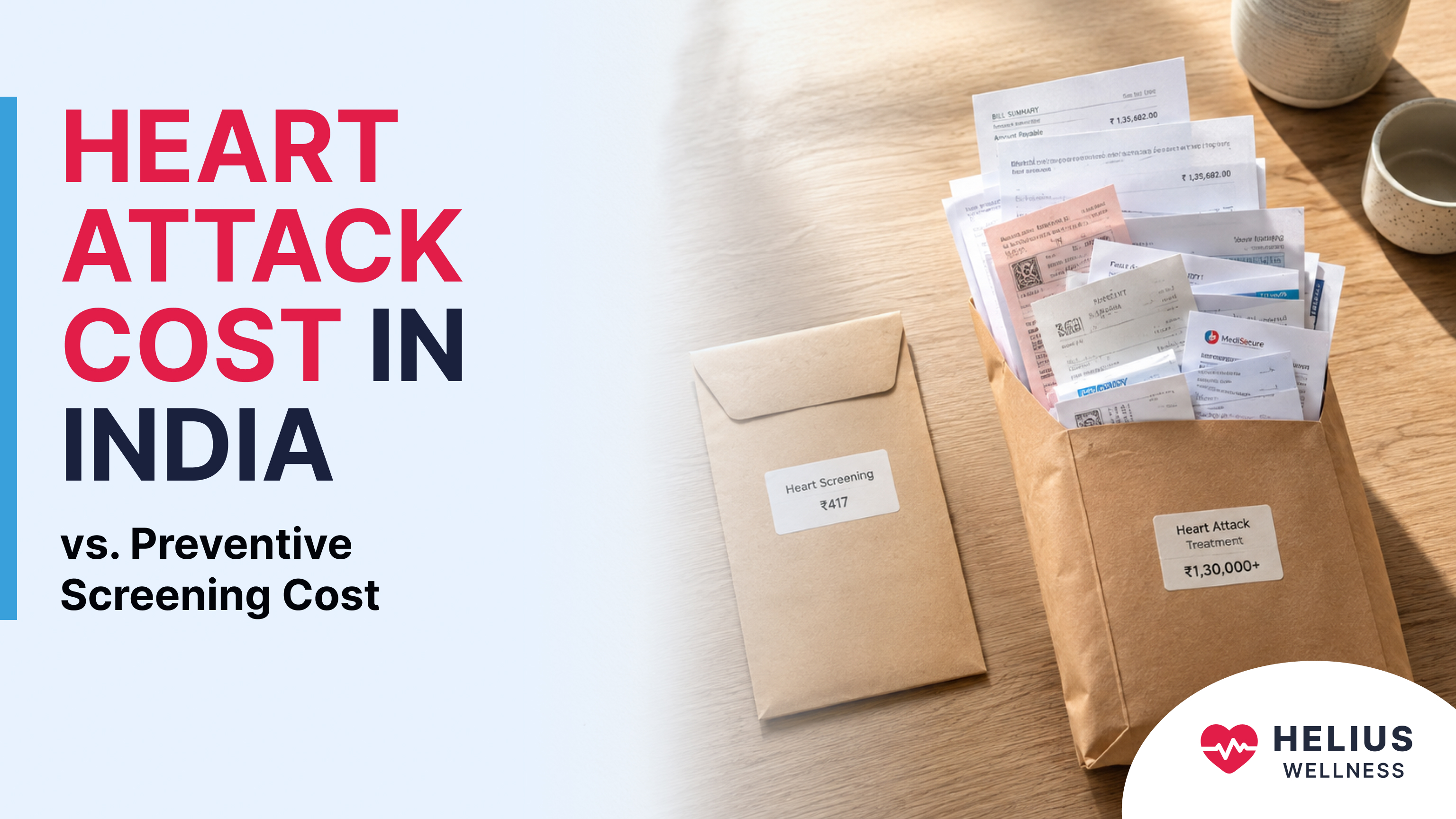
Under the Central Government Health Scheme's official rate list, a lipid profile, one of the simplest heart-risk screening tests, costs ₹417 to ₹490. A balloon coronary angioplasty (PTCA), the procedure many people only get after a heart attack, costs ₹78,200 to ₹92,000.
This price excludes the coronary stent, which is priced separately under a national price cap. Same heart, same disease: a gap of well over 150x, depending purely on when you find out.
Most articles on this topic stop at the hospital bill. But this one doesn't. Below is the full ledger: what a heart attack actually costs in India, what screening costs instead, and why that gap is starting to matter to more than just patients.
Table of Contents
1. What a Heart Attack Actually Costs in India
2. The Hidden Bill
3. What Preventive Screening Actually Costs
4. Doing the Math: Is Screening Actually Worth It?
5. Why This Matters Beyond Your Own Health
6. FAQs
What a Heart Attack Actually Costs in India
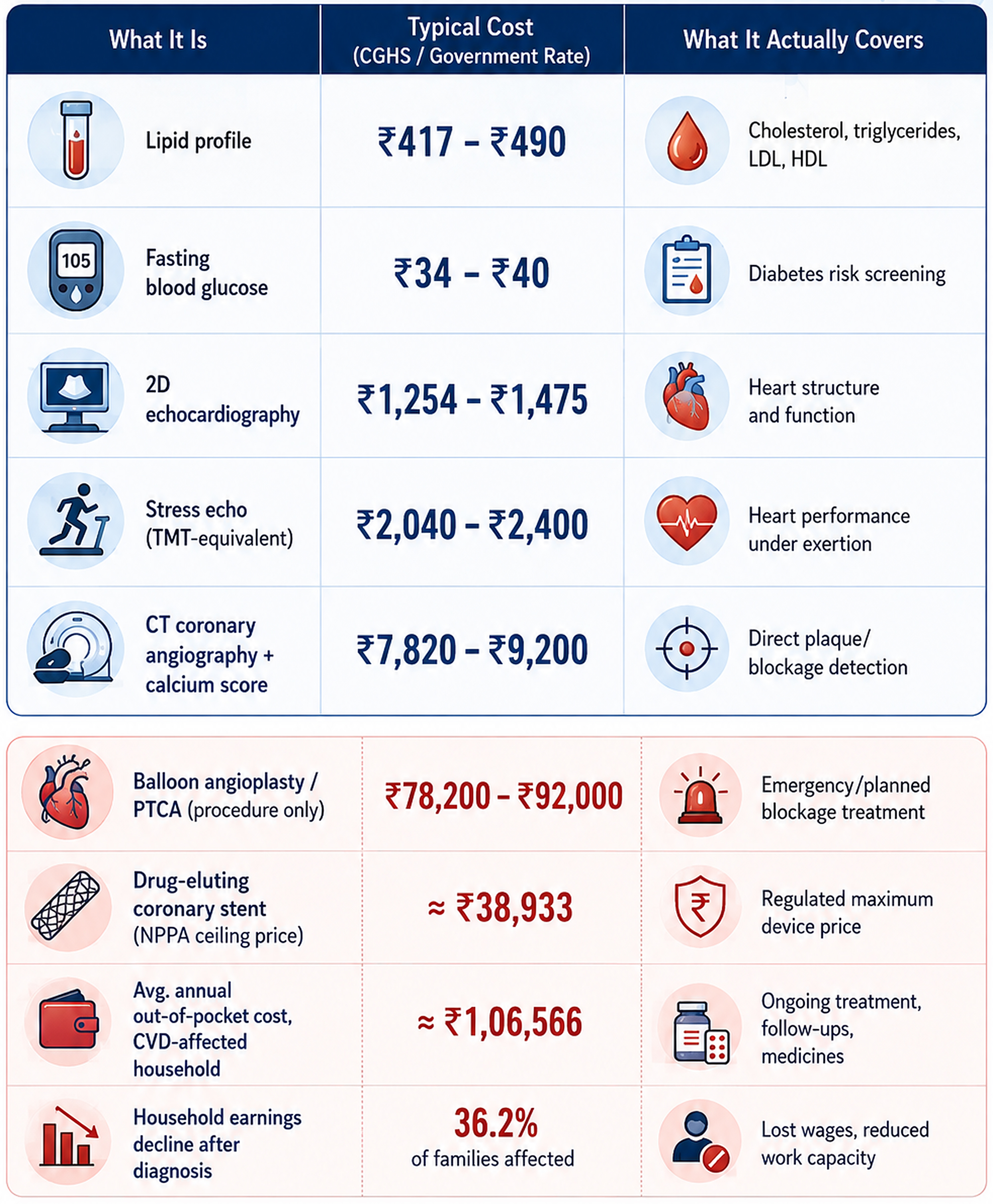
The bill starts before admission. Under the Central Government Health Scheme's (CGHS) official rate circular, a PTCA procedure is priced at ₹78,200 for a non-NABH-accredited hospital and ₹92,000 for an NABH-accredited one.
The coronary stent itself is billed separately. That ceiling has been revised upward periodically for inflation; the current cap on a drug-eluting stent sits at roughly ₹38,933.
Add the two together, and a full angioplasty with one drug-eluting stent runs to somewhere between ₹89,000 and ₹1.3 lakh at fully regulated, government-negotiated rates before counting hospital charges outside the scheme, ICU stay, or complications, which push real-world private-hospital bills considerably higher.
And this is only the emergency phase; medication, follow-ups, and cardiac rehab continue for years afterward.
This isn't only an Indian problem. The WHO notes that cardiovascular disease remains the world's leading cause of death, and the World Heart Federation reports that roughly four in five of those deaths occur in low- and middle-income countries, where early detection is often the missing piece.
Do you want to know your heart risk?
Book a Super ECG screening with Helius Wellness
Get a clear, doctor-reviewed heart health report in under 15 minutes!
The Hidden Bill
Here's what the hospital invoice leaves out. A national household survey found that Indian families with a cardiovascular disease patient spend 16.5% more of their income out-of-pocket on healthcare. Additionally, they are more than twice as likely to borrow money or sell assets to pay for inpatient care, compared with similar families without CVD. Working-age members of these households are also less likely to be employed.
More recent numbers make this concrete. An ICMR-funded study across 21 hospitals, including NIMS Hyderabad, found the average annual out-of-pocket cost for a family managing a cardiac condition was around ₹1,06,566, with 17.7% of families selling assets or taking private loans to cope, and 36.2% seeing household earnings decline.
Older data tells a similar story from a different angle: out-of-pocket spending on non-communicable diseases in India rose from 31.6% to 47.3% of related costs between 1995 and 2004.
This pattern shows up everywhere, not just India. In the US, the CDC calculates that heart disease and stroke cost the health system $223.2 billion a year directly and cause a further $191.5 billion in indirect costs, almost matching the direct bill.
Australia's Heart Foundation and the Heart Research Institute project a similar pattern, expecting indirect costs from lost work and care to outweigh direct healthcare spending on cardiovascular disease by 2029.
The hospital bill was never the whole story. India's data just makes that unusually visible.
What Preventive Screening Actually Costs
- A lipid profile cholesterol, triglycerides, LDL, HDL costs ₹417 to ₹490 under CGHS rates, and a fasting blood glucose test adds another ₹34 to ₹40.
- A 2D echocardiogram, which images the heart's structure and function, is rated at ₹1,254–1,475, and a stress echo (the TMT-equivalent test) at ₹2,040–2,400.
- A CT coronary angiography with calcium scoring, a test Johns Hopkins Medicine describes as one of the more individualized ways to see actual plaque buildup rather than just estimated risk, is rated at ₹7,820–9,200.
The Real Numbers: Direct Cost vs. Hidden Cost vs. Prevention Cost
Doing the Math: Is Screening Actually Worth It?
A peer-reviewed study found that population-level CVD risk screening cost roughly ₹8,656 to ₹88,588 for every additional healthy year of life it produced, comfortably within the range health economists consider good value for money.
The researchers concluded that wider screening rollout across India would meaningfully cut the number of future heart attacks and strokes.
A ₹417–9,200 screening test against a regulated procedure cost of ₹89,000–1.3 lakh for the angioplasty alone, plus roughly ₹1 lakh a year in ongoing hidden costs if things go wrong.
That isn't a marginal trade-off. It's a rounding error next to a life-altering bill.
A Super ECG costs less than a month of takeaway coffee and could save you lakhs!
Book a Super ECG screening with Helius Wellness
Why This Matters Beyond Your Own Health
The same imbalance showing up in household budgets is showing up in capital markets. India's diagnostics market was valued at roughly $40.1 billion in 2025 and is projected to reach $124.5 billion by 2034.
According to the National Health Authority, which runs the government's Ayushman Bharat PM-JAY scheme, the scheme's core benefit is cashless secondary and tertiary hospitalisation cover of up to ₹5 lakh per family per year.
It's built to catch people once they're already sick, while routine outpatient screening is handled separately through primary-care Health and wellness centres rather than as a direct diagnostic benefit. That gap between what's insured and what actually reduces cost is exactly where private diagnostics and health-tech are building their business case.
FAQs
1. How much does heart attack treatment cost in India?
Under official government (CGHS) rates, a balloon angioplasty procedure alone costs ₹78,200–92,000, plus a separately price-capped stent (up to roughly ₹38,933 for a drug-eluting stent), totalling ₹89,000–1.3 lakh, before medication, follow-ups, and lost income. Private-hospital bills for the same procedure are commonly higher.
2. Is preventive cardiac screening actually worth the cost?
Yes. An Indian cost-effectiveness study found population-level CVD screening delivers strong value for money, and the cost of screening (₹417–9,200 at government rates) is a small fraction of the cost of treating a heart attack.
3. What does a basic heart checkup include?
Most basic packages include a lipid profile, fasting blood glucose, and blood pressure/ECG check; more comprehensive packages add a 2D echo and a stress test (TMT).
4. Does health insurance cover preventive heart screening in India?
Usually not by default. Standalone outpatient screening is often excluded unless your policy has a wellness rider, and government schemes like Ayushman Bharat PM-JAY are built around hospitalisation cover rather than routine preventive check-ups.






India’s first AI-powered NCD diagnostics network.
Follow Us


Helius Wellness 2026. All Rights Reserved
August 14, 2026
Heart Attack Cost in India vs. Preventive Screening Cost
See the real cost of heart attack treatment in India, direct, hidden, and long-term, compared to what preventive cardiac screening actually costs.
Author:
Paresh Masani
TL;DR
- Direct cost: Under official government (CGHS) package rates, a balloon coronary angioplasty (PTCA) procedure alone costs ₹78,200–92,000, plus a separately price-capped coronary stent (up to roughly ₹38,933 for a drug-eluting stent). Private-hospital bills for the same procedure commonly run well beyond these regulated rates.
- Hidden cost: Indian households managing a cardiovascular disease (CVD) case spend far more out-of-pocket, borrow more, and often see income drop, averaging around ₹1,06,566 a year in one recent multi-hospital study.
- Prevention cost: Government (CGHS)-rated screening tests range from ₹417 for a lipid profile to ₹9,200 for a CT coronary angiography with calcium scoring.
- The verdict: An Indian cost-effectiveness study found population-level heart screening is genuinely good value for money, and global data shows the economic case for prevention keeps strengthening.
Under the Central Government Health Scheme's official rate list, a lipid profile, one of the simplest heart-risk screening tests, costs ₹417 to ₹490. A balloon coronary angioplasty (PTCA), the procedure many people only get after a heart attack, costs ₹78,200 to ₹92,000.
This price excludes the coronary stent, which is priced separately under a national price cap. Same heart, same disease: a gap of well over 150x, depending purely on when you find out.
Most articles on this topic stop at the hospital bill. But this one doesn't. Below is the full ledger: what a heart attack actually costs in India, what screening costs instead, and why that gap is starting to matter to more than just patients.
Table of Contents
1. What a Heart Attack Actually Costs in India
2. The Hidden Bill
3. What Preventive Screening Actually Costs
4. Doing the Math: Is Screening Actually Worth It?
5. Why This Matters Beyond Your Own Health
6. FAQs
What a Heart Attack Actually Costs in India
The bill starts before admission. Under the Central Government Health Scheme's (CGHS) official rate circular, a PTCA procedure is priced at ₹78,200 for a non-NABH-accredited hospital and ₹92,000 for an NABH-accredited one.
The coronary stent itself is billed separately. That ceiling has been revised upward periodically for inflation; the current cap on a drug-eluting stent sits at roughly ₹38,933.
Add the two together, and a full angioplasty with one drug-eluting stent runs to somewhere between ₹89,000 and ₹1.3 lakh at fully regulated, government-negotiated rates before counting hospital charges outside the scheme, ICU stay, or complications, which push real-world private-hospital bills considerably higher.
And this is only the emergency phase; medication, follow-ups, and cardiac rehab continue for years afterward.
This isn't only an Indian problem. The WHO notes that cardiovascular disease remains the world's leading cause of death, and the World Heart Federation reports that roughly four in five of those deaths occur in low- and middle-income countries, where early detection is often the missing piece.
Do you want to know your heart risk?
Book a Super ECG screening with Helius Wellness
Get a clear, doctor-reviewed heart health report in under 15 minutes!
The Hidden Bill
Here's what the hospital invoice leaves out. A national household survey found that Indian families with a cardiovascular disease patient spend 16.5% more of their income out-of-pocket on healthcare. Additionally, they are more than twice as likely to borrow money or sell assets to pay for inpatient care, compared with similar families without CVD. Working-age members of these households are also less likely to be employed.
More recent numbers make this concrete. An ICMR-funded study across 21 hospitals, including NIMS Hyderabad, found the average annual out-of-pocket cost for a family managing a cardiac condition was around ₹1,06,566, with 17.7% of families selling assets or taking private loans to cope, and 36.2% seeing household earnings decline.
Older data tells a similar story from a different angle: out-of-pocket spending on non-communicable diseases in India rose from 31.6% to 47.3% of related costs between 1995 and 2004.
This pattern shows up everywhere, not just India. In the US, the CDC calculates that heart disease and stroke cost the health system $223.2 billion a year directly and cause a further $191.5 billion in indirect costs, almost matching the direct bill.
Australia's Heart Foundation and the Heart Research Institute project a similar pattern, expecting indirect costs from lost work and care to outweigh direct healthcare spending on cardiovascular disease by 2029.
The hospital bill was never the whole story. India's data just makes that unusually visible.
What Preventive Screening Actually Costs
- A lipid profile cholesterol, triglycerides, LDL, HDL costs ₹417 to ₹490 under CGHS rates, and a fasting blood glucose test adds another ₹34 to ₹40.
- A 2D echocardiogram, which images the heart's structure and function, is rated at ₹1,254–1,475, and a stress echo (the TMT-equivalent test) at ₹2,040–2,400.
- A CT coronary angiography with calcium scoring, a test Johns Hopkins Medicine describes as one of the more individualized ways to see actual plaque buildup rather than just estimated risk, is rated at ₹7,820–9,200.
The Real Numbers: Direct Cost vs. Hidden Cost vs. Prevention Cost
Doing the Math: Is Screening Actually Worth It?
A peer-reviewed study found that population-level CVD risk screening cost roughly ₹8,656 to ₹88,588 for every additional healthy year of life it produced, comfortably within the range health economists consider good value for money.
The researchers concluded that wider screening rollout across India would meaningfully cut the number of future heart attacks and strokes.
A ₹417–9,200 screening test against a regulated procedure cost of ₹89,000–1.3 lakh for the angioplasty alone, plus roughly ₹1 lakh a year in ongoing hidden costs if things go wrong.
That isn't a marginal trade-off. It's a rounding error next to a life-altering bill.
A Super ECG costs less than a month of takeaway coffee and could save you lakhs!
Book a Super ECG screening with Helius Wellness
Why This Matters Beyond Your Own Health
The same imbalance showing up in household budgets is showing up in capital markets. India's diagnostics market was valued at roughly $40.1 billion in 2025 and is projected to reach $124.5 billion by 2034.
According to the National Health Authority, which runs the government's Ayushman Bharat PM-JAY scheme, the scheme's core benefit is cashless secondary and tertiary hospitalisation cover of up to ₹5 lakh per family per year.
It's built to catch people once they're already sick, while routine outpatient screening is handled separately through primary-care Health and wellness centres rather than as a direct diagnostic benefit. That gap between what's insured and what actually reduces cost is exactly where private diagnostics and health-tech are building their business case.
FAQs
1. How much does heart attack treatment cost in India?
Under official government (CGHS) rates, a balloon angioplasty procedure alone costs ₹78,200–92,000, plus a separately price-capped stent (up to roughly ₹38,933 for a drug-eluting stent), totalling ₹89,000–1.3 lakh, before medication, follow-ups, and lost income. Private-hospital bills for the same procedure are commonly higher.
2. Is preventive cardiac screening actually worth the cost?
Yes. An Indian cost-effectiveness study found population-level CVD screening delivers strong value for money, and the cost of screening (₹417–9,200 at government rates) is a small fraction of the cost of treating a heart attack.
3. What does a basic heart checkup include?
Most basic packages include a lipid profile, fasting blood glucose, and blood pressure/ECG check; more comprehensive packages add a 2D echo and a stress test (TMT).
4. Does health insurance cover preventive heart screening in India?
Usually not by default. Standalone outpatient screening is often excluded unless your policy has a wellness rider, and government schemes like Ayushman Bharat PM-JAY are built around hospitalisation cover rather than routine preventive check-ups.
India’s first AI-powered NCD diagnostics network.
Helius Wellness 2026. All Rights Reserved
Follow Us
August 14, 2026
Heart Attack Cost in India vs. Preventive Screening Cost
See the real cost of heart attack treatment in India, direct, hidden, and long-term, compared to what preventive cardiac screening actually costs.
Author:
Paresh Masani
TL;DR
- Direct cost: Under official government (CGHS) package rates, a balloon coronary angioplasty (PTCA) procedure alone costs ₹78,200–92,000, plus a separately price-capped coronary stent (up to roughly ₹38,933 for a drug-eluting stent). Private-hospital bills for the same procedure commonly run well beyond these regulated rates.
- Hidden cost: Indian households managing a cardiovascular disease (CVD) case spend far more out-of-pocket, borrow more, and often see income drop, averaging around ₹1,06,566 a year in one recent multi-hospital study.
- Prevention cost: Government (CGHS)-rated screening tests range from ₹417 for a lipid profile to ₹9,200 for a CT coronary angiography with calcium scoring.
- The verdict: An Indian cost-effectiveness study found population-level heart screening is genuinely good value for money, and global data shows the economic case for prevention keeps strengthening.
Under the Central Government Health Scheme's official rate list, a lipid profile, one of the simplest heart-risk screening tests, costs ₹417 to ₹490. A balloon coronary angioplasty (PTCA), the procedure many people only get after a heart attack, costs ₹78,200 to ₹92,000.
This price excludes the coronary stent, which is priced separately under a national price cap. Same heart, same disease: a gap of well over 150x, depending purely on when you find out.
Most articles on this topic stop at the hospital bill. But this one doesn't. Below is the full ledger: what a heart attack actually costs in India, what screening costs instead, and why that gap is starting to matter to more than just patients.
Table of Contents
1. What a Heart Attack Actually Costs in India
2. The Hidden Bill
3. What Preventive Screening Actually Costs
4. Doing the Math: Is Screening Actually Worth It?
5. Why This Matters Beyond Your Own Health
6. FAQs
What a Heart Attack Actually Costs in India
The bill starts before admission. Under the Central Government Health Scheme's (CGHS) official rate circular, a PTCA procedure is priced at ₹78,200 for a non-NABH-accredited hospital and ₹92,000 for an NABH-accredited one.
The coronary stent itself is billed separately. That ceiling has been revised upward periodically for inflation; the current cap on a drug-eluting stent sits at roughly ₹38,933.
Add the two together, and a full angioplasty with one drug-eluting stent runs to somewhere between ₹89,000 and ₹1.3 lakh at fully regulated, government-negotiated rates before counting hospital charges outside the scheme, ICU stay, or complications, which push real-world private-hospital bills considerably higher.
And this is only the emergency phase; medication, follow-ups, and cardiac rehab continue for years afterward.
This isn't only an Indian problem. The WHO notes that cardiovascular disease remains the world's leading cause of death, and the World Heart Federation reports that roughly four in five of those deaths occur in low- and middle-income countries, where early detection is often the missing piece.
Do you want to know your heart risk?
Book a Super ECG screening with Helius Wellness
Get a clear, doctor-reviewed heart health report in under 15 minutes!
The Hidden Bill
Here's what the hospital invoice leaves out. A national household survey found that Indian families with a cardiovascular disease patient spend 16.5% more of their income out-of-pocket on healthcare. Additionally, they are more than twice as likely to borrow money or sell assets to pay for inpatient care, compared with similar families without CVD. Working-age members of these households are also less likely to be employed.
More recent numbers make this concrete. An ICMR-funded study across 21 hospitals, including NIMS Hyderabad, found the average annual out-of-pocket cost for a family managing a cardiac condition was around ₹1,06,566, with 17.7% of families selling assets or taking private loans to cope, and 36.2% seeing household earnings decline.
Older data tells a similar story from a different angle: out-of-pocket spending on non-communicable diseases in India rose from 31.6% to 47.3% of related costs between 1995 and 2004.
This pattern shows up everywhere, not just India. In the US, the CDC calculates that heart disease and stroke cost the health system $223.2 billion a year directly and cause a further $191.5 billion in indirect costs, almost matching the direct bill.
Australia's Heart Foundation and the Heart Research Institute project a similar pattern, expecting indirect costs from lost work and care to outweigh direct healthcare spending on cardiovascular disease by 2029.
The hospital bill was never the whole story. India's data just makes that unusually visible.
What Preventive Screening Actually Costs
- A lipid profile cholesterol, triglycerides, LDL, HDL costs ₹417 to ₹490 under CGHS rates, and a fasting blood glucose test adds another ₹34 to ₹40.
- A 2D echocardiogram, which images the heart's structure and function, is rated at ₹1,254–1,475, and a stress echo (the TMT-equivalent test) at ₹2,040–2,400.
- A CT coronary angiography with calcium scoring, a test Johns Hopkins Medicine describes as one of the more individualized ways to see actual plaque buildup rather than just estimated risk, is rated at ₹7,820–9,200.
The Real Numbers: Direct Cost vs. Hidden Cost vs. Prevention Cost
Doing the Math: Is Screening Actually Worth It?
A peer-reviewed study found that population-level CVD risk screening cost roughly ₹8,656 to ₹88,588 for every additional healthy year of life it produced, comfortably within the range health economists consider good value for money.
The researchers concluded that wider screening rollout across India would meaningfully cut the number of future heart attacks and strokes.
A ₹417–9,200 screening test against a regulated procedure cost of ₹89,000–1.3 lakh for the angioplasty alone, plus roughly ₹1 lakh a year in ongoing hidden costs if things go wrong.
That isn't a marginal trade-off. It's a rounding error next to a life-altering bill.
A Super ECG costs less than a month of takeaway coffee and could save you lakhs!
Book a Super ECG screening with Helius Wellness
Why This Matters Beyond Your Own Health
The same imbalance showing up in household budgets is showing up in capital markets. India's diagnostics market was valued at roughly $40.1 billion in 2025 and is projected to reach $124.5 billion by 2034.
According to the National Health Authority, which runs the government's Ayushman Bharat PM-JAY scheme, the scheme's core benefit is cashless secondary and tertiary hospitalisation cover of up to ₹5 lakh per family per year.
It's built to catch people once they're already sick, while routine outpatient screening is handled separately through primary-care Health and wellness centres rather than as a direct diagnostic benefit. That gap between what's insured and what actually reduces cost is exactly where private diagnostics and health-tech are building their business case.
FAQs
1. How much does heart attack treatment cost in India?
Under official government (CGHS) rates, a balloon angioplasty procedure alone costs ₹78,200–92,000, plus a separately price-capped stent (up to roughly ₹38,933 for a drug-eluting stent), totalling ₹89,000–1.3 lakh, before medication, follow-ups, and lost income. Private-hospital bills for the same procedure are commonly higher.
2. Is preventive cardiac screening actually worth the cost?
Yes. An Indian cost-effectiveness study found population-level CVD screening delivers strong value for money, and the cost of screening (₹417–9,200 at government rates) is a small fraction of the cost of treating a heart attack.
3. What does a basic heart checkup include?
Most basic packages include a lipid profile, fasting blood glucose, and blood pressure/ECG check; more comprehensive packages add a 2D echo and a stress test (TMT).
4. Does health insurance cover preventive heart screening in India?
Usually not by default. Standalone outpatient screening is often excluded unless your policy has a wellness rider, and government schemes like Ayushman Bharat PM-JAY are built around hospitalisation cover rather than routine preventive check-ups.


India’s first AI-powered NCD diagnostics network.
Helius Wellness 2026. All Rights Reserved
Follow Us