

August 21, 2026
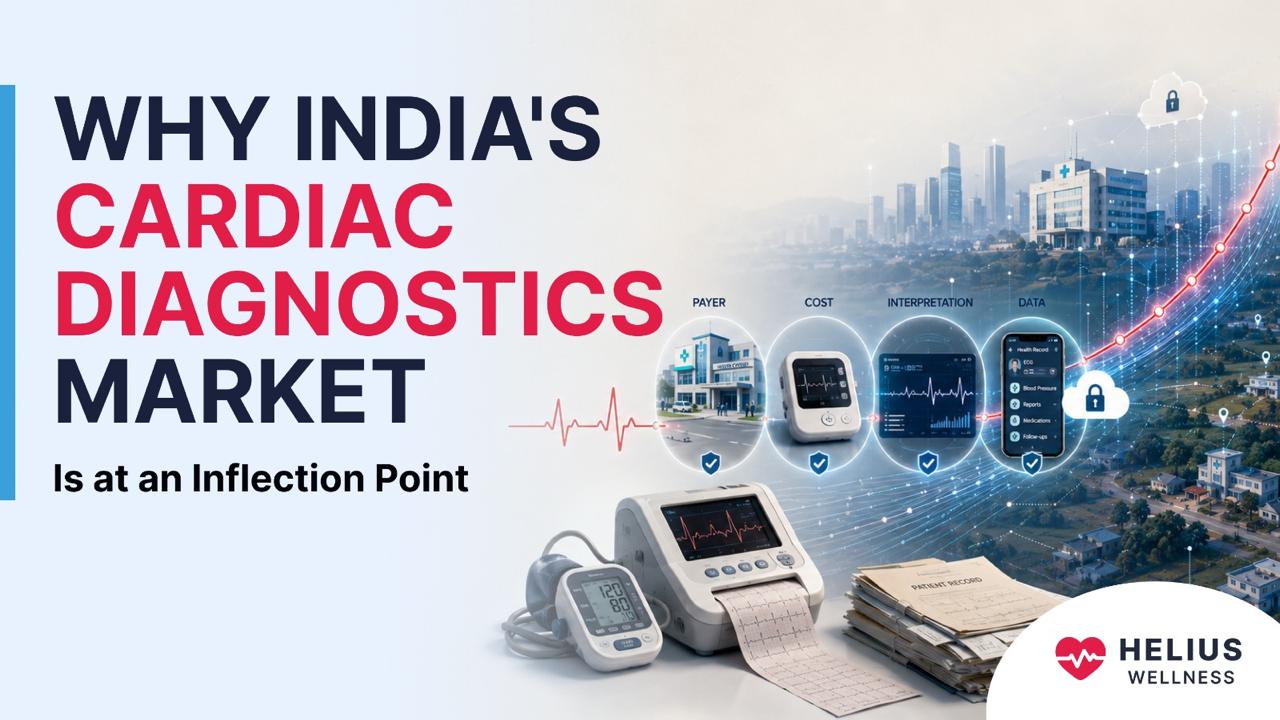
Why India's Cardiac Diagnostics Market Is at an Inflection Point
Four converging unlocks: payer, cost, interpretation, and data rails explain why the preventive healthcare market investment case in India finally works now.
Author:
Kavya Dave
Key Takeaways
- India's cardiovascular burden has been large for 30 years. Large burden alone was never an investable thesis; the missing piece was a payer.
- Four unlocks converged recently: public screening infrastructure at scale, falling point-of-care hardware costs, algorithmic interpretation that decouples volume from specialist headcount, and national digital health rails.
- The bottleneck has moved. It is no longer detection. It is interpretation and follow-through.
- Track three metrics to test this thesis: cost per screened patient, repeat-screening rate, and referral-to-intervention conversion.
Indians develop cardiovascular disease roughly a decade earlier than European populations. The data highlights: in Western populations, about 23% of CVD deaths occur before age 70, while in India that figure is 52%. India's age-standardised CVD death rate of 272 per 100,000 exceeds the global average of 235.
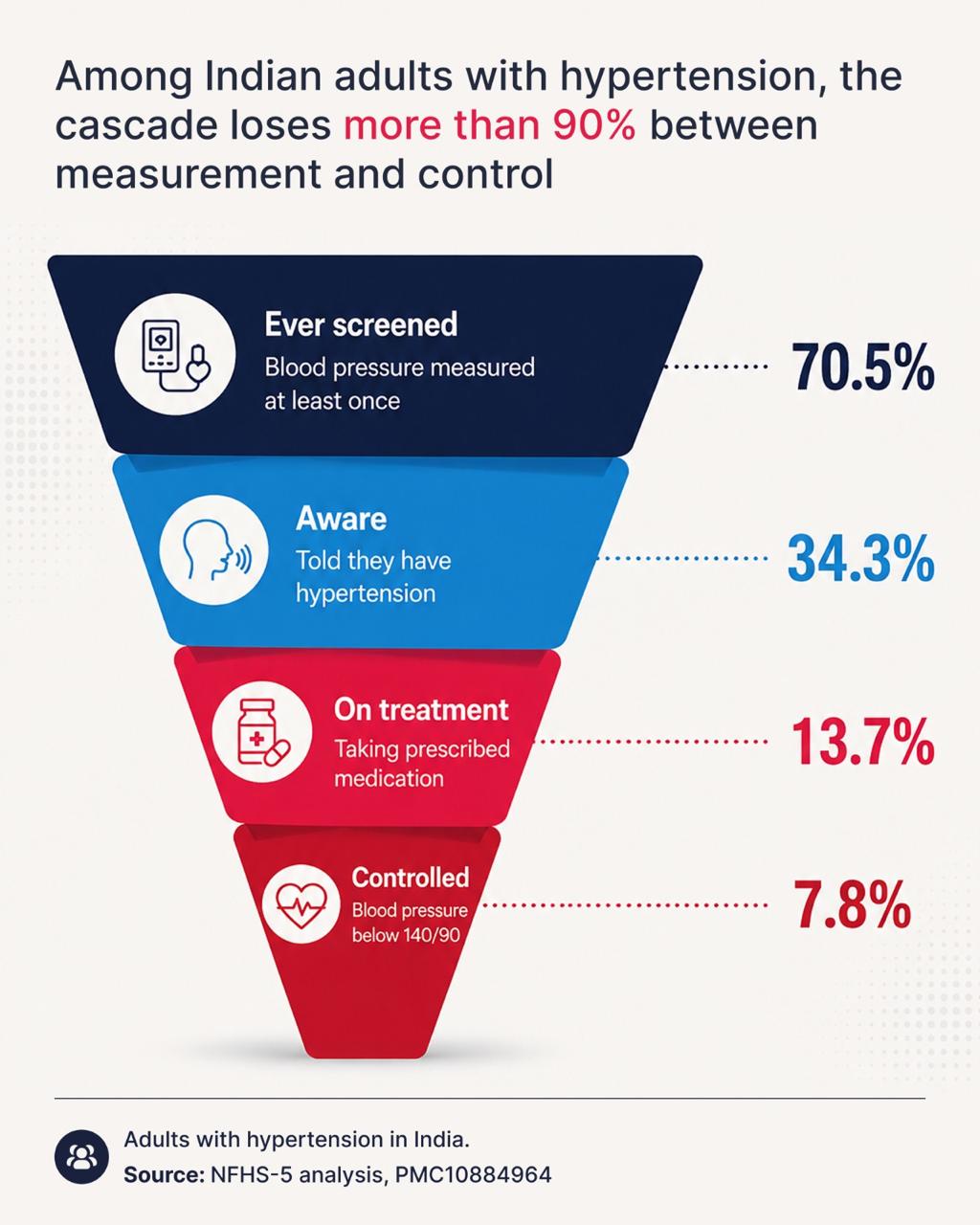
Analysis of National Family Health Survey-5 data found that among Indian adults with hypertension, 70.5% had ever had their blood pressure measured, 34.3% were aware of the diagnosis, 13.7% were on medication, and only 7.8% had it controlled. The researchers note that the familiar "rule of halves" does not even apply in India!
Table of Contents
1. Why "Huge Burden" Was Never The Idea
2. Unlock 1: The Payer Finally Exists
3. Unlock 2: The Cost Curve Crossed The Tier-2 Threshold
4. Unlock 3: The Interpretation Bottleneck Breaks
5. Unlock 4: Results Now Persist
6. What Changed?
7. How to Challenge This Idea
8. Still Doesn’t Work?
Why "Huge Burden" Was Never The Idea
Here is the argument investors should kill first. India's cardiac burden was already enormous in 2005. Capital that entered preventive diagnostics on burden logic alone mostly underperformed, for one reason: no one was paying for asymptomatic screening.
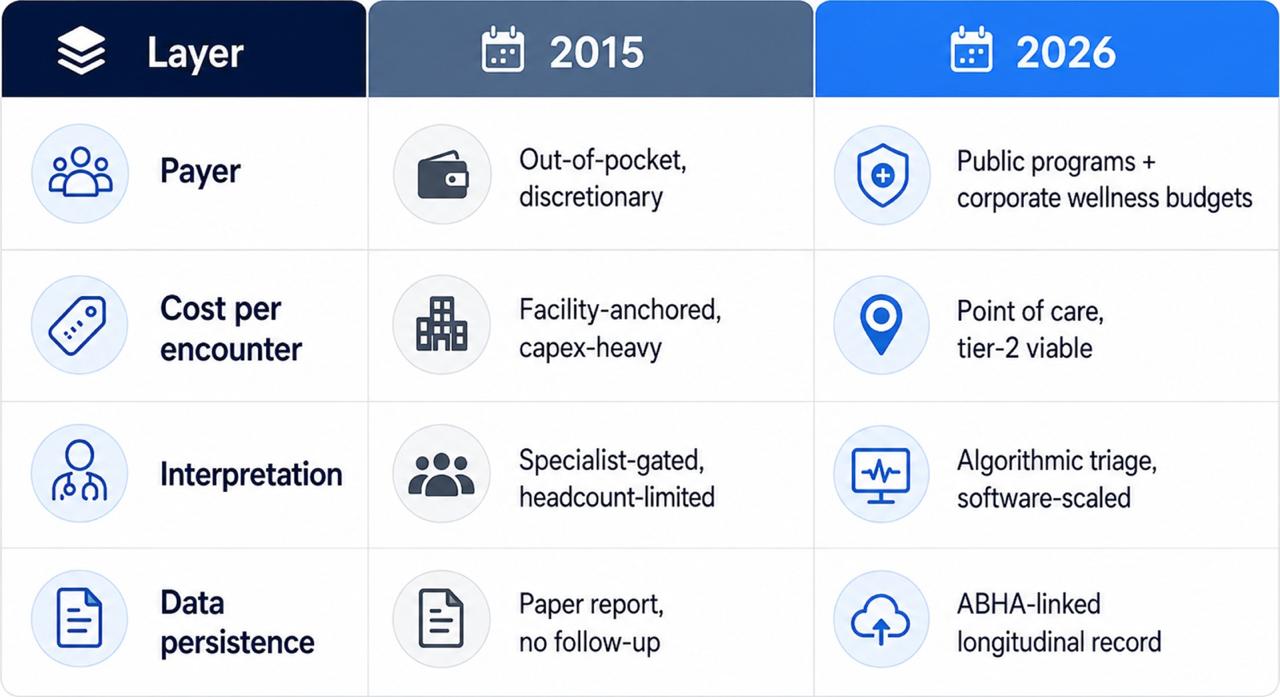
Preventive cardiac testing was discretionary, out-of-pocket, urban, and episodic. You cannot build recurring revenue on a product a healthy person buys once. Market-size decks that lead with disease prevalence are describing a need, not a market.
What changed is not the burden. It is who pays, what it costs, who reads the result, and whether the result persists. The four unlocks.
Unlock 1: The Payer Finally Exists
India has built screening rails at a scale that has no international parallel. As of October 2025, Ayushman Arogya Mandirs had conducted 38.79 crore hypertension screenings and 36.05 crore diabetes screenings, across roughly 1.8 lakh operational centres, with over 130 crore cumulative NCD screenings. PM-JAY sits behind it, covering secondary and tertiary care for over 10 crore families.
Simultaneously, the private market shifted. Wellness and preventive services grew at over 25% CAGR across major listed diagnostic chains in the four years to FY25, rising from 6–12% of revenue in FY21 to 12–25% in FY25. India's diagnostics services market is projected to reach $15–16 billion by FY30 at roughly 12% CAGR.
Preventive cardiac screening has moved from a discretionary purchase to a funded programme. That is the single most important change of the last decade.
Helius Wellness is built for exactly this shift!
Unlock 2: The Cost Curve Crossed The Tier-2 Threshold
Cardiac diagnostics historically required capital equipment and a physical facility. India has approximately 2,200 operational cardiac catheterisation labs against an estimated need of 6,500, about 1.5 per million population.
Building out that gap in concrete is a decade-long, capital-intensive project. Building it out in portable, point-of-care hardware is not. When the marginal cost of one screening encounter falls low enough, tier-2 and tier-3 unit economics close, and that is where the undiagnosed population actually lives.
Over 60% of India's population is rural, yet urban markets generate more than 70% of diagnostic revenue.
Unlock 3: The Interpretation Bottleneck Breaks
This is the unlock most investors underweight.
India has fewer than 5 cardiologists per million population, markedly below high-income benchmarks, and those specialists are concentrated in metros. You can screen 38 crore people. You cannot hire 38 crore cardiologist-hours.
Every screening programme built on human interpretation hits a hard ceiling: volume scales linearly with specialist headcount. Algorithmic ECG interpretation breaks that coupling. It converts a supply-constrained input into a software-constrained one, which is the structural precondition for any diagnostics business that intends to compound.
Companies building in this layer, Helius Wellness’ Super ECG among them, are effectively arbitraging the gap between India's screening capacity and its interpretive capacity. That gap, not the disease burden, is the actual asset.
Unlock 4: Results Now Persist
A screening result that lives on paper generates one transaction. A result attached to a longitudinal record generates a relationship.
India's National NCD portal now creates an Ayushman Bharat Health Account (ABHA), a unique digital health ID for each individual screened, building a longitudinal record and enabling downward referral. Combined with CDSCO device pathways, clinical evidence and distribution have become portable across states in a way they simply were not five years ago.
This is what converts screening from a one-off service into recurring revenue.
What Changed?
How to Challenge This Idea
Using these three metrics:
- Cost per screened patient, fully loaded. If this doesn't fall year-on-year, the cost unlock is not real.
- Repeat-screening rate at 12 months. Preventive care without recurrence is a services business, not a platform.
- Referral-to-intervention conversion. This is where value leaks today; the cascade data shows attrition of over 90% from prevalence to control.
What Still Doesn't Work
Honest failure modes, and they apply to every company in this category, including ours.
Reimbursement lag is real; public programme cycles are slow and margin-thin. Screening volume is not an outcome; detecting more disease without closing the referral loop generates cost, not health.
Distribution into tier-2 and tier-3 markets still requires ground capex that software margins do not cover. And clinical validation in Indian cohorts remains thinner than most pitch decks imply.
Summary
The question for investors in the preventive healthcare market India investment landscape is no longer whether the market exists. Four independent unlocks have answered that.
The open question is timing specifically, whether independent capital arrives before large hospital and diagnostic chains bundle detection, interpretation, and referral into a single vertically integrated offer. Consolidation is already visible among organised diagnostic chains.
Inflection points are only obvious afterwards. This one has a date attached, and it is closer than the market-sizing reports suggest.






India’s first AI-powered NCD diagnostics network.
Follow Us


Helius Wellness 2026. All Rights Reserved
August 21, 2026
Why India's Cardiac Diagnostics Market Is at an Inflection Point
Four converging unlocks: payer, cost, interpretation, and data rails explain why the preventive healthcare market investment case in India finally works now.
Author:
Kavya Dave
Key Takeaways
- India's cardiovascular burden has been large for 30 years. Large burden alone was never an investable thesis; the missing piece was a payer.
- Four unlocks converged recently: public screening infrastructure at scale, falling point-of-care hardware costs, algorithmic interpretation that decouples volume from specialist headcount, and national digital health rails.
- The bottleneck has moved. It is no longer detection. It is interpretation and follow-through.
- Track three metrics to test this thesis: cost per screened patient, repeat-screening rate, and referral-to-intervention conversion.
Indians develop cardiovascular disease roughly a decade earlier than European populations. The data highlights: in Western populations, about 23% of CVD deaths occur before age 70, while in India that figure is 52%. India's age-standardised CVD death rate of 272 per 100,000 exceeds the global average of 235.
Analysis of National Family Health Survey-5 data found that among Indian adults with hypertension, 70.5% had ever had their blood pressure measured, 34.3% were aware of the diagnosis, 13.7% were on medication, and only 7.8% had it controlled. The researchers note that the familiar "rule of halves" does not even apply in India!
Table of Contents
1. Why "Huge Burden" Was Never The Idea
2. Unlock 1: The Payer Finally Exists
3. Unlock 2: The Cost Curve Crossed The Tier-2 Threshold
4. Unlock 3: The Interpretation Bottleneck Breaks
5. Unlock 4: Results Now Persist
6. What Changed?
7. How to Challenge This Idea
8. Still Doesn’t Work?
Why "Huge Burden" Was Never The Idea
Here is the argument investors should kill first. India's cardiac burden was already enormous in 2005. Capital that entered preventive diagnostics on burden logic alone mostly underperformed, for one reason: no one was paying for asymptomatic screening.
Preventive cardiac testing was discretionary, out-of-pocket, urban, and episodic. You cannot build recurring revenue on a product a healthy person buys once. Market-size decks that lead with disease prevalence are describing a need, not a market.
What changed is not the burden. It is who pays, what it costs, who reads the result, and whether the result persists. The four unlocks.
Unlock 1: The Payer Finally Exists
India has built screening rails at a scale that has no international parallel. As of October 2025, Ayushman Arogya Mandirs had conducted 38.79 crore hypertension screenings and 36.05 crore diabetes screenings, across roughly 1.8 lakh operational centres, with over 130 crore cumulative NCD screenings. PM-JAY sits behind it, covering secondary and tertiary care for over 10 crore families.
Simultaneously, the private market shifted. Wellness and preventive services grew at over 25% CAGR across major listed diagnostic chains in the four years to FY25, rising from 6–12% of revenue in FY21 to 12–25% in FY25. India's diagnostics services market is projected to reach $15–16 billion by FY30 at roughly 12% CAGR.
Preventive cardiac screening has moved from a discretionary purchase to a funded programme. That is the single most important change of the last decade.
Helius Wellness is built for exactly this shift!
Unlock 2: The Cost Curve Crossed The Tier-2 Threshold
Cardiac diagnostics historically required capital equipment and a physical facility. India has approximately 2,200 operational cardiac catheterisation labs against an estimated need of 6,500, about 1.5 per million population.
Building out that gap in concrete is a decade-long, capital-intensive project. Building it out in portable, point-of-care hardware is not. When the marginal cost of one screening encounter falls low enough, tier-2 and tier-3 unit economics close, and that is where the undiagnosed population actually lives.
Over 60% of India's population is rural, yet urban markets generate more than 70% of diagnostic revenue.
Unlock 3: The Interpretation Bottleneck Breaks
This is the unlock most investors underweight.
India has fewer than 5 cardiologists per million population, markedly below high-income benchmarks, and those specialists are concentrated in metros. You can screen 38 crore people. You cannot hire 38 crore cardiologist-hours.
Every screening programme built on human interpretation hits a hard ceiling: volume scales linearly with specialist headcount. Algorithmic ECG interpretation breaks that coupling. It converts a supply-constrained input into a software-constrained one, which is the structural precondition for any diagnostics business that intends to compound.
Companies building in this layer, Helius Wellness’ Super ECG among them, are effectively arbitraging the gap between India's screening capacity and its interpretive capacity. That gap, not the disease burden, is the actual asset.
Unlock 4: Results Now Persist
A screening result that lives on paper generates one transaction. A result attached to a longitudinal record generates a relationship.
India's National NCD portal now creates an Ayushman Bharat Health Account (ABHA), a unique digital health ID for each individual screened, building a longitudinal record and enabling downward referral. Combined with CDSCO device pathways, clinical evidence and distribution have become portable across states in a way they simply were not five years ago.
This is what converts screening from a one-off service into recurring revenue.
What Changed?
How to Challenge This Idea
Using these three metrics:
- Cost per screened patient, fully loaded. If this doesn't fall year-on-year, the cost unlock is not real.
- Repeat-screening rate at 12 months. Preventive care without recurrence is a services business, not a platform.
- Referral-to-intervention conversion. This is where value leaks today; the cascade data shows attrition of over 90% from prevalence to control.
What Still Doesn't Work
Honest failure modes, and they apply to every company in this category, including ours.
Reimbursement lag is real; public programme cycles are slow and margin-thin. Screening volume is not an outcome; detecting more disease without closing the referral loop generates cost, not health.
Distribution into tier-2 and tier-3 markets still requires ground capex that software margins do not cover. And clinical validation in Indian cohorts remains thinner than most pitch decks imply.
Summary
The question for investors in the preventive healthcare market India investment landscape is no longer whether the market exists. Four independent unlocks have answered that.
The open question is timing specifically, whether independent capital arrives before large hospital and diagnostic chains bundle detection, interpretation, and referral into a single vertically integrated offer. Consolidation is already visible among organised diagnostic chains.
Inflection points are only obvious afterwards. This one has a date attached, and it is closer than the market-sizing reports suggest.
India’s first AI-powered NCD diagnostics network.
Helius Wellness 2026. All Rights Reserved
Follow Us
August 21, 2026
Why India's Cardiac Diagnostics Market Is at an Inflection Point
Four converging unlocks: payer, cost, interpretation, and data rails explain why the preventive healthcare market investment case in India finally works now.
Author:
Kavya Dave
Key Takeaways
- India's cardiovascular burden has been large for 30 years. Large burden alone was never an investable thesis; the missing piece was a payer.
- Four unlocks converged recently: public screening infrastructure at scale, falling point-of-care hardware costs, algorithmic interpretation that decouples volume from specialist headcount, and national digital health rails.
- The bottleneck has moved. It is no longer detection. It is interpretation and follow-through.
- Track three metrics to test this thesis: cost per screened patient, repeat-screening rate, and referral-to-intervention conversion.
Indians develop cardiovascular disease roughly a decade earlier than European populations. The data highlights: in Western populations, about 23% of CVD deaths occur before age 70, while in India that figure is 52%. India's age-standardised CVD death rate of 272 per 100,000 exceeds the global average of 235.
Analysis of National Family Health Survey-5 data found that among Indian adults with hypertension, 70.5% had ever had their blood pressure measured, 34.3% were aware of the diagnosis, 13.7% were on medication, and only 7.8% had it controlled. The researchers note that the familiar "rule of halves" does not even apply in India!
Table of Contents
1. Why "Huge Burden" Was Never The Idea
2. Unlock 1: The Payer Finally Exists
3. Unlock 2: The Cost Curve Crossed The Tier-2 Threshold
4. Unlock 3: The Interpretation Bottleneck Breaks
5. Unlock 4: Results Now Persist
6. What Changed?
7. How to Challenge This Idea
8. Still Doesn’t Work?
Why "Huge Burden" Was Never The Idea
Here is the argument investors should kill first. India's cardiac burden was already enormous in 2005. Capital that entered preventive diagnostics on burden logic alone mostly underperformed, for one reason: no one was paying for asymptomatic screening.
Preventive cardiac testing was discretionary, out-of-pocket, urban, and episodic. You cannot build recurring revenue on a product a healthy person buys once. Market-size decks that lead with disease prevalence are describing a need, not a market.
What changed is not the burden. It is who pays, what it costs, who reads the result, and whether the result persists. The four unlocks.
Unlock 1: The Payer Finally Exists
India has built screening rails at a scale that has no international parallel. As of October 2025, Ayushman Arogya Mandirs had conducted 38.79 crore hypertension screenings and 36.05 crore diabetes screenings, across roughly 1.8 lakh operational centres, with over 130 crore cumulative NCD screenings. PM-JAY sits behind it, covering secondary and tertiary care for over 10 crore families.
Simultaneously, the private market shifted. Wellness and preventive services grew at over 25% CAGR across major listed diagnostic chains in the four years to FY25, rising from 6–12% of revenue in FY21 to 12–25% in FY25. India's diagnostics services market is projected to reach $15–16 billion by FY30 at roughly 12% CAGR.
Preventive cardiac screening has moved from a discretionary purchase to a funded programme. That is the single most important change of the last decade.
Helius Wellness is built for exactly this shift!
Unlock 2: The Cost Curve Crossed The Tier-2 Threshold
Cardiac diagnostics historically required capital equipment and a physical facility. India has approximately 2,200 operational cardiac catheterisation labs against an estimated need of 6,500, about 1.5 per million population.
Building out that gap in concrete is a decade-long, capital-intensive project. Building it out in portable, point-of-care hardware is not. When the marginal cost of one screening encounter falls low enough, tier-2 and tier-3 unit economics close, and that is where the undiagnosed population actually lives.
Over 60% of India's population is rural, yet urban markets generate more than 70% of diagnostic revenue.
Unlock 3: The Interpretation Bottleneck Breaks
This is the unlock most investors underweight.
India has fewer than 5 cardiologists per million population, markedly below high-income benchmarks, and those specialists are concentrated in metros. You can screen 38 crore people. You cannot hire 38 crore cardiologist-hours.
Every screening programme built on human interpretation hits a hard ceiling: volume scales linearly with specialist headcount. Algorithmic ECG interpretation breaks that coupling. It converts a supply-constrained input into a software-constrained one, which is the structural precondition for any diagnostics business that intends to compound.
Companies building in this layer, Helius Wellness’ Super ECG among them, are effectively arbitraging the gap between India's screening capacity and its interpretive capacity. That gap, not the disease burden, is the actual asset.
Unlock 4: Results Now Persist
A screening result that lives on paper generates one transaction. A result attached to a longitudinal record generates a relationship.
India's National NCD portal now creates an Ayushman Bharat Health Account (ABHA), a unique digital health ID for each individual screened, building a longitudinal record and enabling downward referral. Combined with CDSCO device pathways, clinical evidence and distribution have become portable across states in a way they simply were not five years ago.
This is what converts screening from a one-off service into recurring revenue.
What Changed?
How to Challenge This Idea
Using these three metrics:
- Cost per screened patient, fully loaded. If this doesn't fall year-on-year, the cost unlock is not real.
- Repeat-screening rate at 12 months. Preventive care without recurrence is a services business, not a platform.
- Referral-to-intervention conversion. This is where value leaks today; the cascade data shows attrition of over 90% from prevalence to control.
What Still Doesn't Work
Honest failure modes, and they apply to every company in this category, including ours.
Reimbursement lag is real; public programme cycles are slow and margin-thin. Screening volume is not an outcome; detecting more disease without closing the referral loop generates cost, not health.
Distribution into tier-2 and tier-3 markets still requires ground capex that software margins do not cover. And clinical validation in Indian cohorts remains thinner than most pitch decks imply.
Summary
The question for investors in the preventive healthcare market India investment landscape is no longer whether the market exists. Four independent unlocks have answered that.
The open question is timing specifically, whether independent capital arrives before large hospital and diagnostic chains bundle detection, interpretation, and referral into a single vertically integrated offer. Consolidation is already visible among organised diagnostic chains.
Inflection points are only obvious afterwards. This one has a date attached, and it is closer than the market-sizing reports suggest.


India’s first AI-powered NCD diagnostics network.
Helius Wellness 2026. All Rights Reserved
Follow Us