

August 7, 2026
Family History and Heart Disease: What Your Genes Are Actually Telling You
A parent's heart attack doesn't hand down a diagnosis. It's a mix of genes, habits, and environment, and the difference matters for what you do next.
Author:
Kavya Dave
TL;DR
A family history of heart disease means a parent, sibling, or child developed it, and it counts more heavily if that happened before age 55 in a man or 65 in a woman. It is not a genetic sentence. It reflects inherited genes, shared household habits, and shared environment together, and it remains one of the strongest independent predictors doctors use, separate from cholesterol or blood pressure alone. Knowing it early means monitoring can start years before symptoms would otherwise appear.
Cardiovascular disease killed an estimated 19.8 million people globally in 2022, roughly a third of all deaths worldwide, according to the WHO. Somewhere in that number is a quieter statistic: for millions of people, the first clue to their own risk was never a lab report. It was a parent's or sibling's diagnosis.
Family history of heart disease is one of the oldest risk factors in medicine, and one of the most misunderstood. Most people treat it as a coin flip inherited from their parents. It is actually a composite signal, and understanding what it's made of changes how seriously and how specifically you act on it.
Table of Contents
1. What Counts as a "Family History" of Heart Disease?
2. How Doctors Actually Measure This Risk
3. Family History Vs. Genetic Testing: They're Not The Same Thing
4. Building A Three-Generation Health Record
5. What You Can Actually Change
6. FAQs
What Counts as a "Family History" of Heart Disease?
According to the CDC, a family history of heart disease means a first-degree relative a parent, sibling, or child has been diagnosed with heart disease or a related condition such as high blood pressure or high cholesterol.
It carries the most clinical weight when that diagnosis occurred at a younger age: before 55 for men, before 65 for women. This is often called premature heart disease, and it signals a stronger inherited component than a diagnosis later in life.
Why Heart Disease Runs in Families
Heart disease clusters in families for three overlapping reasons, and most conversations only mention one of them.
1. Genes.
Some inherited conditions raise risk directly. Familial hypercholesterolemia, a genetic disorder that keeps LDL cholesterol abnormally high from birth, affects about 1 in every 311 people, per the CDC. Left untreated, it leads to heart attacks in roughly half of affected men by age 50 and a third of affected women by 60.
2. Shared habits.
Families often eat similar meals, share activity levels, and pick up smoking or sedentary habits from each other. These are inherited in practice, not in DNA.
3. Shared environment.
Access to healthcare, exposure to air pollution, and neighbourhood-level stress all run in families too, and all influence cardiovascular risk independently of genetics.
A population study of adopted and non-adopted individuals found that family history carries a substantial share of non-genetic risk, the kind shaped by shared habits and surroundings rather than shared DNA alone. That is the core distinction this article keeps coming back to.
If heart disease runs in your family, the goal is catching change early, not waiting for symptoms. Super ECG from Helius Wellness reads the heart's electrical, acoustic, and mechanical signals in one sitting, giving you and your doctor an earlier, fuller picture than a standard ECG alone.
How Doctors Actually Measure This Risk
Clinicians don't treat "yes" or "no" family history as equal for everyone. Three questions shape how much weight it carries.
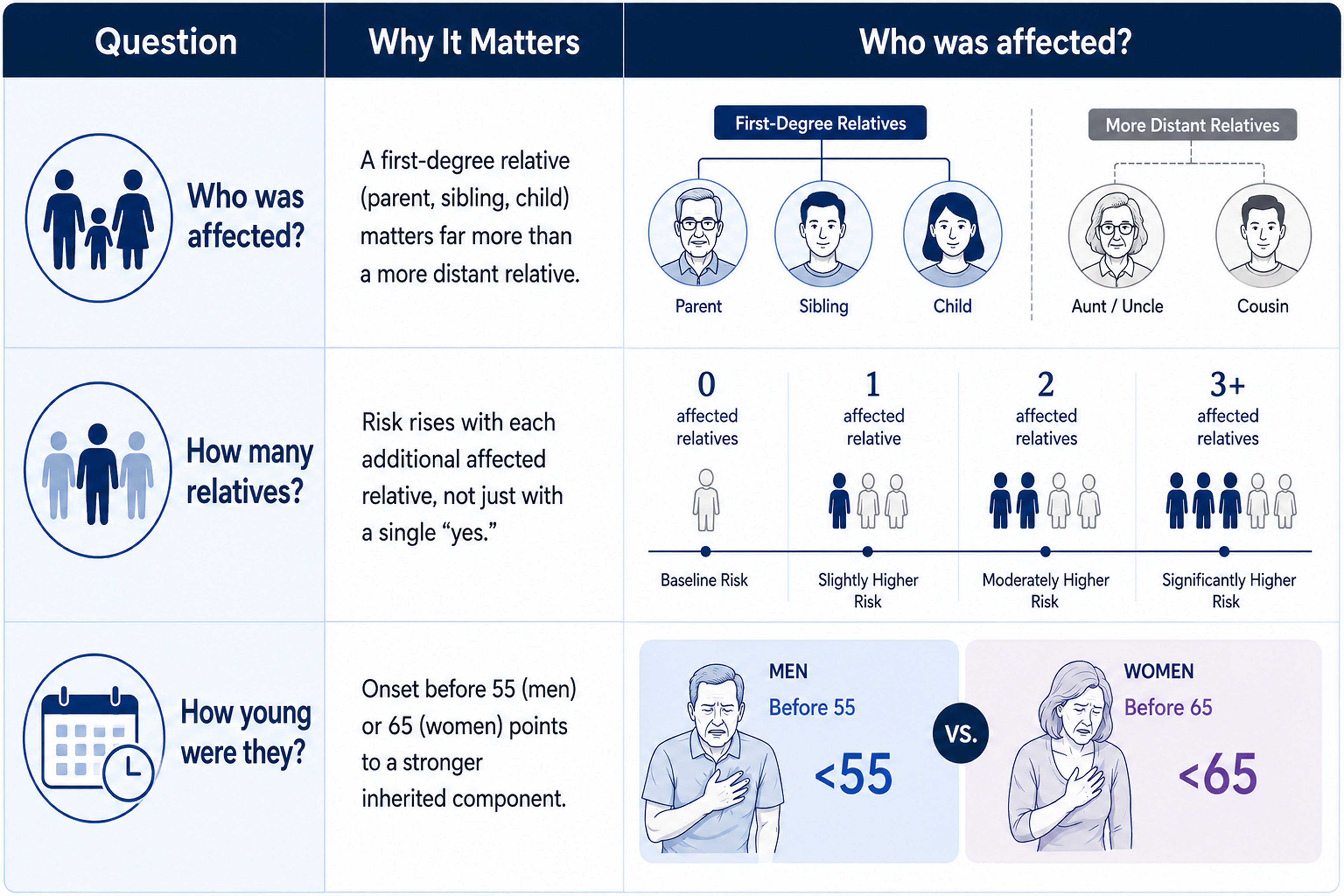
The scale of this effect is well documented. A case-control study from Kerala, India, found that family history of cardiovascular disease was independently associated with premature coronary heart disease, with risk rising in a near-linear pattern as more family members were affected.
Separately, the UAE Healthy Future Study found that offspring of parents with premature cardiovascular disease carried a 60 to 75 percent higher risk than those without such a history, describing a two- to five-fold increase in overall likelihood tied to family history of cardiovascular disease.
In the United States, AHA data estimated that 27.8 million American adults carry a family history of premature heart disease, most with a notably less favourable cardiovascular health profile than peers without one.
Family History Vs. Genetic Testing: They're Not The Same Thing
It's tempting to treat family history as a rough proxy for "bad genes," and genetic testing as the precise version of the same information. Research suggests otherwise.
Genetic or polygenic risk scores isolate specific DNA variants; family history captures those variants plus decades of shared behaviour and surroundings layered on top.
The medRxiv adoption study cited above found that polygenic risk scores explain only a minor portion of what family history predicts, and that the two measures are largely independent of one another.
In practice, that means a clean genetic test result doesn't cancel out a strong family history, and a strong family history doesn't require a genetic test to be taken seriously.
They're answering different questions. If you're curious about what a genetic or wearable-based risk score can and can't tell you on its own, that's a separate conversation worth having with your doctor.
Building A Three-Generation Health Record
Most people can name a relative's heart condition. Far fewer can say at what age it started, which is the detail that changes clinical decisions. The CDC's My Family Health Portrait tool is a free, structured way to record this.
For each relative, note:
- The condition itself (heart attack, bypass, stent, high blood pressure, high cholesterol),
- the age at diagnosis or event, and
- for relatives who have passed away, age and cause of death.
Update it whenever a new diagnosis appears in the family, and bring it to your next check-up rather than mentioning it in passing.
What You Can Actually Change
A family history is a starting point for closer attention, not a fixed outcome.
The World Heart Federation estimates that up to 80 percent of premature heart attacks and strokes are preventable, largely through managing blood pressure, cholesterol, tobacco use, physical activity, and diet the same modifiable factors that often travel through families alongside the genetic ones.
Knowing your family history tells you which of these levers deserve earlier, closer attention, and at what age to start pulling them.
Summary
A relative's heart disease is not a prediction about your own. It's a set of clues about genes, habits, and environment that, read together, tell you when to start paying closer attention and how closely to look. Documented properly and shared with a doctor, it becomes one of the most useful, and most overlooked, tools for catching heart disease before it becomes an emergency.
FAQs
1. Is heart disease hereditary?
Not directly, in most cases. What's inherited is a mix of genetic susceptibility, cholesterol and blood pressure tendencies, and shared family habits and environment that together raise or lower risk.
2. At what age does family history become a serious risk factor?
It carries more weight when a parent or sibling developed heart disease before 55 (men) or 65 (women). Earlier onset generally points to a stronger inherited component.
3. Can I lower my risk if heart disease runs in my family?
Yes. Family history is a prompt for earlier, more frequent monitoring, not a fixed outcome. Managing blood pressure, cholesterol, weight, tobacco use, and activity meaningfully reduces risk even with a strong family history.
4. Is family history the same as a genetic risk score?
No. Family history reflects genes, habits, and environment together, while a genetic risk score isolates DNA variants alone. Research shows the two capture different, only partly overlapping information.



India’s first AI-powered NCD diagnostics network.
Follow Us


Helius Wellness 2026. All Rights Reserved
August 7, 2026
Family History and Heart Disease: What Your Genes Are Actually Telling You
A parent's heart attack doesn't hand down a diagnosis. It's a mix of genes, habits, and environment, and the difference matters for what you do next.
Author:
Kavya Dave
TL;DR
A family history of heart disease means a parent, sibling, or child developed it, and it counts more heavily if that happened before age 55 in a man or 65 in a woman. It is not a genetic sentence. It reflects inherited genes, shared household habits, and shared environment together, and it remains one of the strongest independent predictors doctors use, separate from cholesterol or blood pressure alone. Knowing it early means monitoring can start years before symptoms would otherwise appear.
Cardiovascular disease killed an estimated 19.8 million people globally in 2022, roughly a third of all deaths worldwide, according to the WHO. Somewhere in that number is a quieter statistic: for millions of people, the first clue to their own risk was never a lab report. It was a parent's or sibling's diagnosis.
Family history of heart disease is one of the oldest risk factors in medicine, and one of the most misunderstood. Most people treat it as a coin flip inherited from their parents. It is actually a composite signal, and understanding what it's made of changes how seriously and how specifically you act on it.
Table of Contents
1. What Counts as a "Family History" of Heart Disease?
2. How Doctors Actually Measure This Risk
3. Family History Vs. Genetic Testing: They're Not The Same Thing
4. Building A Three-Generation Health Record
5. What You Can Actually Change
6. FAQs
What Counts as a "Family History" of Heart Disease?
According to the CDC, a family history of heart disease means a first-degree relative a parent, sibling, or child has been diagnosed with heart disease or a related condition such as high blood pressure or high cholesterol.
It carries the most clinical weight when that diagnosis occurred at a younger age: before 55 for men, before 65 for women. This is often called premature heart disease, and it signals a stronger inherited component than a diagnosis later in life.
Why Heart Disease Runs in Families
Heart disease clusters in families for three overlapping reasons, and most conversations only mention one of them.
1. Genes.
Some inherited conditions raise risk directly. Familial hypercholesterolemia, a genetic disorder that keeps LDL cholesterol abnormally high from birth, affects about 1 in every 311 people, per the CDC. Left untreated, it leads to heart attacks in roughly half of affected men by age 50 and a third of affected women by 60.
2. Shared habits.
Families often eat similar meals, share activity levels, and pick up smoking or sedentary habits from each other. These are inherited in practice, not in DNA.
3. Shared environment.
Access to healthcare, exposure to air pollution, and neighbourhood-level stress all run in families too, and all influence cardiovascular risk independently of genetics.
A population study of adopted and non-adopted individuals found that family history carries a substantial share of non-genetic risk, the kind shaped by shared habits and surroundings rather than shared DNA alone. That is the core distinction this article keeps coming back to.
If heart disease runs in your family, the goal is catching change early, not waiting for symptoms. Super ECG from Helius Wellness reads the heart's electrical, acoustic, and mechanical signals in one sitting, giving you and your doctor an earlier, fuller picture than a standard ECG alone.
How Doctors Actually Measure This Risk
Clinicians don't treat "yes" or "no" family history as equal for everyone. Three questions shape how much weight it carries.
The scale of this effect is well documented. A case-control study from Kerala, India, found that family history of cardiovascular disease was independently associated with premature coronary heart disease, with risk rising in a near-linear pattern as more family members were affected.
Separately, the UAE Healthy Future Study found that offspring of parents with premature cardiovascular disease carried a 60 to 75 percent higher risk than those without such a history, describing a two- to five-fold increase in overall likelihood tied to family history of cardiovascular disease.
In the United States, AHA data estimated that 27.8 million American adults carry a family history of premature heart disease, most with a notably less favourable cardiovascular health profile than peers without one.
Family History Vs. Genetic Testing: They're Not The Same Thing
It's tempting to treat family history as a rough proxy for "bad genes," and genetic testing as the precise version of the same information. Research suggests otherwise.
Genetic or polygenic risk scores isolate specific DNA variants; family history captures those variants plus decades of shared behaviour and surroundings layered on top.
The medRxiv adoption study cited above found that polygenic risk scores explain only a minor portion of what family history predicts, and that the two measures are largely independent of one another.
In practice, that means a clean genetic test result doesn't cancel out a strong family history, and a strong family history doesn't require a genetic test to be taken seriously.
They're answering different questions. If you're curious about what a genetic or wearable-based risk score can and can't tell you on its own, that's a separate conversation worth having with your doctor.
Building A Three-Generation Health Record
Most people can name a relative's heart condition. Far fewer can say at what age it started, which is the detail that changes clinical decisions. The CDC's My Family Health Portrait tool is a free, structured way to record this.
For each relative, note:
- The condition itself (heart attack, bypass, stent, high blood pressure, high cholesterol),
- the age at diagnosis or event, and
- for relatives who have passed away, age and cause of death.
Update it whenever a new diagnosis appears in the family, and bring it to your next check-up rather than mentioning it in passing.
What You Can Actually Change
A family history is a starting point for closer attention, not a fixed outcome.
The World Heart Federation estimates that up to 80 percent of premature heart attacks and strokes are preventable, largely through managing blood pressure, cholesterol, tobacco use, physical activity, and diet the same modifiable factors that often travel through families alongside the genetic ones.
Knowing your family history tells you which of these levers deserve earlier, closer attention, and at what age to start pulling them.
Summary
A relative's heart disease is not a prediction about your own. It's a set of clues about genes, habits, and environment that, read together, tell you when to start paying closer attention and how closely to look. Documented properly and shared with a doctor, it becomes one of the most useful, and most overlooked, tools for catching heart disease before it becomes an emergency.
FAQs
1. Is heart disease hereditary?
Not directly, in most cases. What's inherited is a mix of genetic susceptibility, cholesterol and blood pressure tendencies, and shared family habits and environment that together raise or lower risk.
2. At what age does family history become a serious risk factor?
It carries more weight when a parent or sibling developed heart disease before 55 (men) or 65 (women). Earlier onset generally points to a stronger inherited component.
3. Can I lower my risk if heart disease runs in my family?
Yes. Family history is a prompt for earlier, more frequent monitoring, not a fixed outcome. Managing blood pressure, cholesterol, weight, tobacco use, and activity meaningfully reduces risk even with a strong family history.
4. Is family history the same as a genetic risk score?
No. Family history reflects genes, habits, and environment together, while a genetic risk score isolates DNA variants alone. Research shows the two capture different, only partly overlapping information.
India’s first AI-powered NCD diagnostics network.
Helius Wellness 2026. All Rights Reserved
Follow Us
August 7, 2026
Family History and Heart Disease: What Your Genes Are Actually Telling You
A parent's heart attack doesn't hand down a diagnosis. It's a mix of genes, habits, and environment, and the difference matters for what you do next.
Author:
Kavya Dave
TL;DR
A family history of heart disease means a parent, sibling, or child developed it, and it counts more heavily if that happened before age 55 in a man or 65 in a woman. It is not a genetic sentence. It reflects inherited genes, shared household habits, and shared environment together, and it remains one of the strongest independent predictors doctors use, separate from cholesterol or blood pressure alone. Knowing it early means monitoring can start years before symptoms would otherwise appear.
Cardiovascular disease killed an estimated 19.8 million people globally in 2022, roughly a third of all deaths worldwide, according to the WHO. Somewhere in that number is a quieter statistic: for millions of people, the first clue to their own risk was never a lab report. It was a parent's or sibling's diagnosis.
Family history of heart disease is one of the oldest risk factors in medicine, and one of the most misunderstood. Most people treat it as a coin flip inherited from their parents. It is actually a composite signal, and understanding what it's made of changes how seriously and how specifically you act on it.
Table of Contents
1. What Counts as a "Family History" of Heart Disease?
2. How Doctors Actually Measure This Risk
3. Family History Vs. Genetic Testing: They're Not The Same Thing
4. Building A Three-Generation Health Record
5. What You Can Actually Change
6. FAQs
What Counts as a "Family History" of Heart Disease?
According to the CDC, a family history of heart disease means a first-degree relative a parent, sibling, or child has been diagnosed with heart disease or a related condition such as high blood pressure or high cholesterol.
It carries the most clinical weight when that diagnosis occurred at a younger age: before 55 for men, before 65 for women. This is often called premature heart disease, and it signals a stronger inherited component than a diagnosis later in life.
Why Heart Disease Runs in Families
Heart disease clusters in families for three overlapping reasons, and most conversations only mention one of them.
1. Genes.
Some inherited conditions raise risk directly. Familial hypercholesterolemia, a genetic disorder that keeps LDL cholesterol abnormally high from birth, affects about 1 in every 311 people, per the CDC. Left untreated, it leads to heart attacks in roughly half of affected men by age 50 and a third of affected women by 60.
2. Shared habits.
Families often eat similar meals, share activity levels, and pick up smoking or sedentary habits from each other. These are inherited in practice, not in DNA.
3. Shared environment.
Access to healthcare, exposure to air pollution, and neighbourhood-level stress all run in families too, and all influence cardiovascular risk independently of genetics.
A population study of adopted and non-adopted individuals found that family history carries a substantial share of non-genetic risk, the kind shaped by shared habits and surroundings rather than shared DNA alone. That is the core distinction this article keeps coming back to.
If heart disease runs in your family, the goal is catching change early, not waiting for symptoms. Super ECG from Helius Wellness reads the heart's electrical, acoustic, and mechanical signals in one sitting, giving you and your doctor an earlier, fuller picture than a standard ECG alone.
How Doctors Actually Measure This Risk
Clinicians don't treat "yes" or "no" family history as equal for everyone. Three questions shape how much weight it carries.
The scale of this effect is well documented. A case-control study from Kerala, India, found that family history of cardiovascular disease was independently associated with premature coronary heart disease, with risk rising in a near-linear pattern as more family members were affected.
Separately, the UAE Healthy Future Study found that offspring of parents with premature cardiovascular disease carried a 60 to 75 percent higher risk than those without such a history, describing a two- to five-fold increase in overall likelihood tied to family history of cardiovascular disease.
In the United States, AHA data estimated that 27.8 million American adults carry a family history of premature heart disease, most with a notably less favourable cardiovascular health profile than peers without one.
Family History Vs. Genetic Testing: They're Not The Same Thing
It's tempting to treat family history as a rough proxy for "bad genes," and genetic testing as the precise version of the same information. Research suggests otherwise.
Genetic or polygenic risk scores isolate specific DNA variants; family history captures those variants plus decades of shared behaviour and surroundings layered on top.
The medRxiv adoption study cited above found that polygenic risk scores explain only a minor portion of what family history predicts, and that the two measures are largely independent of one another.
In practice, that means a clean genetic test result doesn't cancel out a strong family history, and a strong family history doesn't require a genetic test to be taken seriously.
They're answering different questions. If you're curious about what a genetic or wearable-based risk score can and can't tell you on its own, that's a separate conversation worth having with your doctor.
Building A Three-Generation Health Record
Most people can name a relative's heart condition. Far fewer can say at what age it started, which is the detail that changes clinical decisions. The CDC's My Family Health Portrait tool is a free, structured way to record this.
For each relative, note:
- The condition itself (heart attack, bypass, stent, high blood pressure, high cholesterol),
- the age at diagnosis or event, and
- for relatives who have passed away, age and cause of death.
Update it whenever a new diagnosis appears in the family, and bring it to your next check-up rather than mentioning it in passing.
What You Can Actually Change
A family history is a starting point for closer attention, not a fixed outcome.
The World Heart Federation estimates that up to 80 percent of premature heart attacks and strokes are preventable, largely through managing blood pressure, cholesterol, tobacco use, physical activity, and diet the same modifiable factors that often travel through families alongside the genetic ones.
Knowing your family history tells you which of these levers deserve earlier, closer attention, and at what age to start pulling them.
Summary
A relative's heart disease is not a prediction about your own. It's a set of clues about genes, habits, and environment that, read together, tell you when to start paying closer attention and how closely to look. Documented properly and shared with a doctor, it becomes one of the most useful, and most overlooked, tools for catching heart disease before it becomes an emergency.
FAQs
1. Is heart disease hereditary?
Not directly, in most cases. What's inherited is a mix of genetic susceptibility, cholesterol and blood pressure tendencies, and shared family habits and environment that together raise or lower risk.
2. At what age does family history become a serious risk factor?
It carries more weight when a parent or sibling developed heart disease before 55 (men) or 65 (women). Earlier onset generally points to a stronger inherited component.
3. Can I lower my risk if heart disease runs in my family?
Yes. Family history is a prompt for earlier, more frequent monitoring, not a fixed outcome. Managing blood pressure, cholesterol, weight, tobacco use, and activity meaningfully reduces risk even with a strong family history.
4. Is family history the same as a genetic risk score?
No. Family history reflects genes, habits, and environment together, while a genetic risk score isolates DNA variants alone. Research shows the two capture different, only partly overlapping information.
Related Blogs

Family History and Heart Disease: What Your Genes Are Actually Telling You


August 7, 2026

What Happens After a Heart Attack: Why Cardiac Rehab in India Is Still an Afterthought
July 31, 2026

Women and Heart Disease in India: The Risk That Still Gets Diagnosed Too Late
July 24, 2026
Show all blogs
India’s first AI-powered NCD diagnostics network.
Helius Wellness 2026. All Rights Reserved
Follow Us