

July 24, 2026
Women and Heart Disease in India: The Risk That Still Gets Diagnosed Too Late
Heart disease kills more Indian women than breast cancer, yet most cases go undiagnosed. Learn the real symptoms, risk factors, and why doctors miss them.
Author:
Kavya Dave
Nearly half of Indian women with real heart disease symptoms never get a matching diagnosis.
National ageing survey data show 7.02% of older Indian women report symptoms consistent with angina. Yet only 3.55% have ever been diagnosed with heart disease.
It is a gap almost double what's seen in men of the same age. It's like women being sent home with a "stress" or "acidity" diagnosis when the real cause is their heart.
Heart disease symptoms in India are different in men and women, per se. We have shared facts, studies, and research on the diagnostic gap and ways to overcome it. Keep reading.
Table of Contents
1. The Scale of the Problem in India
2. The Diagnosed vs. Undiagnosed Story
3. Why Heart Attack Symptoms in Women Look Different
4. Often Overlooked Risk Factors
5. What This Means for Women and Clinicians
6. FAQs
The Scale of the Problem in India
Cardiovascular disease (CVD) is already India's leading cause of death, and women are not spared at all.
According to Global Burden of Disease data analyzed for Indian women, CVD caused an estimated 1.18 million deaths in a single year, with ischemic heart disease (IHD) alone accounting for roughly 620,000 of those deaths.
What's more alarming is the trend: between 2000 and 2017, annual IHD deaths among Indian women nearly doubled, rising close to 94%, a faster increase than seen in men over the same period.
A 2024 systematic review found CVD prevalence higher in women (14%) than in men (12%), with urban women facing an even steeper burden.
Moreover, the World Health Organization predicts that the global burden of CVD will increase substantially by 2050.
The Diagnosed vs. Undiagnosed Story
Here's where the "underdiagnosis" story becomes concrete.
The Longitudinal Ageing Study of India (LASI) found that only 3.55% of older women had ever been diagnosed with heart disease, yet 7.02% of them reported symptoms consistent with angina, nearly double the diagnosed rate.
In men, the diagnosed and symptomatic rates were far closer together. That gap between "has symptoms" and "has a diagnosis" is the underdiagnosis crisis.
This isn't unique to India.
A study across ten Indian hospitals found something similar. Women were far less likely than men to show the "classic" heart attack pattern that doctors are trained to spot fast. Their cases might be delayed rather than flagged as urgent.
Why Heart Attack Symptoms in Women Look Different
- Textbook heart attack symptoms, like crushing chest pain on the left arm, are how heart disease shows up in men.
- Women more often experience nausea, sweating, vomiting, and pain in the neck, jaw, throat, abdomen, or back rather than obvious chest pain.
Research found that using the standard definition of "typical" angina would fail to catch symptoms in roughly 65% of women who actually have coronary artery disease.
This mismatch has consequences beyond India, too.
A 2025 review found that among emergency department patients whose angina was initially missed, 63% were women compared to 37% men.
Fatigue, breathlessness, and indigestion-like discomfort get written off as stress, anxiety, or "just tiredness" both by women themselves and, sometimes, by clinicians who aren't actively screening for atypical presentation.
Often Overlooked Risk Factors
A few risk drivers matter, especially for Indian women, and rarely make it into general heart-health advice:
- Iron-deficiency anemia, common among Indian women, is linked to worse outcomes in both acute coronary events and heart failure.
- Menopause before age 40, PCOS, and pregnancy complications, such as high blood pressure or gestational diabetes, are recognized sex-specific risk factors that raise a woman's long-term cardiovascular risk.
- Psychological stress, intensified by rapid urbanization, dual responsibilities at home and work, and limited social support, has a documented physiological link to heart disease risk in Indian women, through elevated heart rate, blood pressure, and vascular strain.
- Coronary artery disease in India climbed sharply across recent decades in both urban and rural populations, and it now competes directly with and in many cases surpasses cancer as a cause of death in women.
Women are also underrepresented in cardiovascular research generally, making up well under half of participants in clinical trials globally, which means much of the "standard" heart disease knowledge base still doesn't reflect female physiology as closely as it should.
What This Means for Women and Clinicians
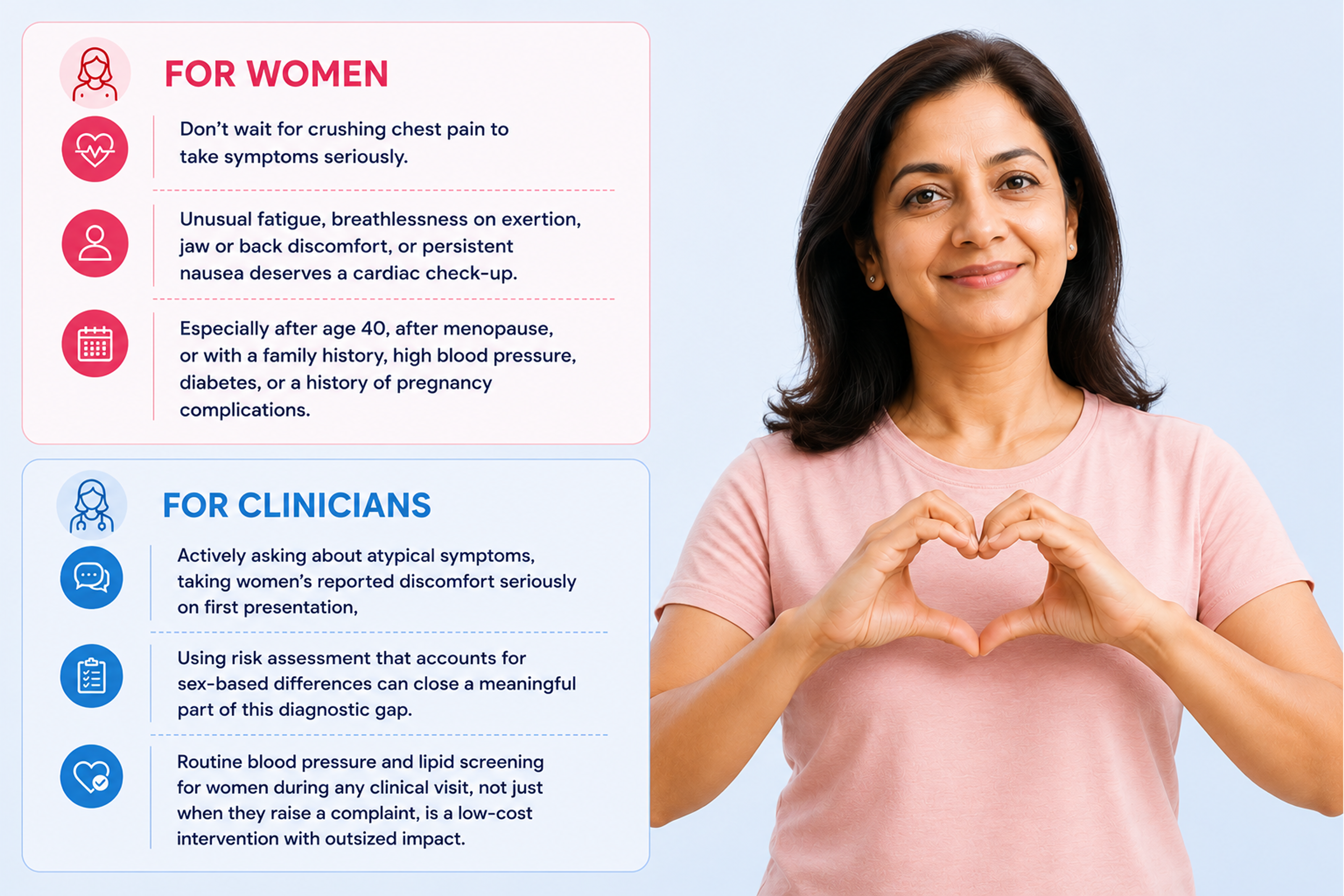
Summary
Heart disease in Indian women isn't rare, and it isn't a man's disease that occasionally affects women. It's a leading cause of death hiding behind symptoms that don't fit the textbook picture.
Recognizing that gap as a woman, as a family member, or as a clinician is the single most effective thing anyone can do to catch it earlier and act on it.
FAQs
1. What are the early heart disease symptoms in women in India?
Fatigue, breathlessness, nausea, indigestion-like discomfort, and pain in the jaw, neck, or back are common early signs, often without the chest-crushing pain seen in men.
2. Why is heart disease underdiagnosed in Indian women?
Symptoms often don't match the "typical" male-pattern presentation doctors are trained on, and social or systemic factors mean women are less likely to be promptly tested, referred for imaging, or treated as aggressively as men with similar risk profiles.
3. At what age should Indian women start heart health screening?
Risk rises notably after menopause, so regular blood pressure, blood sugar, and cholesterol checks from the early 40s onward, sooner with a family history, PCOS, or pregnancy complications, are advisable (best if starting in the 30s).



India’s first AI-powered NCD diagnostics network.
Follow Us


Helius Wellness 2026. All Rights Reserved
July 24, 2026
Women and Heart Disease in India: The Risk That Still Gets Diagnosed Too Late
Heart disease kills more Indian women than breast cancer, yet most cases go undiagnosed. Learn the real symptoms, risk factors, and why doctors miss them.
Author:
Kavya Dave
Nearly half of Indian women with real heart disease symptoms never get a matching diagnosis.
National ageing survey data show 7.02% of older Indian women report symptoms consistent with angina. Yet only 3.55% have ever been diagnosed with heart disease.
It is a gap almost double what's seen in men of the same age. It's like women being sent home with a "stress" or "acidity" diagnosis when the real cause is their heart.
Heart disease symptoms in India are different in men and women, per se. We have shared facts, studies, and research on the diagnostic gap and ways to overcome it. Keep reading.
Table of Contents
1. The Scale of the Problem in India
2. The Diagnosed vs. Undiagnosed Story
3. Why Heart Attack Symptoms in Women Look Different
4. Often Overlooked Risk Factors
5. What This Means for Women and Clinicians
6. FAQs
The Scale of the Problem in India
Cardiovascular disease (CVD) is already India's leading cause of death, and women are not spared at all.
According to Global Burden of Disease data analyzed for Indian women, CVD caused an estimated 1.18 million deaths in a single year, with ischemic heart disease (IHD) alone accounting for roughly 620,000 of those deaths.
What's more alarming is the trend: between 2000 and 2017, annual IHD deaths among Indian women nearly doubled, rising close to 94%, a faster increase than seen in men over the same period.
A 2024 systematic review found CVD prevalence higher in women (14%) than in men (12%), with urban women facing an even steeper burden.
Moreover, the World Health Organization predicts that the global burden of CVD will increase substantially by 2050.
The Diagnosed vs. Undiagnosed Story
Here's where the "underdiagnosis" story becomes concrete.
The Longitudinal Ageing Study of India (LASI) found that only 3.55% of older women had ever been diagnosed with heart disease, yet 7.02% of them reported symptoms consistent with angina, nearly double the diagnosed rate.
In men, the diagnosed and symptomatic rates were far closer together. That gap between "has symptoms" and "has a diagnosis" is the underdiagnosis crisis.
This isn't unique to India.
A study across ten Indian hospitals found something similar. Women were far less likely than men to show the "classic" heart attack pattern that doctors are trained to spot fast. Their cases might be delayed rather than flagged as urgent.
Why Heart Attack Symptoms in Women Look Different
- Textbook heart attack symptoms, like crushing chest pain on the left arm, are how heart disease shows up in men.
- Women more often experience nausea, sweating, vomiting, and pain in the neck, jaw, throat, abdomen, or back rather than obvious chest pain.
Research found that using the standard definition of "typical" angina would fail to catch symptoms in roughly 65% of women who actually have coronary artery disease.
This mismatch has consequences beyond India, too.
A 2025 review found that among emergency department patients whose angina was initially missed, 63% were women compared to 37% men.
Fatigue, breathlessness, and indigestion-like discomfort get written off as stress, anxiety, or "just tiredness" both by women themselves and, sometimes, by clinicians who aren't actively screening for atypical presentation.
Often Overlooked Risk Factors
A few risk drivers matter, especially for Indian women, and rarely make it into general heart-health advice:
- Iron-deficiency anemia, common among Indian women, is linked to worse outcomes in both acute coronary events and heart failure.
- Menopause before age 40, PCOS, and pregnancy complications, such as high blood pressure or gestational diabetes, are recognized sex-specific risk factors that raise a woman's long-term cardiovascular risk.
- Psychological stress, intensified by rapid urbanization, dual responsibilities at home and work, and limited social support, has a documented physiological link to heart disease risk in Indian women, through elevated heart rate, blood pressure, and vascular strain.
- Coronary artery disease in India climbed sharply across recent decades in both urban and rural populations, and it now competes directly with and in many cases surpasses cancer as a cause of death in women.
Women are also underrepresented in cardiovascular research generally, making up well under half of participants in clinical trials globally, which means much of the "standard" heart disease knowledge base still doesn't reflect female physiology as closely as it should.
What This Means for Women and Clinicians
Summary
Heart disease in Indian women isn't rare, and it isn't a man's disease that occasionally affects women. It's a leading cause of death hiding behind symptoms that don't fit the textbook picture.
Recognizing that gap as a woman, as a family member, or as a clinician is the single most effective thing anyone can do to catch it earlier and act on it.
FAQs
1. What are the early heart disease symptoms in women in India?
Fatigue, breathlessness, nausea, indigestion-like discomfort, and pain in the jaw, neck, or back are common early signs, often without the chest-crushing pain seen in men.
2. Why is heart disease underdiagnosed in Indian women?
Symptoms often don't match the "typical" male-pattern presentation doctors are trained on, and social or systemic factors mean women are less likely to be promptly tested, referred for imaging, or treated as aggressively as men with similar risk profiles.
3. At what age should Indian women start heart health screening?
Risk rises notably after menopause, so regular blood pressure, blood sugar, and cholesterol checks from the early 40s onward, sooner with a family history, PCOS, or pregnancy complications, are advisable (best if starting in the 30s).
India’s first AI-powered NCD diagnostics network.
Helius Wellness 2026. All Rights Reserved
Follow Us
July 24, 2026
Women and Heart Disease in India: The Risk That Still Gets Diagnosed Too Late
Heart disease kills more Indian women than breast cancer, yet most cases go undiagnosed. Learn the real symptoms, risk factors, and why doctors miss them.
Author:
Kavya Dave
Nearly half of Indian women with real heart disease symptoms never get a matching diagnosis.
National ageing survey data show 7.02% of older Indian women report symptoms consistent with angina. Yet only 3.55% have ever been diagnosed with heart disease.
It is a gap almost double what's seen in men of the same age. It's like women being sent home with a "stress" or "acidity" diagnosis when the real cause is their heart.
Heart disease symptoms in India are different in men and women, per se. We have shared facts, studies, and research on the diagnostic gap and ways to overcome it. Keep reading.
Table of Contents
1. The Scale of the Problem in India
2. The Diagnosed vs. Undiagnosed Story
3. Why Heart Attack Symptoms in Women Look Different
4. Often Overlooked Risk Factors
5. What This Means for Women and Clinicians
6. FAQs
The Scale of the Problem in India
Cardiovascular disease (CVD) is already India's leading cause of death, and women are not spared at all.
According to Global Burden of Disease data analyzed for Indian women, CVD caused an estimated 1.18 million deaths in a single year, with ischemic heart disease (IHD) alone accounting for roughly 620,000 of those deaths.
What's more alarming is the trend: between 2000 and 2017, annual IHD deaths among Indian women nearly doubled, rising close to 94%, a faster increase than seen in men over the same period.
A 2024 systematic review found CVD prevalence higher in women (14%) than in men (12%), with urban women facing an even steeper burden.
Moreover, the World Health Organization predicts that the global burden of CVD will increase substantially by 2050.
The Diagnosed vs. Undiagnosed Story
Here's where the "underdiagnosis" story becomes concrete.
The Longitudinal Ageing Study of India (LASI) found that only 3.55% of older women had ever been diagnosed with heart disease, yet 7.02% of them reported symptoms consistent with angina, nearly double the diagnosed rate.
In men, the diagnosed and symptomatic rates were far closer together. That gap between "has symptoms" and "has a diagnosis" is the underdiagnosis crisis.
This isn't unique to India.
A study across ten Indian hospitals found something similar. Women were far less likely than men to show the "classic" heart attack pattern that doctors are trained to spot fast. Their cases might be delayed rather than flagged as urgent.
Why Heart Attack Symptoms in Women Look Different
- Textbook heart attack symptoms, like crushing chest pain on the left arm, are how heart disease shows up in men.
- Women more often experience nausea, sweating, vomiting, and pain in the neck, jaw, throat, abdomen, or back rather than obvious chest pain.
Research found that using the standard definition of "typical" angina would fail to catch symptoms in roughly 65% of women who actually have coronary artery disease.
This mismatch has consequences beyond India, too.
A 2025 review found that among emergency department patients whose angina was initially missed, 63% were women compared to 37% men.
Fatigue, breathlessness, and indigestion-like discomfort get written off as stress, anxiety, or "just tiredness" both by women themselves and, sometimes, by clinicians who aren't actively screening for atypical presentation.
Often Overlooked Risk Factors
A few risk drivers matter, especially for Indian women, and rarely make it into general heart-health advice:
- Iron-deficiency anemia, common among Indian women, is linked to worse outcomes in both acute coronary events and heart failure.
- Menopause before age 40, PCOS, and pregnancy complications, such as high blood pressure or gestational diabetes, are recognized sex-specific risk factors that raise a woman's long-term cardiovascular risk.
- Psychological stress, intensified by rapid urbanization, dual responsibilities at home and work, and limited social support, has a documented physiological link to heart disease risk in Indian women, through elevated heart rate, blood pressure, and vascular strain.
- Coronary artery disease in India climbed sharply across recent decades in both urban and rural populations, and it now competes directly with and in many cases surpasses cancer as a cause of death in women.
Women are also underrepresented in cardiovascular research generally, making up well under half of participants in clinical trials globally, which means much of the "standard" heart disease knowledge base still doesn't reflect female physiology as closely as it should.
What This Means for Women and Clinicians
Summary
Heart disease in Indian women isn't rare, and it isn't a man's disease that occasionally affects women. It's a leading cause of death hiding behind symptoms that don't fit the textbook picture.
Recognizing that gap as a woman, as a family member, or as a clinician is the single most effective thing anyone can do to catch it earlier and act on it.
FAQs
1. What are the early heart disease symptoms in women in India?
Fatigue, breathlessness, nausea, indigestion-like discomfort, and pain in the jaw, neck, or back are common early signs, often without the chest-crushing pain seen in men.
2. Why is heart disease underdiagnosed in Indian women?
Symptoms often don't match the "typical" male-pattern presentation doctors are trained on, and social or systemic factors mean women are less likely to be promptly tested, referred for imaging, or treated as aggressively as men with similar risk profiles.
3. At what age should Indian women start heart health screening?
Risk rises notably after menopause, so regular blood pressure, blood sugar, and cholesterol checks from the early 40s onward, sooner with a family history, PCOS, or pregnancy complications, are advisable (best if starting in the 30s).
Related Blogs

Women and Heart Disease in India: The Risk That Still Gets Diagnosed Too Late


July 24, 2026
Why Delhi's Smog Season Is a Heart Attack Risk, Not Just a Lung Problem
July 17, 2026
ECG vs 2D Echo vs Super ECG: What Each Test Actually Tells You About Your Heart And What It Doesn't
July 10, 2026
Show all blogs
India’s first AI-powered NCD diagnostics network.
Helius Wellness 2026. All Rights Reserved
Follow Us