

July 31, 2026
What Happens After a Heart Attack: Why Cardiac Rehab in India Is Still an Afterthought
India has 1 cardiac rehab spot per 360 patients. Discover why 90% of heart attack survivors recover alone and what continuous monitoring can change.
Author:
Paresh Masani
India has one cardiac rehabilitation spot for roughly every 360 patients who need one each year.
That single number, from a national audit by the International Council of Cardiovascular Prevention and Rehabilitation, says more about heart attack recovery in India than any patient story could.
It means that for the overwhelming majority of survivors, the structured, supervised recovery program considered standard practice worldwide simply isn't there to walk into.
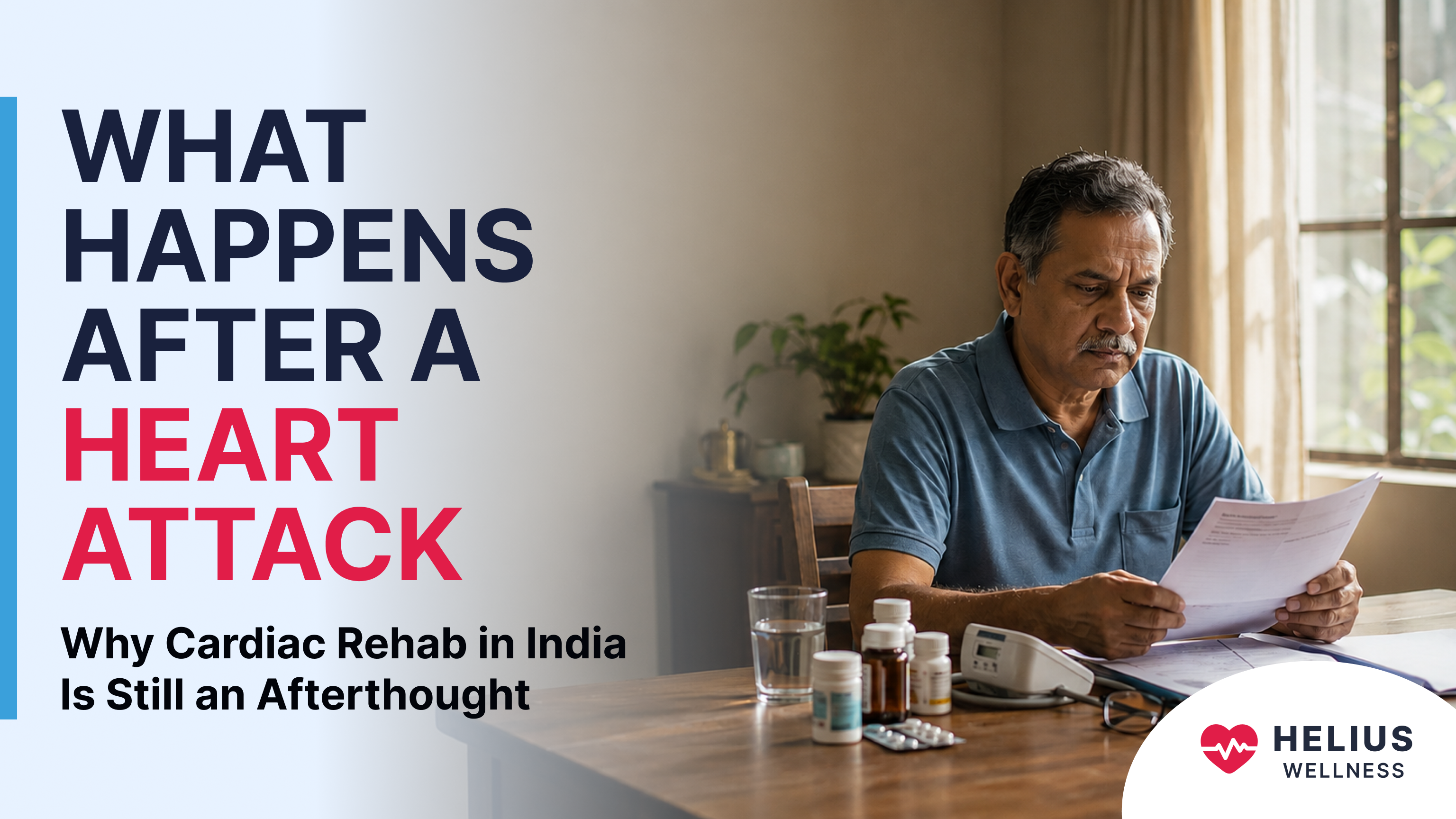
What they get instead, in most cases, is a discharge folder with a prescription, a follow-up date a month away, and a single line of advice: walk daily, avoid stress.
Nobody asks whether they have stairs at home, a physically demanding job, or a family history that makes a second event more likely. Medically, they've been saved. What happens next is left almost entirely to them.
India has become genuinely good at the emergency part of cardiac care. Catheterisation labs, stents, and bypass surgery are available in most large cities, often within the golden hour.
But the months after a heart attack, when a person is meant to be rebuilt physically and mentally, remain largely unsupervised.
Table of Contents
1. The 90 Days Nobody Warns You About
2. Why the Gap Exists
3. What Gets Missed When Rehab Is Skipped
4. What Continuous Monitoring Changes
5. The “Discharge Note” Isn't a Rehab Plan
The 90 Days Nobody Warns You About
For most heart attack survivors in India, recovery isn't a program; it's improvisation. In the weeks after discharge, patients are quietly left to answer questions no one prepared them for:
- How much walking is safe?
- Is this chest twinge normal or an emergency?
- Can I go back to a desk job, a kitchen, a two-wheeler commute?
- Is the fear I feel every time my heart skips a beat something I should mention to anyone?
Structured cardiac rehabilitation exists precisely to answer these questions under supervision through monitored exercise, education on medication and diet, and psychological support.
Globally, participation in such programs ranges from 20% to 50% of eligible patients.
In India, uptake is even lower: a hospital-based study found that only 9.3% of enrolled patients completed a structured outpatient rehabilitation program. The other 90 percent go home with a prescription and a hope.
Why the Gap Exists
The absence of cardiac rehab in India isn't due to a lack of awareness that it works. It's structural.
1. It isn't reimbursed.
Most Indian insurers cover the angioplasty and the hospital stay, but not the recovery program that determines whether that angioplasty holds up long-term.
The same ICCPR audit found that only one cardiac rehab program in India reported being reimbursed through an alternative payment model; everything else relies on out-of-pocket payment or simply isn't offered.
2. It is geographically concentrated.
Formal rehab centres cluster around a handful of metro hospitals. A patient discharged from a tier-2 or tier-3 city hospital, where most of India's cardiac events now occur, often has no rehab facility within reasonable travelling distance.
3. Inconsistent referrals.
A 2024 survey of Indian physiotherapists found that nearly 80% believed it would be difficult for a physiotherapist to refer a patient to a cardiac rehab program in the current system.
What Gets Missed When Rehab Is Skipped
Cardiovascular disease in India isn't a simple statistic; it's a leading and disproportionately early threat.
Age-adjusted cardiovascular mortality in India runs at 349 per 100,000 among men and 265 per 100,000 among women, more than double the rate in the United States.
Globally, cardiovascular disease already accounts for roughly one in three deaths, with 85% of those linked directly to heart attack and stroke.
Rehab is one of the few interventions proven to change that trajectory.
It shows up quietly: a missed medication dose that becomes a pattern, chest discomfort during unsupervised exertion that goes unreported, anxiety after a cardiac event that never gets addressed, and slowly narrows a person's life.
None of this appears on a discharge summary. All of it shows up, eventually, as a second event or a hospital readmission that could plausibly have been prevented.
What Continuous Monitoring Changes
Formal, centre-based rehab is the gold standard, and expanding it through insurance reform, decentralised access, and stronger referral pathways is the real long-term fix.
But for the months between hospital discharge and the next in-person follow-up, especially for patients far from a rehab centre, continuous at-home monitoring can close part of the visibility gap.
Tracking a patient's electrical, acoustic, and mechanical heart signals over time gives both the patient and their doctor a clearer picture of how recovery is actually progressing, not a replacement for supervised rehab or clinical judgment, but a way to catch what unsupervised recovery currently misses.
Most of what goes wrong after a heart attack goes wrong quietly.
Super ECG tracks a patient's electrical, acoustic, and mechanical heart signals continuously, not just during a clinic visit. Patient and doctor get a clearer, ongoing picture of recovery instead of a single snapshot once a month.
See how →
The “Discharge Note” Isn't a Rehab Plan
"Walk daily, avoid stress" isn't wrong. It's just not a recovery plan.
India has built a genuinely world-class capability at the moment when a heart stops working properly.
What it hasn't built yet is the infrastructure for the months after, when a person is quietly deciding, alone, how to live with a heart that has already proven it can fail.
Closing that gap will take insurance reform, decentralised rehab access, and referral pathways that don't depend on individual doctors remembering to mention it.
Until then, recovery in India remains what it has quietly been for too long, something patients are expected to manage on willpower, in a system that gave them none of the tools to do it.


India’s first AI-powered NCD diagnostics network.
Follow Us


Helius Wellness 2026. All Rights Reserved
July 31, 2026
What Happens After a Heart Attack: Why Cardiac Rehab in India Is Still an Afterthought
India has 1 cardiac rehab spot per 360 patients. Discover why 90% of heart attack survivors recover alone and what continuous monitoring can change.
Author:
Paresh Masani
India has one cardiac rehabilitation spot for roughly every 360 patients who need one each year.
That single number, from a national audit by the International Council of Cardiovascular Prevention and Rehabilitation, says more about heart attack recovery in India than any patient story could.
It means that for the overwhelming majority of survivors, the structured, supervised recovery program considered standard practice worldwide simply isn't there to walk into.
What they get instead, in most cases, is a discharge folder with a prescription, a follow-up date a month away, and a single line of advice: walk daily, avoid stress.
Nobody asks whether they have stairs at home, a physically demanding job, or a family history that makes a second event more likely. Medically, they've been saved. What happens next is left almost entirely to them.
India has become genuinely good at the emergency part of cardiac care. Catheterisation labs, stents, and bypass surgery are available in most large cities, often within the golden hour.
But the months after a heart attack, when a person is meant to be rebuilt physically and mentally, remain largely unsupervised.
Table of Contents
1. The 90 Days Nobody Warns You About
2. Why the Gap Exists
3. What Gets Missed When Rehab Is Skipped
4. What Continuous Monitoring Changes
5. The “Discharge Note” Isn't a Rehab Plan
The 90 Days Nobody Warns You About
For most heart attack survivors in India, recovery isn't a program; it's improvisation. In the weeks after discharge, patients are quietly left to answer questions no one prepared them for:
- How much walking is safe?
- Is this chest twinge normal or an emergency?
- Can I go back to a desk job, a kitchen, a two-wheeler commute?
- Is the fear I feel every time my heart skips a beat something I should mention to anyone?
Structured cardiac rehabilitation exists precisely to answer these questions under supervision through monitored exercise, education on medication and diet, and psychological support.
Globally, participation in such programs ranges from 20% to 50% of eligible patients.
In India, uptake is even lower: a hospital-based study found that only 9.3% of enrolled patients completed a structured outpatient rehabilitation program. The other 90 percent go home with a prescription and a hope.
Why the Gap Exists
The absence of cardiac rehab in India isn't due to a lack of awareness that it works. It's structural.
1. It isn't reimbursed.
Most Indian insurers cover the angioplasty and the hospital stay, but not the recovery program that determines whether that angioplasty holds up long-term.
The same ICCPR audit found that only one cardiac rehab program in India reported being reimbursed through an alternative payment model; everything else relies on out-of-pocket payment or simply isn't offered.
2. It is geographically concentrated.
Formal rehab centres cluster around a handful of metro hospitals. A patient discharged from a tier-2 or tier-3 city hospital, where most of India's cardiac events now occur, often has no rehab facility within reasonable travelling distance.
3. Inconsistent referrals.
A 2024 survey of Indian physiotherapists found that nearly 80% believed it would be difficult for a physiotherapist to refer a patient to a cardiac rehab program in the current system.
What Gets Missed When Rehab Is Skipped
Cardiovascular disease in India isn't a simple statistic; it's a leading and disproportionately early threat.
Age-adjusted cardiovascular mortality in India runs at 349 per 100,000 among men and 265 per 100,000 among women, more than double the rate in the United States.
Globally, cardiovascular disease already accounts for roughly one in three deaths, with 85% of those linked directly to heart attack and stroke.
Rehab is one of the few interventions proven to change that trajectory.
It shows up quietly: a missed medication dose that becomes a pattern, chest discomfort during unsupervised exertion that goes unreported, anxiety after a cardiac event that never gets addressed, and slowly narrows a person's life.
None of this appears on a discharge summary. All of it shows up, eventually, as a second event or a hospital readmission that could plausibly have been prevented.
What Continuous Monitoring Changes
Formal, centre-based rehab is the gold standard, and expanding it through insurance reform, decentralised access, and stronger referral pathways is the real long-term fix.
But for the months between hospital discharge and the next in-person follow-up, especially for patients far from a rehab centre, continuous at-home monitoring can close part of the visibility gap.
Tracking a patient's electrical, acoustic, and mechanical heart signals over time gives both the patient and their doctor a clearer picture of how recovery is actually progressing, not a replacement for supervised rehab or clinical judgment, but a way to catch what unsupervised recovery currently misses.
Most of what goes wrong after a heart attack goes wrong quietly.
Super ECG tracks a patient's electrical, acoustic, and mechanical heart signals continuously, not just during a clinic visit. Patient and doctor get a clearer, ongoing picture of recovery instead of a single snapshot once a month.
See how →
The “Discharge Note” Isn't a Rehab Plan
"Walk daily, avoid stress" isn't wrong. It's just not a recovery plan.
India has built a genuinely world-class capability at the moment when a heart stops working properly.
What it hasn't built yet is the infrastructure for the months after, when a person is quietly deciding, alone, how to live with a heart that has already proven it can fail.
Closing that gap will take insurance reform, decentralised rehab access, and referral pathways that don't depend on individual doctors remembering to mention it.
Until then, recovery in India remains what it has quietly been for too long, something patients are expected to manage on willpower, in a system that gave them none of the tools to do it.
India’s first AI-powered NCD diagnostics network.
Helius Wellness 2026. All Rights Reserved
Follow Us
July 31, 2026
What Happens After a Heart Attack: Why Cardiac Rehab in India Is Still an Afterthought
India has 1 cardiac rehab spot per 360 patients. Discover why 90% of heart attack survivors recover alone and what continuous monitoring can change.
Author:
Paresh Masani
India has one cardiac rehabilitation spot for roughly every 360 patients who need one each year.
That single number, from a national audit by the International Council of Cardiovascular Prevention and Rehabilitation, says more about heart attack recovery in India than any patient story could.
It means that for the overwhelming majority of survivors, the structured, supervised recovery program considered standard practice worldwide simply isn't there to walk into.
What they get instead, in most cases, is a discharge folder with a prescription, a follow-up date a month away, and a single line of advice: walk daily, avoid stress.
Nobody asks whether they have stairs at home, a physically demanding job, or a family history that makes a second event more likely. Medically, they've been saved. What happens next is left almost entirely to them.
India has become genuinely good at the emergency part of cardiac care. Catheterisation labs, stents, and bypass surgery are available in most large cities, often within the golden hour.
But the months after a heart attack, when a person is meant to be rebuilt physically and mentally, remain largely unsupervised.
Table of Contents
1. The 90 Days Nobody Warns You About
2. Why the Gap Exists
3. What Gets Missed When Rehab Is Skipped
4. What Continuous Monitoring Changes
5. The “Discharge Note” Isn't a Rehab Plan
The 90 Days Nobody Warns You About
For most heart attack survivors in India, recovery isn't a program; it's improvisation. In the weeks after discharge, patients are quietly left to answer questions no one prepared them for:
- How much walking is safe?
- Is this chest twinge normal or an emergency?
- Can I go back to a desk job, a kitchen, a two-wheeler commute?
- Is the fear I feel every time my heart skips a beat something I should mention to anyone?
Structured cardiac rehabilitation exists precisely to answer these questions under supervision through monitored exercise, education on medication and diet, and psychological support.
Globally, participation in such programs ranges from 20% to 50% of eligible patients.
In India, uptake is even lower: a hospital-based study found that only 9.3% of enrolled patients completed a structured outpatient rehabilitation program. The other 90 percent go home with a prescription and a hope.
Why the Gap Exists
The absence of cardiac rehab in India isn't due to a lack of awareness that it works. It's structural.
1. It isn't reimbursed.
Most Indian insurers cover the angioplasty and the hospital stay, but not the recovery program that determines whether that angioplasty holds up long-term.
The same ICCPR audit found that only one cardiac rehab program in India reported being reimbursed through an alternative payment model; everything else relies on out-of-pocket payment or simply isn't offered.
2. It is geographically concentrated.
Formal rehab centres cluster around a handful of metro hospitals. A patient discharged from a tier-2 or tier-3 city hospital, where most of India's cardiac events now occur, often has no rehab facility within reasonable travelling distance.
3. Inconsistent referrals.
A 2024 survey of Indian physiotherapists found that nearly 80% believed it would be difficult for a physiotherapist to refer a patient to a cardiac rehab program in the current system.
What Gets Missed When Rehab Is Skipped
Cardiovascular disease in India isn't a simple statistic; it's a leading and disproportionately early threat.
Age-adjusted cardiovascular mortality in India runs at 349 per 100,000 among men and 265 per 100,000 among women, more than double the rate in the United States.
Globally, cardiovascular disease already accounts for roughly one in three deaths, with 85% of those linked directly to heart attack and stroke.
Rehab is one of the few interventions proven to change that trajectory.
It shows up quietly: a missed medication dose that becomes a pattern, chest discomfort during unsupervised exertion that goes unreported, anxiety after a cardiac event that never gets addressed, and slowly narrows a person's life.
None of this appears on a discharge summary. All of it shows up, eventually, as a second event or a hospital readmission that could plausibly have been prevented.
What Continuous Monitoring Changes
Formal, centre-based rehab is the gold standard, and expanding it through insurance reform, decentralised access, and stronger referral pathways is the real long-term fix.
But for the months between hospital discharge and the next in-person follow-up, especially for patients far from a rehab centre, continuous at-home monitoring can close part of the visibility gap.
Tracking a patient's electrical, acoustic, and mechanical heart signals over time gives both the patient and their doctor a clearer picture of how recovery is actually progressing, not a replacement for supervised rehab or clinical judgment, but a way to catch what unsupervised recovery currently misses.
Most of what goes wrong after a heart attack goes wrong quietly.
Super ECG tracks a patient's electrical, acoustic, and mechanical heart signals continuously, not just during a clinic visit. Patient and doctor get a clearer, ongoing picture of recovery instead of a single snapshot once a month.
See how →
The “Discharge Note” Isn't a Rehab Plan
"Walk daily, avoid stress" isn't wrong. It's just not a recovery plan.
India has built a genuinely world-class capability at the moment when a heart stops working properly.
What it hasn't built yet is the infrastructure for the months after, when a person is quietly deciding, alone, how to live with a heart that has already proven it can fail.
Closing that gap will take insurance reform, decentralised rehab access, and referral pathways that don't depend on individual doctors remembering to mention it.
Until then, recovery in India remains what it has quietly been for too long, something patients are expected to manage on willpower, in a system that gave them none of the tools to do it.
Related Blogs

What Happens After a Heart Attack: Why Cardiac Rehab in India Is Still an Afterthought


July 31, 2026

Women and Heart Disease in India: The Risk That Still Gets Diagnosed Too Late
July 24, 2026


Why Delhi's Smog Season Is a Heart Attack Risk, Not Just a Lung Problem
July 17, 2026
Show all blogs
India’s first AI-powered NCD diagnostics network.
Helius Wellness 2026. All Rights Reserved
Follow Us