


September 3, 2026
Why Heart Attacks Are Rising Among Young Indians in Their 30s and 40s
Heart attacks in young Indians are rising. Here's the 15-year silent build-up behind them and what to test in your 30s.
Author:
Kavya Dave
Key Takeaways
- Indians have a heart attack roughly 10 years earlier than Western populations, and rates in young Indians are several times higher.
- The cause is rarely one bad habit. It is a 15-year build-up of insulin resistance, hidden belly fat, untreated blood pressure, and inherited lipid risk.
- BMI and a basic annual health check miss most of it.
- A heart attack at 38 is not a 38-year-old event. It is the visible end of a process that quietly began around 25.
Every few weeks, another headline: a 34-year-old fit and active professional, a gym session, a sudden cardiac arrest. The coverage always focuses on the final four minutes. The medical evidence points somewhere else.
Research on young Indian heart attack patients shows that Indians develop acute myocardial infarction about 10 years earlier, with rates three to five times higher in young Indians than in other populations.
The INTERHEART study found that the mean age of heart attack in South Asians was 52 years, compared with 60 to 65 years in European and North American groups.
This is not new. What is new is the sheer number of young Indians now entering that pipeline. Below is what actually happens across the two decades nobody watches.
Table of Contents
1. Age 25: The Genetic Starting Line
2. Age 28: Where The Fat Goes
3. Age 31: The Metabolic Tipping Point
4. Age 34: Pressure, Sleep And The Desk Job
5. Age 36: What The Artery Looks Like Now
6. Age 38: Why It Still Looks Sudden
7. Reading The Timeline Backwards
8. What To Do In Your 30s, Specifically
Age 25: The Genetic Starting Line
Some risk is set before any lifestyle choice is made. Lipoprotein(a), or Lp(a), is an inherited particle that is increasingly recognised as the strongest known genetic risk factor for premature coronary artery disease.
It is a problem of population frequency here: roughly 25% of South Asians have levels above 50 mg/dL, higher than Western populations, which may partly explain the earlier onset and more aggressive course of coronary disease in this group.
Lp(a) is stable for life and is rarely tested in a routine Indian health package.
Age 28: Where The Fat Goes
Asian Indians show a "thin-fat" phenotype, with excess fat deposited centrally and viscerally, meaning that at the same BMI they are more insulin resistant and have a higher prevalence of type 2 diabetes and metabolic syndrome.
INTERHEART reached the same practical conclusion, noting that abdominal obesity is a greater risk factor than BMI, and waist-to-hip ratio should replace BMI as the obesity indicator.
Meaning: a 28-year-old with a BMI of 22 and a slightly thickening waist can already be metabolically unwell.
Not sure what your numbers actually mean?
Book a preventive heart health assessment and get a full cardiometabolic picture instead of a single weight reading.
Age 31: The Metabolic Tipping Point
This is where the silent decade turns loud on paper but stays silent in the body. The ICMR-INDIAB national survey found a weighted prevalence of 11.4% for diabetes, 15.3% for prediabetes, 35.5% for hypertension, 39.5% for abdominal obesity, and 81.2% for dyslipidaemia among Indian adults.
Read that last figure again. Four out of five Indian adults surveyed had an abnormal lipid profile. Prediabetes and early hypertension produce no symptoms at all, which is exactly why they are ignored through the thirties.
Age 34: Pressure, Sleep And The Desk Job
Long commutes, night shifts, chronic work stress, poor sleep and near-zero structured movement all land in the same decade as career peak.
INTERHEART established that nine risk factors, including smoking, diabetes, psychosocial factors, sedentary lifestyle, abdominal obesity, hypertension and dyslipidaemia, accounted for about 90% of heart attacks. Almost all of them are modifiable, and almost none of them announce themselves.
Age 36: What The Artery Looks Like Now
By the mid-thirties, the arterial wall in a high-risk young Indian is not a clean pipe with one narrow spot. It carries diffuse, multi-vessel plaque. Studies note that "malignant" coronary artery disease describes a severe, extensive atherosclerotic process across multiple coronary arteries in young people who often carry little or no burden of the established risk factors.
Age 38: Why It Still Looks Sudden
Here is the fact that explains almost every "but he was healthy" headline. Plaque rupture does not require a severe blockage. In the vulnerable plaque literature, approximately 70% of lesions responsible for myocardial infarction have been reported as less than 50% stenotic.
A stress test can look acceptable. An angiogram is not routinely done. And a plaque that occupies a third of a vessel can still rupture on a Tuesday morning.
Reading The Timeline Backwards
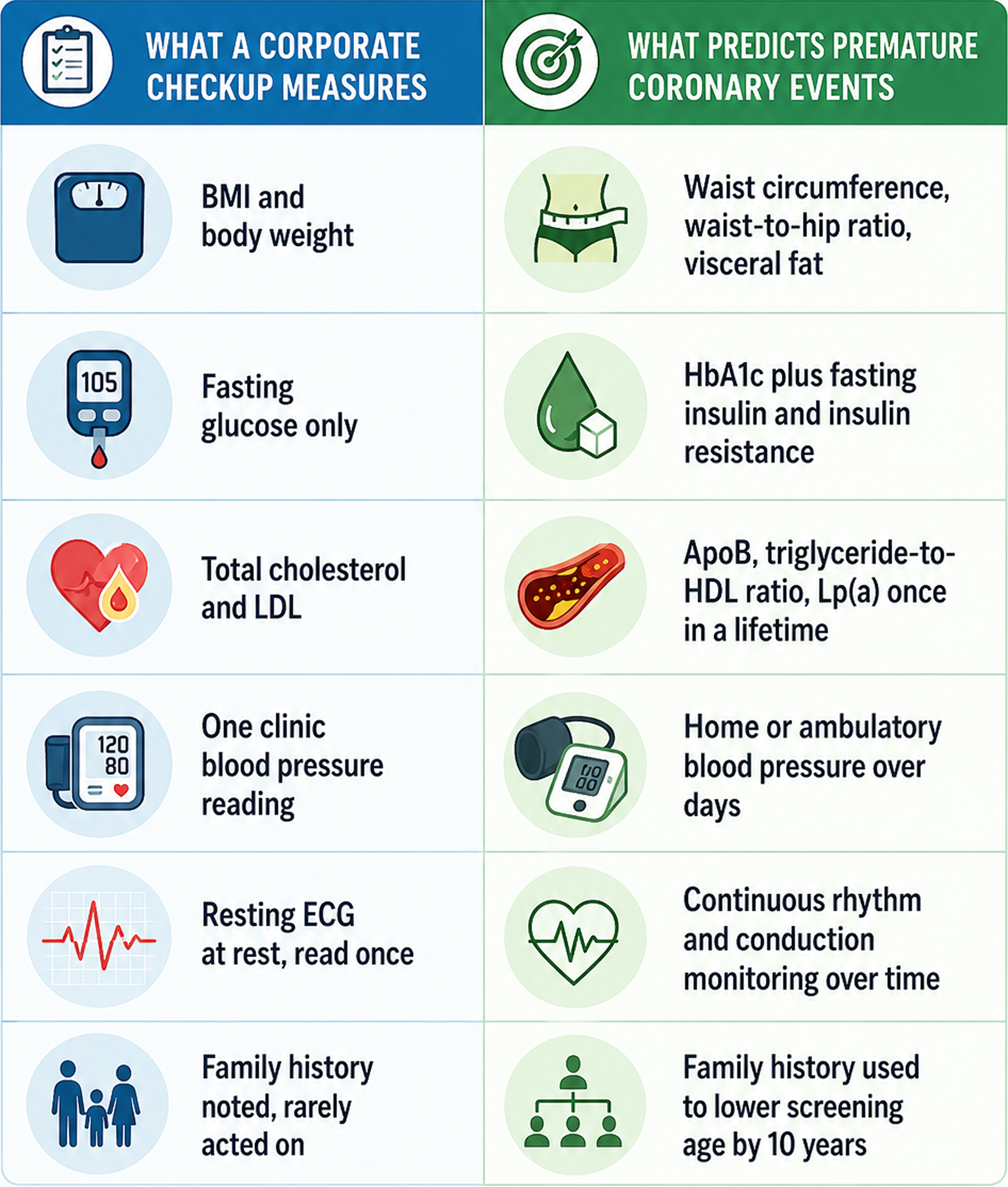
Every one of those years was detectable. The gap is not medical capability. It is what a standard checkup chooses to look at.
A single resting ECG captures about 10 seconds of your heart's life.
See how Super ECG extends that window and picks up 55+ patterns at once!
What To Do In Your 30s, Specifically
- Get a baseline before 30, not after 40. If a parent or sibling had early heart disease, start ten years earlier than they presented.
- Measure your waist, not just your weight.
- Test Lp(a) once. It does not change, so once is enough.
- Treat blood pressure and prediabetes as urgent, not as "borderline, review next year."
- Take atypical symptoms seriously. Young patients often present with breathlessness, unusual fatigue, or palpitations rather than classic chest pain.
- Repeat testing on a rhythm, not a whim. Annual is a habit. Once every five years is a coincidence.
Summary
The rise in heart attacks among young Indians is real, and it is not mysterious. It is a slow, measurable, largely modifiable process that we happen to be measuring with the wrong tools at the wrong age.
You cannot change the age at which your genes start acting. You can absolutely change the age at which you start looking.






India’s first AI-powered NCD diagnostics network.
Follow Us


Helius Wellness 2026. All Rights Reserved
September 3, 2026
Why Heart Attacks Are Rising Among Young Indians in Their 30s and 40s
Heart attacks in young Indians are rising. Here's the 15-year silent build-up behind them and what to test in your 30s.
Author:
Kavya Dave
Key Takeaways
- Indians have a heart attack roughly 10 years earlier than Western populations, and rates in young Indians are several times higher.
- The cause is rarely one bad habit. It is a 15-year build-up of insulin resistance, hidden belly fat, untreated blood pressure, and inherited lipid risk.
- BMI and a basic annual health check miss most of it.
- A heart attack at 38 is not a 38-year-old event. It is the visible end of a process that quietly began around 25.
Every few weeks, another headline: a 34-year-old fit and active professional, a gym session, a sudden cardiac arrest. The coverage always focuses on the final four minutes. The medical evidence points somewhere else.
Research on young Indian heart attack patients shows that Indians develop acute myocardial infarction about 10 years earlier, with rates three to five times higher in young Indians than in other populations.
The INTERHEART study found that the mean age of heart attack in South Asians was 52 years, compared with 60 to 65 years in European and North American groups.
This is not new. What is new is the sheer number of young Indians now entering that pipeline. Below is what actually happens across the two decades nobody watches.
Table of Contents
1. Age 25: The Genetic Starting Line
2. Age 28: Where The Fat Goes
3. Age 31: The Metabolic Tipping Point
4. Age 34: Pressure, Sleep And The Desk Job
5. Age 36: What The Artery Looks Like Now
6. Age 38: Why It Still Looks Sudden
7. Reading The Timeline Backwards
8. What To Do In Your 30s, Specifically
Age 25: The Genetic Starting Line
Some risk is set before any lifestyle choice is made. Lipoprotein(a), or Lp(a), is an inherited particle that is increasingly recognised as the strongest known genetic risk factor for premature coronary artery disease.
It is a problem of population frequency here: roughly 25% of South Asians have levels above 50 mg/dL, higher than Western populations, which may partly explain the earlier onset and more aggressive course of coronary disease in this group.
Lp(a) is stable for life and is rarely tested in a routine Indian health package.
Age 28: Where The Fat Goes
Asian Indians show a "thin-fat" phenotype, with excess fat deposited centrally and viscerally, meaning that at the same BMI they are more insulin resistant and have a higher prevalence of type 2 diabetes and metabolic syndrome.
INTERHEART reached the same practical conclusion, noting that abdominal obesity is a greater risk factor than BMI, and waist-to-hip ratio should replace BMI as the obesity indicator.
Meaning: a 28-year-old with a BMI of 22 and a slightly thickening waist can already be metabolically unwell.
Not sure what your numbers actually mean?
Book a preventive heart health assessment and get a full cardiometabolic picture instead of a single weight reading.
Age 31: The Metabolic Tipping Point
This is where the silent decade turns loud on paper but stays silent in the body. The ICMR-INDIAB national survey found a weighted prevalence of 11.4% for diabetes, 15.3% for prediabetes, 35.5% for hypertension, 39.5% for abdominal obesity, and 81.2% for dyslipidaemia among Indian adults.
Read that last figure again. Four out of five Indian adults surveyed had an abnormal lipid profile. Prediabetes and early hypertension produce no symptoms at all, which is exactly why they are ignored through the thirties.
Age 34: Pressure, Sleep And The Desk Job
Long commutes, night shifts, chronic work stress, poor sleep and near-zero structured movement all land in the same decade as career peak.
INTERHEART established that nine risk factors, including smoking, diabetes, psychosocial factors, sedentary lifestyle, abdominal obesity, hypertension and dyslipidaemia, accounted for about 90% of heart attacks. Almost all of them are modifiable, and almost none of them announce themselves.
Age 36: What The Artery Looks Like Now
By the mid-thirties, the arterial wall in a high-risk young Indian is not a clean pipe with one narrow spot. It carries diffuse, multi-vessel plaque. Studies note that "malignant" coronary artery disease describes a severe, extensive atherosclerotic process across multiple coronary arteries in young people who often carry little or no burden of the established risk factors.
Age 38: Why It Still Looks Sudden
Here is the fact that explains almost every "but he was healthy" headline. Plaque rupture does not require a severe blockage. In the vulnerable plaque literature, approximately 70% of lesions responsible for myocardial infarction have been reported as less than 50% stenotic.
A stress test can look acceptable. An angiogram is not routinely done. And a plaque that occupies a third of a vessel can still rupture on a Tuesday morning.
Reading The Timeline Backwards
Every one of those years was detectable. The gap is not medical capability. It is what a standard checkup chooses to look at.
A single resting ECG captures about 10 seconds of your heart's life.
See how Super ECG extends that window and picks up 55+ patterns at once!
What To Do In Your 30s, Specifically
- Get a baseline before 30, not after 40. If a parent or sibling had early heart disease, start ten years earlier than they presented.
- Measure your waist, not just your weight.
- Test Lp(a) once. It does not change, so once is enough.
- Treat blood pressure and prediabetes as urgent, not as "borderline, review next year."
- Take atypical symptoms seriously. Young patients often present with breathlessness, unusual fatigue, or palpitations rather than classic chest pain.
- Repeat testing on a rhythm, not a whim. Annual is a habit. Once every five years is a coincidence.
Summary
The rise in heart attacks among young Indians is real, and it is not mysterious. It is a slow, measurable, largely modifiable process that we happen to be measuring with the wrong tools at the wrong age.
You cannot change the age at which your genes start acting. You can absolutely change the age at which you start looking.
India’s first AI-powered NCD diagnostics network.
Helius Wellness 2026. All Rights Reserved
Follow Us
September 3, 2026
Why Heart Attacks Are Rising Among Young Indians in Their 30s and 40s
Heart attacks in young Indians are rising. Here's the 15-year silent build-up behind them and what to test in your 30s.
Author:
Kavya Dave
Key Takeaways
- Indians have a heart attack roughly 10 years earlier than Western populations, and rates in young Indians are several times higher.
- The cause is rarely one bad habit. It is a 15-year build-up of insulin resistance, hidden belly fat, untreated blood pressure, and inherited lipid risk.
- BMI and a basic annual health check miss most of it.
- A heart attack at 38 is not a 38-year-old event. It is the visible end of a process that quietly began around 25.
Every few weeks, another headline: a 34-year-old fit and active professional, a gym session, a sudden cardiac arrest. The coverage always focuses on the final four minutes. The medical evidence points somewhere else.
Research on young Indian heart attack patients shows that Indians develop acute myocardial infarction about 10 years earlier, with rates three to five times higher in young Indians than in other populations.
The INTERHEART study found that the mean age of heart attack in South Asians was 52 years, compared with 60 to 65 years in European and North American groups.
This is not new. What is new is the sheer number of young Indians now entering that pipeline. Below is what actually happens across the two decades nobody watches.
Table of Contents
1. Age 25: The Genetic Starting Line
2. Age 28: Where The Fat Goes
3. Age 31: The Metabolic Tipping Point
4. Age 34: Pressure, Sleep And The Desk Job
5. Age 36: What The Artery Looks Like Now
6. Age 38: Why It Still Looks Sudden
7. Reading The Timeline Backwards
8. What To Do In Your 30s, Specifically
Age 25: The Genetic Starting Line
Some risk is set before any lifestyle choice is made. Lipoprotein(a), or Lp(a), is an inherited particle that is increasingly recognised as the strongest known genetic risk factor for premature coronary artery disease.
It is a problem of population frequency here: roughly 25% of South Asians have levels above 50 mg/dL, higher than Western populations, which may partly explain the earlier onset and more aggressive course of coronary disease in this group.
Lp(a) is stable for life and is rarely tested in a routine Indian health package.
Age 28: Where The Fat Goes
Asian Indians show a "thin-fat" phenotype, with excess fat deposited centrally and viscerally, meaning that at the same BMI they are more insulin resistant and have a higher prevalence of type 2 diabetes and metabolic syndrome.
INTERHEART reached the same practical conclusion, noting that abdominal obesity is a greater risk factor than BMI, and waist-to-hip ratio should replace BMI as the obesity indicator.
Meaning: a 28-year-old with a BMI of 22 and a slightly thickening waist can already be metabolically unwell.
Not sure what your numbers actually mean?
Book a preventive heart health assessment and get a full cardiometabolic picture instead of a single weight reading.
Age 31: The Metabolic Tipping Point
This is where the silent decade turns loud on paper but stays silent in the body. The ICMR-INDIAB national survey found a weighted prevalence of 11.4% for diabetes, 15.3% for prediabetes, 35.5% for hypertension, 39.5% for abdominal obesity, and 81.2% for dyslipidaemia among Indian adults.
Read that last figure again. Four out of five Indian adults surveyed had an abnormal lipid profile. Prediabetes and early hypertension produce no symptoms at all, which is exactly why they are ignored through the thirties.
Age 34: Pressure, Sleep And The Desk Job
Long commutes, night shifts, chronic work stress, poor sleep and near-zero structured movement all land in the same decade as career peak.
INTERHEART established that nine risk factors, including smoking, diabetes, psychosocial factors, sedentary lifestyle, abdominal obesity, hypertension and dyslipidaemia, accounted for about 90% of heart attacks. Almost all of them are modifiable, and almost none of them announce themselves.
Age 36: What The Artery Looks Like Now
By the mid-thirties, the arterial wall in a high-risk young Indian is not a clean pipe with one narrow spot. It carries diffuse, multi-vessel plaque. Studies note that "malignant" coronary artery disease describes a severe, extensive atherosclerotic process across multiple coronary arteries in young people who often carry little or no burden of the established risk factors.
Age 38: Why It Still Looks Sudden
Here is the fact that explains almost every "but he was healthy" headline. Plaque rupture does not require a severe blockage. In the vulnerable plaque literature, approximately 70% of lesions responsible for myocardial infarction have been reported as less than 50% stenotic.
A stress test can look acceptable. An angiogram is not routinely done. And a plaque that occupies a third of a vessel can still rupture on a Tuesday morning.
Reading The Timeline Backwards
Every one of those years was detectable. The gap is not medical capability. It is what a standard checkup chooses to look at.
A single resting ECG captures about 10 seconds of your heart's life.
See how Super ECG extends that window and picks up 55+ patterns at once!
What To Do In Your 30s, Specifically
- Get a baseline before 30, not after 40. If a parent or sibling had early heart disease, start ten years earlier than they presented.
- Measure your waist, not just your weight.
- Test Lp(a) once. It does not change, so once is enough.
- Treat blood pressure and prediabetes as urgent, not as "borderline, review next year."
- Take atypical symptoms seriously. Young patients often present with breathlessness, unusual fatigue, or palpitations rather than classic chest pain.
- Repeat testing on a rhythm, not a whim. Annual is a habit. Once every five years is a coincidence.
Summary
The rise in heart attacks among young Indians is real, and it is not mysterious. It is a slow, measurable, largely modifiable process that we happen to be measuring with the wrong tools at the wrong age.
You cannot change the age at which your genes start acting. You can absolutely change the age at which you start looking.


India’s first AI-powered NCD diagnostics network.
Helius Wellness 2026. All Rights Reserved
Follow Us